


In geometry, finding the exact space between two specific locations on a coordinate plane is a fundamental skill. Whether you are calculating the length of a line segment in a math problem or determining the shortest path between two GPS coordinates, the underlying principle remains the same. This article explores the Distance Formula, how it is derived from the Pythagorean Theorem, and how to apply it using specific coordinate points.
The Foundation: Coordinates and Points
Before we can calculate distance, we must first understand how to locate points in a two-dimensional space. We use a coordinate system, which consists of a horizontal axis (the x-axis) and a vertical axis (the y-axis).
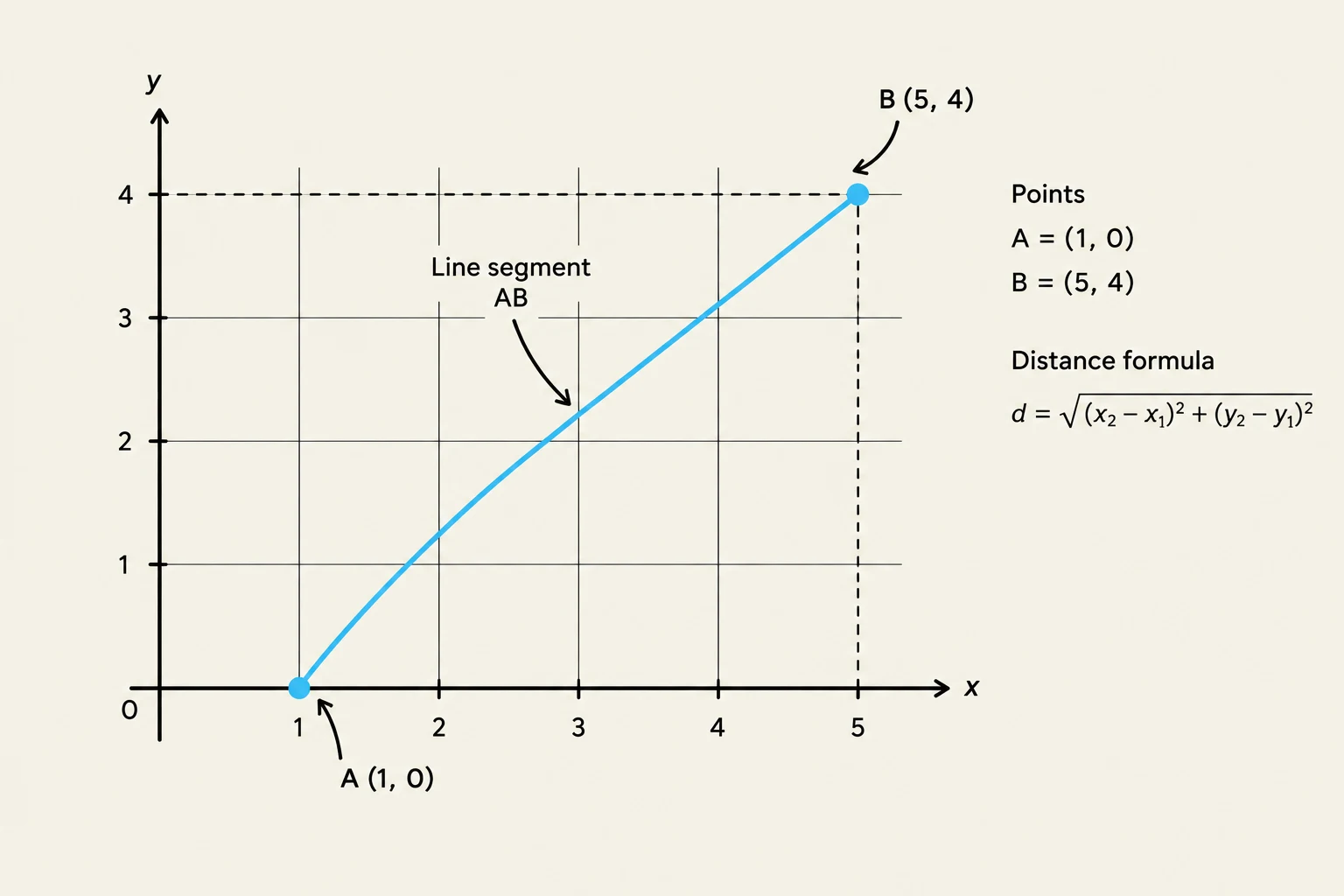
Every location on this plane is represented by an ordered pair known as a coordinate. When we want to find the distance between two specific locations, we label them as Point A and Point B. To keep our calculations organized, we assign specific variables to their positions:
- Point A is represented by the coordinates .
- Point B is represented by the coordinates .
In these pairs, the first number tells you how far to move left or right, and the second number tells you how far to move up or down.
Keep reading for free.
Create an account to finish this reading and make it part of your study routine.
Continue reading freeAlready have an account? Log in
Updated