An overview of the Canadian judicial system, detailing the structure and functions of Provincial and Territorial Courts, Superior Trial Courts, Courts of Appeal, Federal Courts, and the Supreme Court of Canada.
For anyone studying Canadian law or civics, understanding the judicial system can feel like navigating a complex web. At its core, the Canadian court system is organized into a hierarchy. This structure is not just a list of different buildings; it is a functional system of "levels" that determines which court has the authority to hear a specific case and which court has the power to review the decisions of another. This hierarchy ensures consistency in the law and provides a mechanism for judicial oversight, which is essential for government accountability.
The Foundation: Provincial and Territorial Courts
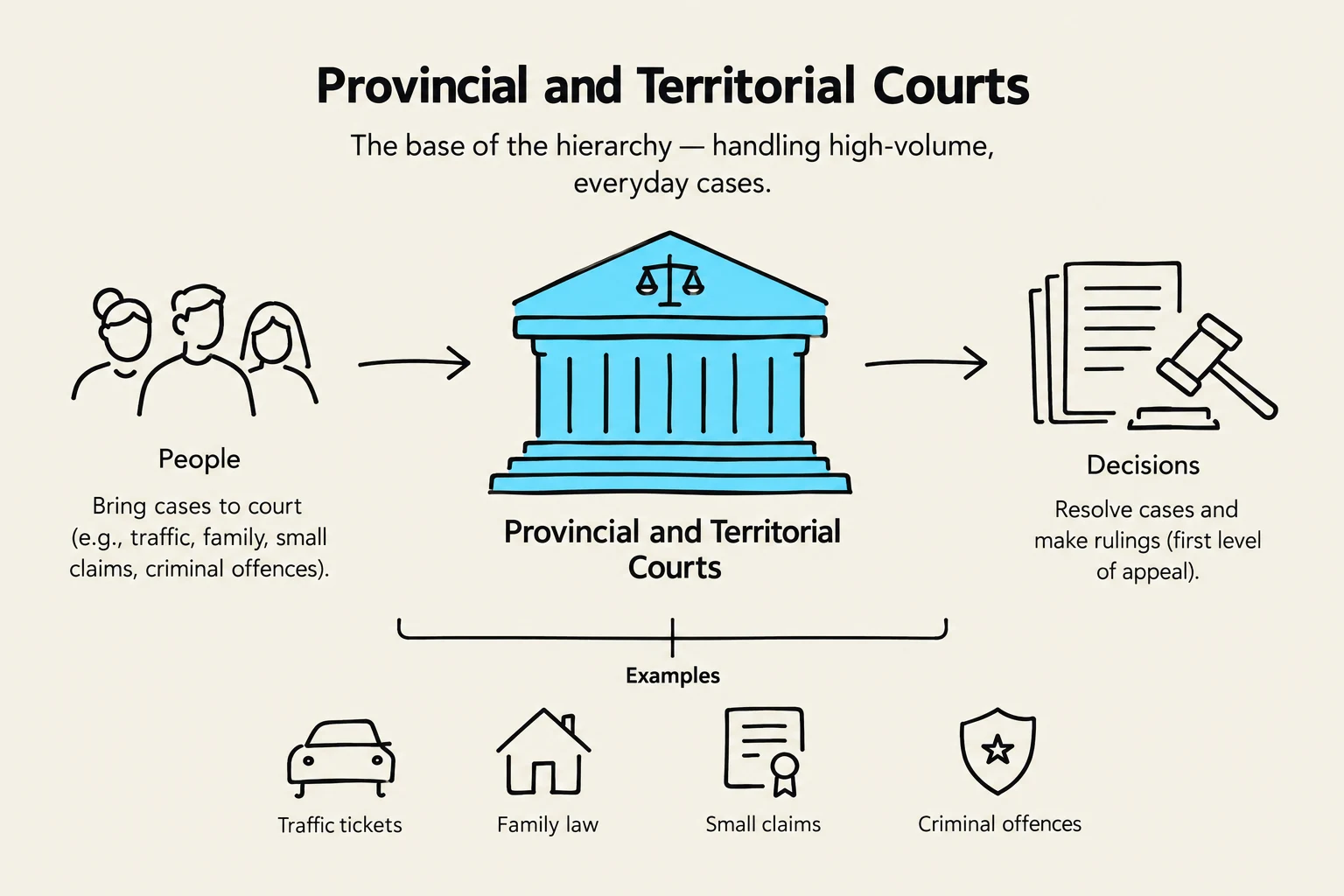
The vast majority of legal interactions in Canada begin at the lowest level of the hierarchy: the Provincial and Territorial Courts. These are "courts of limited jurisdiction," meaning they can only hear specific types of cases as defined by provincial or territorial legislation.
Most everyday legal matters fall into this category. This includes criminal matters (such as driving offenses or minor thefts), family law matters (like child custody), and small claims disputes. Because these courts handle such a high volume of cases, they are often the most accessible point of entry for the public.
Exam Tip: Remember that Provincial Courts are "lower courts." While they handle many serious criminal matters, they do not have the authority to preside over the most severe crimes, such as murder, which must be heard in a Superior Trial Court.
This diagram illustrates the role of Provincial and Territorial Courts in a legal hierarchy, handling common cases and leading to decisions.
The Powerhouse: Superior Trial Courts
Moving up the hierarchy, we encounter the Superior Trial Courts (often called the Supreme Court of a province, though this name can be confusing as it is distinct from the national Supreme Court of Canada). These courts possess "inherent jurisdiction," which is a powerful legal concept. It means they have the authority to hear any matter unless a statute specifically says otherwise.
Superior Trial Courts are where the most serious legal battles take place. In the criminal justice system, they handle the most grave offenses. In civil law, they handle high-value lawsuits that exceed the limits of small claims courts. Because these courts act as the primary "finders of fact"—where witnesses testify and evidence is first presented—their decisions form the bedrock of the legal process.
The Reviewers: Courts of Appeal
When a party believes that a legal error was made during a trial in a Provincial or Superior court, they do not simply "redo" the trial. Instead, they seek a review from a Court of Appeal.
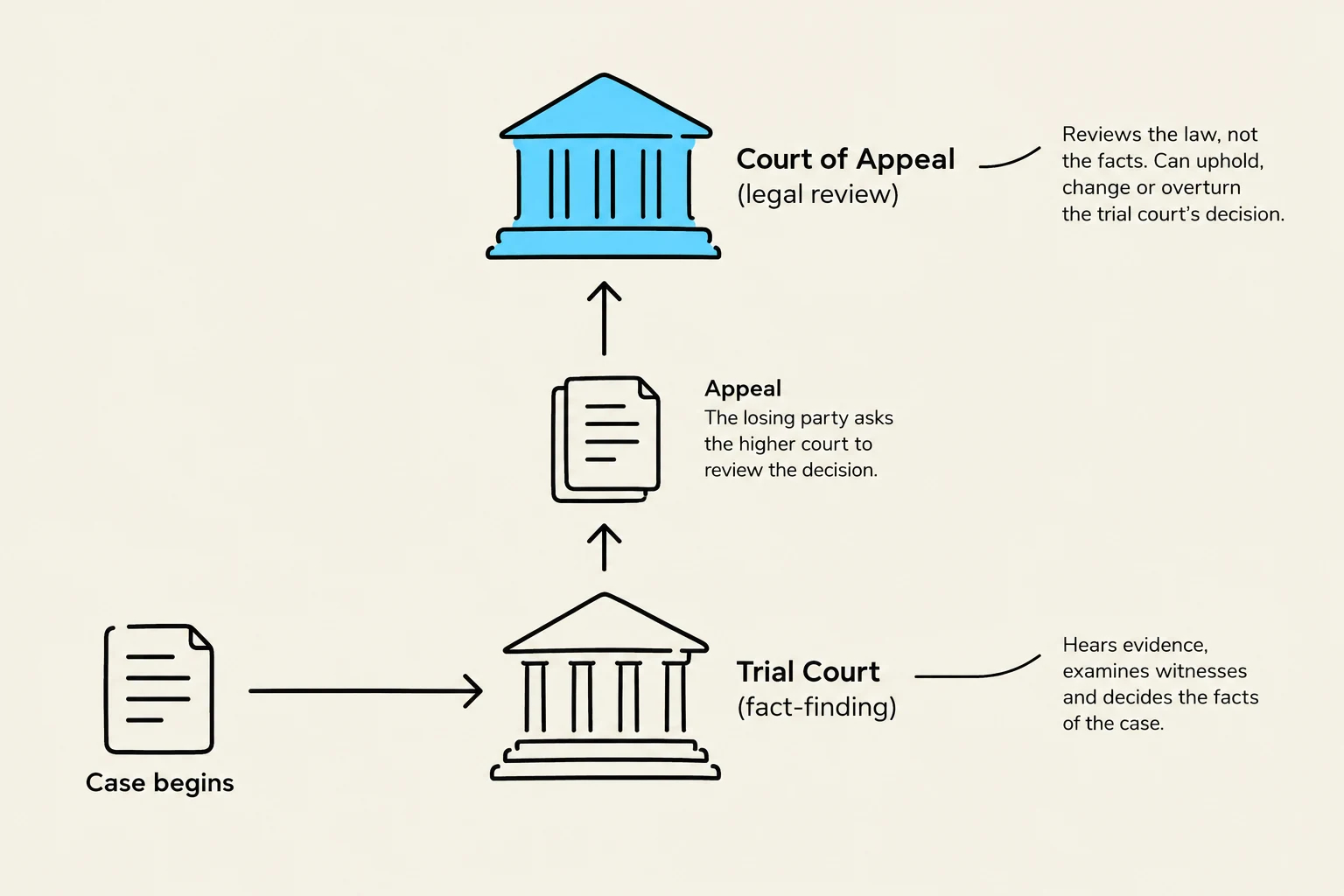
Courts of Appeal are higher-level courts that do not typically hear new evidence or witness testimony. Instead, their role is to review the "record" of the lower court to ensure the law was applied correctly. They focus on legal questions rather than factual disputes. For example, if a judge incorrectly interpreted a specific section of the Criminal Code, the Court of Appeal has the power to correct that interpretation.
This diagram illustrates the basic process of the court system, starting with a case beginning, proceeding to a trial court for fact-finding, and then potentially to a court of appeal for legal review.
The Specialized Path: Federal Courts
While the provincial hierarchy handles most matters, Canada also maintains a separate branch of the judiciary known as the Federal Courts. This system exists because certain legal matters fall under the exclusive jurisdiction of the federal government rather than the provinces.
The Federal Court system includes:
The Federal Court: Handles matters involving federal agencies, immigration, refugee law, and intellectual property.
The Tax Court of Canada: A specialized court that deals specifically with disputes regarding federal taxes.
This parallel system ensures that specialized federal laws are interpreted by judges with specific expertise in those areas, preventing the provincial courts from being overwhelmed by highly technical federal litigation.
The Pinnacle: The Supreme Court of Canada
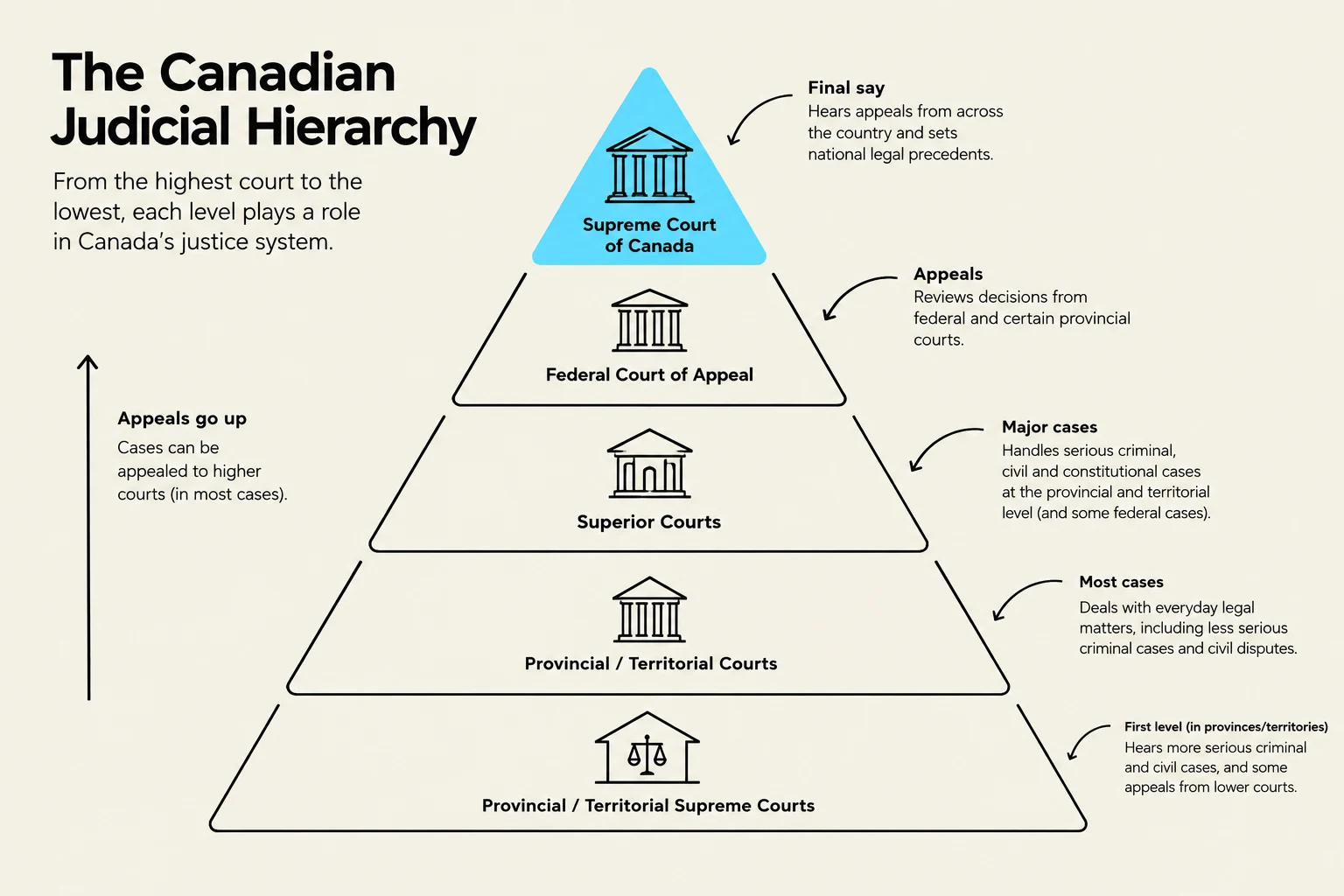
At the very top of the entire Canadian judicial pyramid sits the Supreme Court of Canada (SCC). The SCC is the final court of appeal for the entire country. It is not a court of "first instance" (it doesn't hold trials); rather, it is a court of last resort.
The SCC does not hear every case that is appealed. Instead, it selects cases that are of "public importance"—cases that involve significant legal questions or constitutional issues that affect the nation as a whole. Once the Supreme Court makes a decision, that decision becomes the law of the land, binding all other courts in Canada.
Diagram illustrating the Canadian Judicial Hierarchy, showing the progression from lower courts to the Supreme Court of Canada and the types of cases handled at each level.
Summary of the Hierarchy
To visualize how these components interact, consider the following table:
Court Level
Primary Function
Type of Jurisdiction
Supreme Court of Canada
Final arbiter of national legal issues
National / Final Appeal
Courts of Appeal
Reviewing legal errors from lower courts
Appellate
Superior Trial Courts
Serious criminal and high-value civil trials
Inherent
Provincial/Territorial Courts
Everyday criminal and civil matters
Limited
Federal Courts
Federal-specific matters (Immigration, Tax)
Specialized
Through this structured hierarchy, the Canadian legal system maintains a balance between accessibility for the citizen and rigorous oversight for the government, ensuring that the rule of law is upheld at every level.
Keep reading for free.
Create an account to finish this reading and make it part of your study routine.