An explanation of the microenvironment in marketing and strategic management, detailing the key actors close to a company that directly affect its ability to serve customers, including suppliers, intermediaries, competitors, publics, and customers.
In the study of marketing and strategic management, a company does not operate in a vacuum. While the macroenvironment consists of broad, uncontrollable forces like politics or technology, the microenvironment consists of the actors close to the company that directly affect its ability to serve its customers. Understanding these actors is essential because they form the immediate ecosystem in which a business must compete, negotiate, and collaborate to create and deliver value.
The Core Framework of the Microenvironment
The microenvironment is composed of five primary groups of actors: Suppliers, Intermediaries, Competitors, Publics, and Customers. Each of these groups plays a specific role in the value delivery network. When these actors work in harmony with a company, the firm can achieve its objectives efficiently; however, friction within any of these groups can disrupt the entire supply chain and damage brand reputation.
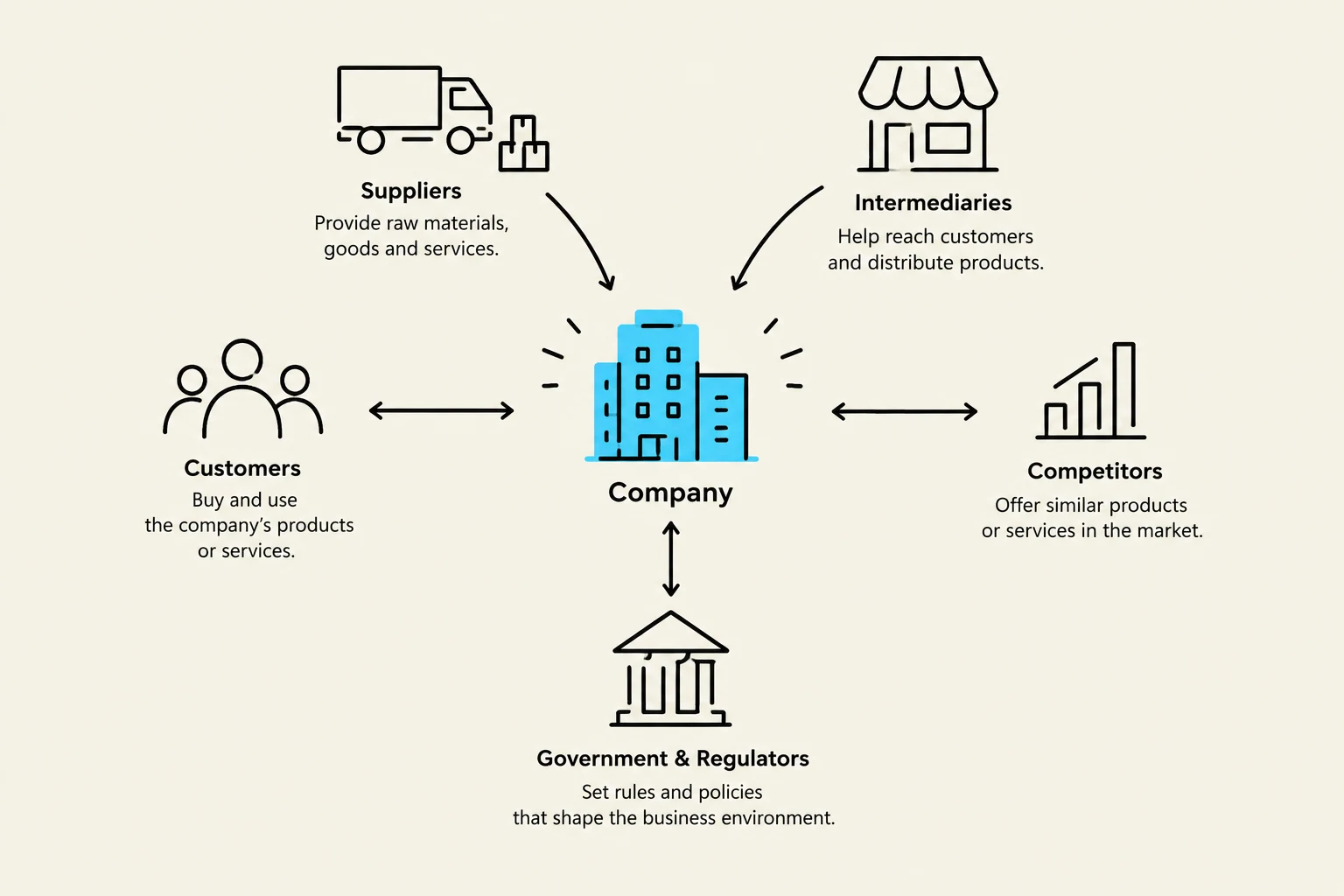
This diagram illustrates the key stakeholders in a business environment: suppliers, intermediaries, customers, competitors, and government/regulators, all interacting with the central company.
Exam Tip: When analyzing a case study, always distinguish between the microenvironment and the macroenvironment. If the factor is something the company can influence through direct relationship management (like a supplier contract), it is microenvironmental. If it is a massive societal shift (like inflation), it is macroenvironmental.
1. Suppliers: The Foundation of the Value Chain
Suppliers are the providers of the resources needed by the company to produce its goods and services. They are the first link in the value delivery network. Because a company's ability to provide value to its customers depends on the availability and quality of its inputs, suppliers are critical strategic partners.
Supply chain disruptions—whether caused by labor strikes, natural disasters, or shortages of raw materials—can lead to production delays and increased costs. A company must manage these relationships carefully to ensure a steady flow of high-quality inputs at competitive prices.
2. Marketing Intermediaries: The Bridge to the Market
Once a product is created, it rarely moves directly from the factory to the end consumer. Marketing intermediaries are the firms that help the company promote, sell, and distribute its goods to final buyers. These include:
Resellers: Wholesalers and retailers that buy goods to sell them at a profit.
Physical Distribution Firms: Companies that aid in the storage and movement of goods.
Marketing Services Agencies: Research firms, advertising agencies, and media outlets that help target and promote products.
Financial Intermediaries: Banks and insurance companies that facilitate transactions and manage risk.
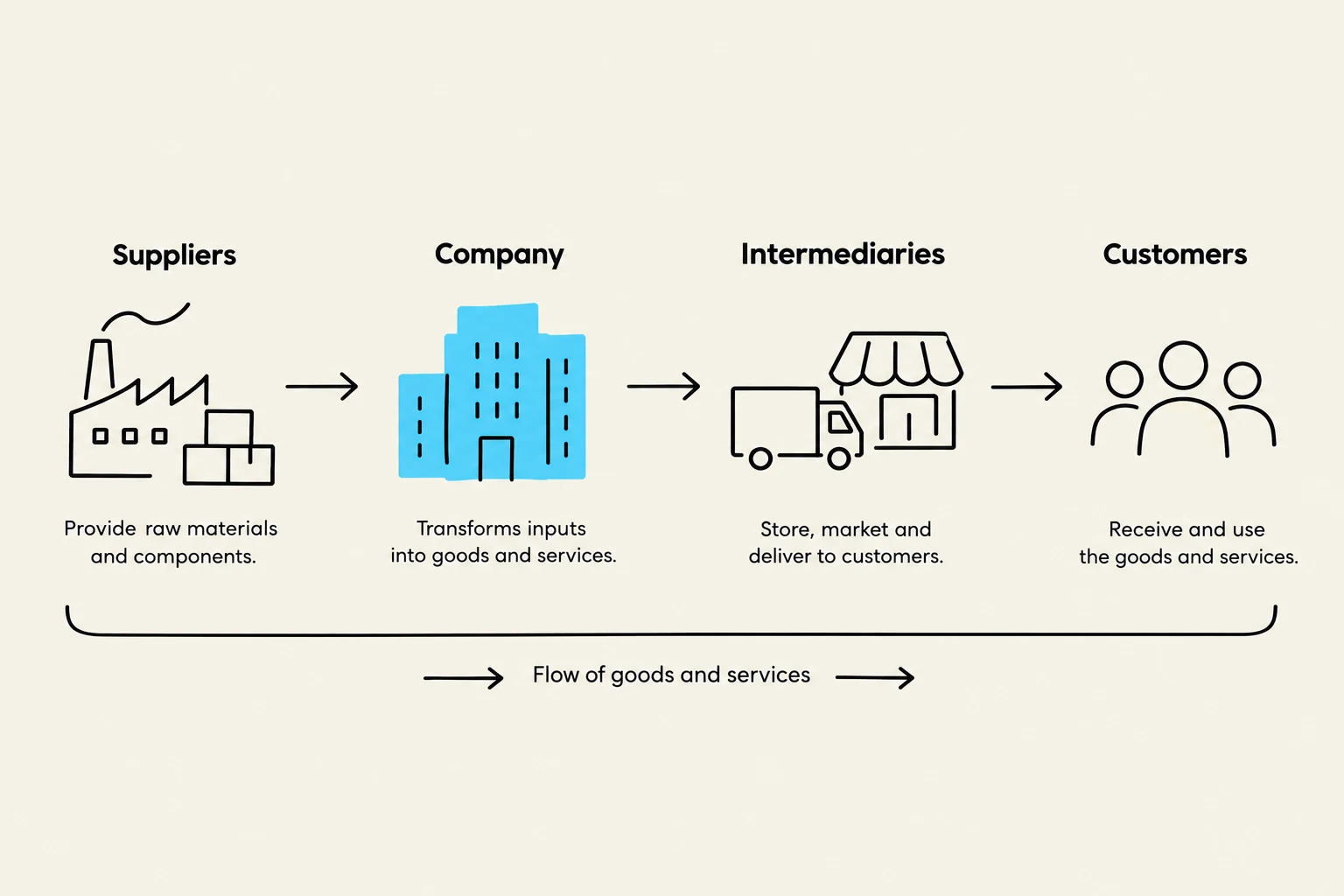
This diagram illustrates a basic supply chain, showing the flow of goods and services from suppliers through intermediaries to customers.
3. Competitors: The Battle for Mindshare
To be successful, a company must provide greater customer value and satisfaction than its competitors do. In the microenvironment, competitors are not just companies selling the exact same product; they are any entity vying for the same customer dollar or "share of wallet."
Strategic positioning requires a company to monitor competitor pricing, product features, and marketing tactics constantly. A company must find a way to differentiate itself—whether through cost leadership, unique features, or superior service—to win in this competitive landscape.
4. Publics: The Influence of External Perception
A "public" is any group that has an actual or potential interest in, or impact on, an organization's ability to achieve its objectives. Unlike customers, publics do not necessarily buy the product, but they can influence how the company is perceived and how it is allowed to operate.
Common types of publics include:
Financial Publics: Groups such as banks, investment analysts, and stockholders who influence the firm's ability to obtain funds.
Media Publics: News media, blogs, and social media influencers who carry messages to the public.
Government Publics: Regulatory bodies that ensure legal compliance.
Local Publics: Neighborhood residents and community organizations.
General Public: The broader societal view of the brand's reputation.
5. Customers: The Ultimate Objective
The most important actor in the microenvironment is the customer. All other actors—suppliers, intermediaries, competitors, and publics—are ultimately oriented toward serving the customer. A company can have the best suppliers and the most efficient intermediaries, but if it fails to meet the needs and wants of its target market, it will not survive.
There are several types of customer markets that a company might serve:
Consumer Markets: Individuals and households buying for personal consumption.
Business Markets: Organizations buying goods for use in their own production processes.
Reseller Markets: Companies buying goods to sell them at a profit.
Government Markets: Agencies buying goods to produce public services.
International Markets: Buyers located in other countries.
Worked Example: The Smartphone Industry
Imagine a smartphone manufacturer.
Suppliers provide the microchips and glass screens.
Intermediaries include mobile carriers (like Verizon or Vodafone) and retail stores (like Best Buy).
Competitors are other smartphone brands offering similar features.
Publics include tech bloggers (media) and environmental groups (general public) concerned about e-waste.
Customers are the millions of individuals who purchase the device for daily use.
By analyzing these five actors, a company can build a robust strategy that anticipates disruptions and leverages relationships to create a sustainable competitive advantage.
Keep reading for free.
Create an account to finish this reading and make it part of your study routine.