Understanding the Attention Economy for Digital Media Professionals
This guide explains the concept of the Attention Economy, where human attention is treated as a scarce commodity. It details how digital media platforms compete for this attention and provides strategies for writers and editors to create engaging, scannable, and comprehensible content for the digital age, addressing ps
In the modern era, we are no longer just consumers of information; we are participants in a high-stakes competition for cognitive resources. As our lives become increasingly intertwined with digital interfaces, a new economic reality has emerged: the Attention Economy. This phenomenon treats human attention not merely as a byproduct of media consumption, but as a scarce, valuable, and highly contested commodity.
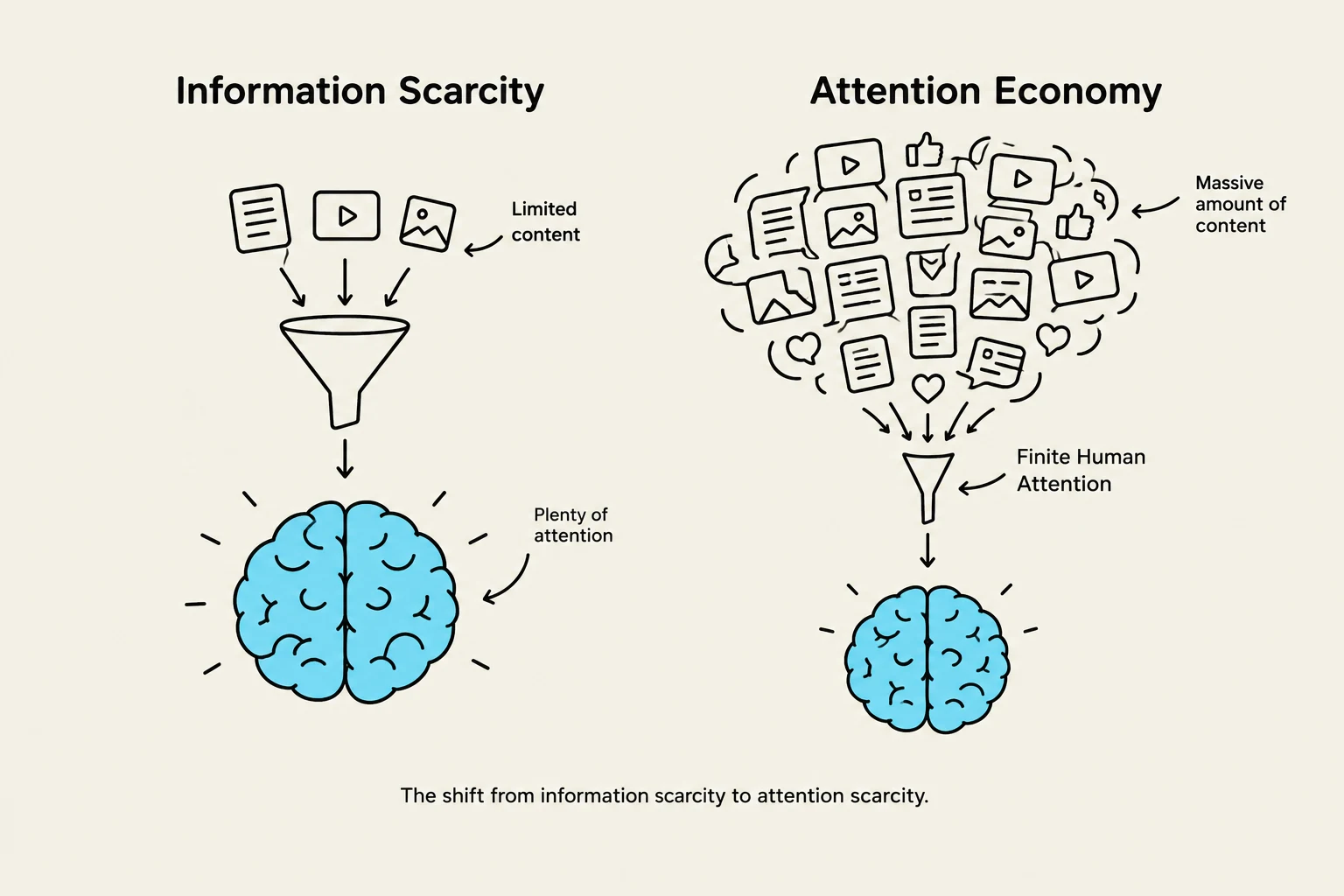
The image illustrates the shift from an information scarcity model, where limited content meets plenty of attention, to an attention economy model, characterized by a massive amount of content competing for finite human attention.
For those entering the fields of journalism, content creation, or digital marketing, understanding this economy is not an elective skill—it is a professional necessity. To write and edit effectively today, one must understand that the battle for a reader's engagement is won or lost in the first few seconds of interaction.
Understanding the Attention Economy
The term "Attention Economy" describes a socio-economic system where the primary limiting factor is not the availability of information, but the capacity of the human mind to process it. In previous decades, information scarcity was the primary challenge. Today, we face information hyper-abundance. Because there is an infinite supply of content but a finite amount of time and mental energy in a human day, attention becomes the "currency" that media companies strive to collect.
As noted by Kane, individuals must constantly divide their limited attention among a vast array of competing media outlets. While the theoretical foundations of this concept were established before the smartphone era, the integration of social media into every facet of daily life has intensified the competition to an unprecedented degree.
The Role of Digital Media and Media Outlets
Digital media platforms—ranging from social networks and news apps to video streaming services—act as the primary arenas for this competition. Unlike traditional print media, where a reader might commit to a long-form article in a controlled environment, digital media outlets are often accessed in "fragmented" states.
Users are frequently switching between tabs, responding to notifications, or scrolling through feeds. This creates a landscape where multiple platforms vie for a single user's cognitive resources simultaneously. For a media outlet to survive, it must not only provide quality content but also design its delivery to survive this constant state of interruption.
Writing and Editing for the Digital Age
This illustration explains how readers scan text, highlighting that big headings, lists, and short paragraphs capture attention, while large blocks of text are often skipped. It visualizes eye movement as jumps between key information points.
For writers and editors, the shift from a "reading economy" to an "attention economy" requires a fundamental change in craft. If you write as if your reader is sitting in a quiet library with no distractions, you will likely fail in a digital environment.
To maintain professional efficacy, creators must master three core strategic pillars:
1. Immediate Capture
In a scrolling environment, the "hook" is everything. Content must be developed to capture attention immediately to prevent users from scrolling past. This involves more than just "clickbait"; it requires crafting headlines, lead sentences, and visual elements that signal relevance and value instantly.
2. Scannable Formatting
Digital readers rarely consume text linearly. Instead, they engage in "scanning"—moving their eyes rapidly down a page to find key information. To accommodate this, editors must:
Use frequent subheadings to break up text.
Utilize bulleted and numbered lists.
Keep paragraphs short and punchy.
Use bold text to highlight essential concepts.
3. Optimized Comprehension
Because users are often distracted by competing stimuli, the core message must be easy to grasp. If a reader has to struggle through dense, academic jargon or overly complex sentence structures, they are likely to abandon the piece in favor of something more easily digestible.
Pro-Tip for Editors: Always perform a "scan test" on your own work. Scroll through your article quickly. If you cannot understand the main argument just by reading the headings and the first sentence of each paragraph, your formatting needs work.
Audience Awareness and Psychological Implications
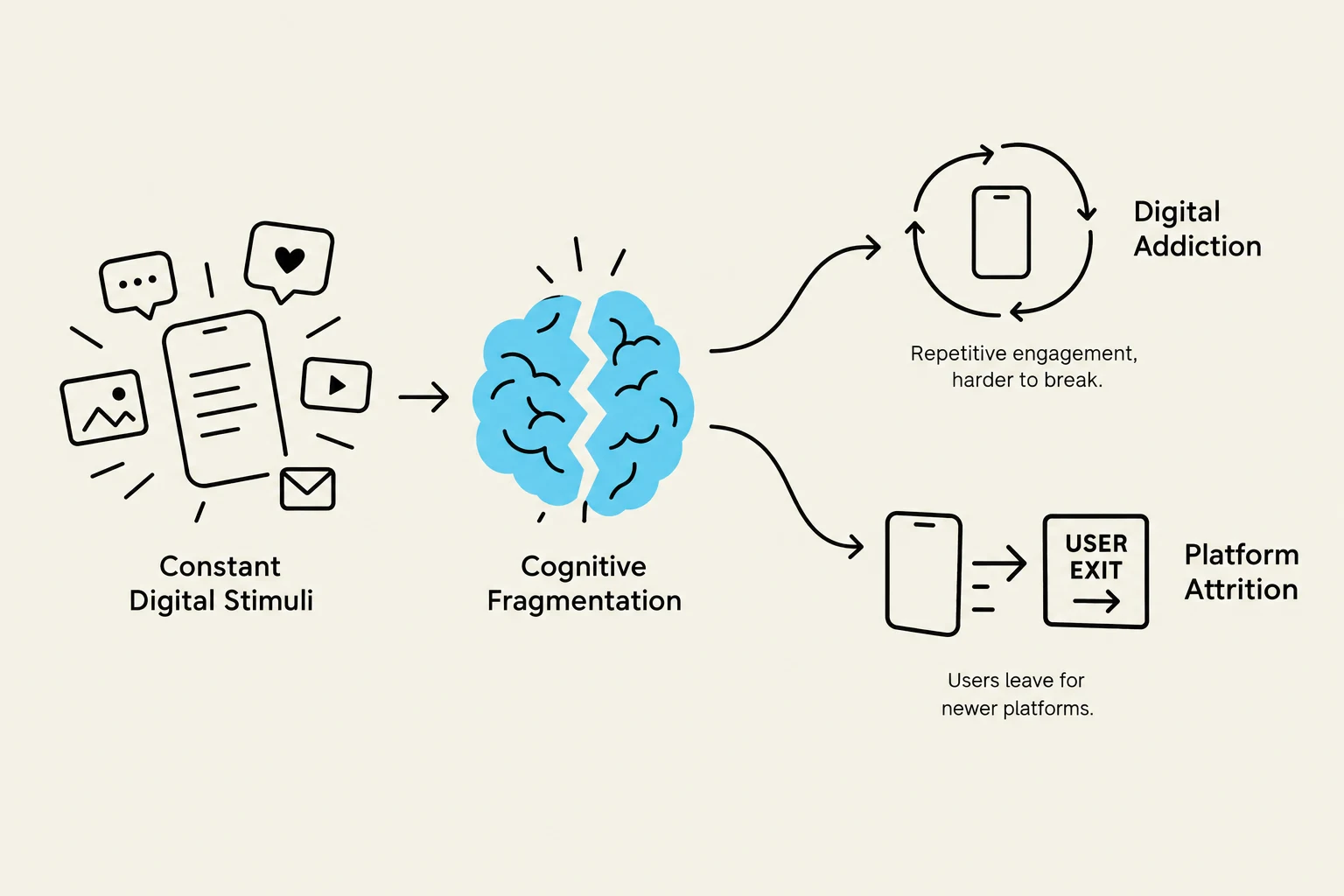
This diagram illustrates the potential negative impacts of constant digital stimuli, leading to cognitive fragmentation, digital addiction, and platform attrition.
A crucial component of professional media production is audience awareness. This goes beyond knowing who your readers are (demographics) and moves into knowing how they behave (psychographics and cognitive habits).
The attention economy does not just affect how content is consumed; it affects the consumers themselves. The constant influx of digital stimuli can lead to several significant psychological and behavioral consequences:
Digital Addiction: The aggressive competition for engagement often utilizes psychological triggers that can lead to excessive time spent on specific platforms.
Cognitive Fragmentation: The constant switching between tasks and platforms can reduce a user's ability to engage in "deep work" or sustained focus.
Platform Attrition: As a reactionary measure to regain control over their time and mental well-being, some users may choose to delete digital media accounts entirely.
Summary for Media Professionals
Mastering the principles of the attention economy allows media professionals to bridge the gap between high-quality information and the fragmented cognitive habits of the modern reader.
By recognizing that attention is a finite resource, you can design content that respects the reader's time while effectively delivering your message. Success in digital media is found at the intersection of meaningful substance and strategic, scannable design.
Self-Reflection Exercise:
To better understand your own position within this economy, consider the following:
Which three types of digital media do you use most frequently?
What is your primary purpose for using them (entertainment, education, connection)?
Have you ever experienced "platform attrition" by deleting an app to regain your focus?
Keep reading for free.
Create an account to finish this reading and make it part of your study routine.