Understanding Tension, Friction, and Drag in Classical Mechanics
This article explains the fundamental physics concepts of tension, friction (static, kinetic, and rolling), and air drag. It details how these forces interact with mass and velocity to influence an object's motion, providing worked examples and summaries for solving related problems.
In the study of classical mechanics, understanding how objects interact through forces is essential for predicting motion. Whether you are analyzing a superhero hanging from a rope, a box sliding across a floor, or a car speeding down a highway, the fundamental principles remain the same: Newton's Laws of Motion. This article explores three critical forces—tension, friction, and drag—and how they interact with mass to produce constant speed or constant acceleration.
Understanding Tension
Tension is a pulling force that exists when two parts of a continuous object, such as a rope, string, or cable, interact. To visualize this, imagine a rope as a series of tiny particles connected by microscopic springs. When you pull one end of the rope, these internal connections stretch and exert a restorative "pulling" force to resist the displacement, transmitting the force through the entire object.
A crucial concept in physics problems is the idealized rope. In many textbook scenarios, we assume the rope is massless and non-stretchable (inextensible). Under these specific conditions, the magnitude of tension is uniform throughout the entire length of the rope (T1=T2=Tn). If the rope is stationary, every segment of it must also be in equilibrium.
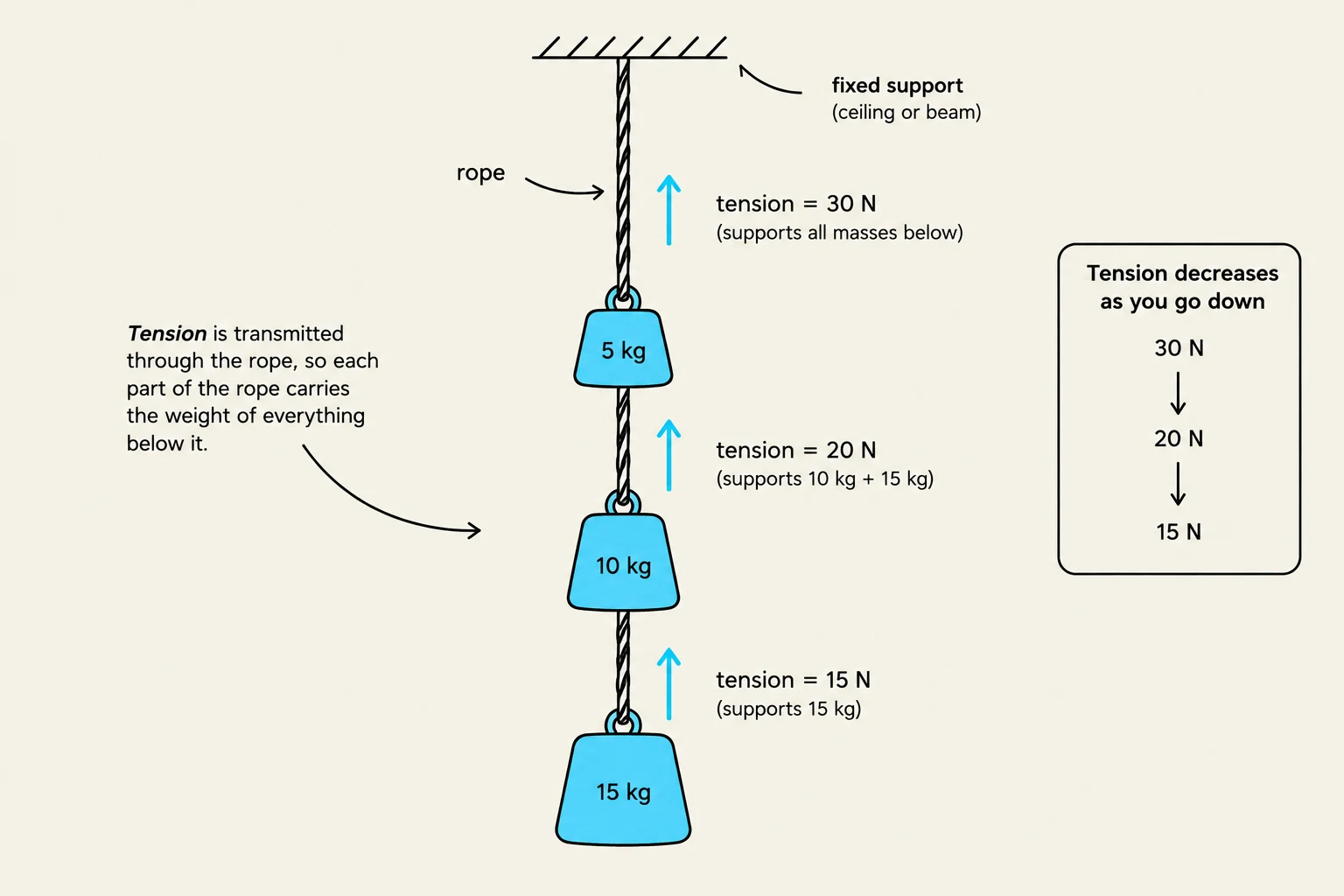
This diagram illustrates the concept of tension in a rope supporting multiple masses. It shows how tension varies along the rope, decreasing as you move down from the fixed support because each section of the rope only supports the weight of the masses below it.
Worked Example: The Hanging Duo
Consider a scenario where a Superhero (87 kg) is hanging above a Trusty Sidekick (55 kg) from a single vertical rope. If the system is motionless, we use the condition of equilibrium where the net force is zero.
Tension between Superhero and Sidekick (Tlower): This part of the rope only supports the Sidekick.
Tlower=msidekick⋅gTlower=55 kg⋅9.8 m/s2=539 N
Tension above the Superhero (Tupper): This part of the rope must support both masses.
Tupper=(msuperhero+msidekick)⋅gTupper=(87+55) kg⋅9.8 m/s2=1392 N
Exam Tip: When an object is accelerating, tension is no longer just equal to the weight. If the system is accelerating upward, the tension must be greater than the weight to provide that upward acceleration ($T - W = ma$).
Friction: Static, Kinetic, and Rolling
Friction is a force that opposes the relative motion (or intended motion) between two surfaces in contact. The type of friction acting on an object depends on whether it is stationary or moving.
Types of Friction
Static Friction (fs): This force acts on objects that are not moving relative to the surface. It prevents motion from starting. For example, if a truck brakes suddenly, a box in the back stays in place because of a static friction force acting in the direction opposite to the truck's deceleration.
Kinetic Friction (fk): Once an object begins to slide, kinetic friction takes over. This force is generally constant regardless of the speed of the sliding object.
Rolling Friction: This occurs when an object, like a wheel or a ball, rolls over a surface.
The Friction Coefficient
The strength of the friction force is determined by the friction coefficient (μ), which is a property of the two materials in contact. The relationship is expressed as:
f=μ⋅FN
where FN is the normal force (the force perpendicular to the surface).
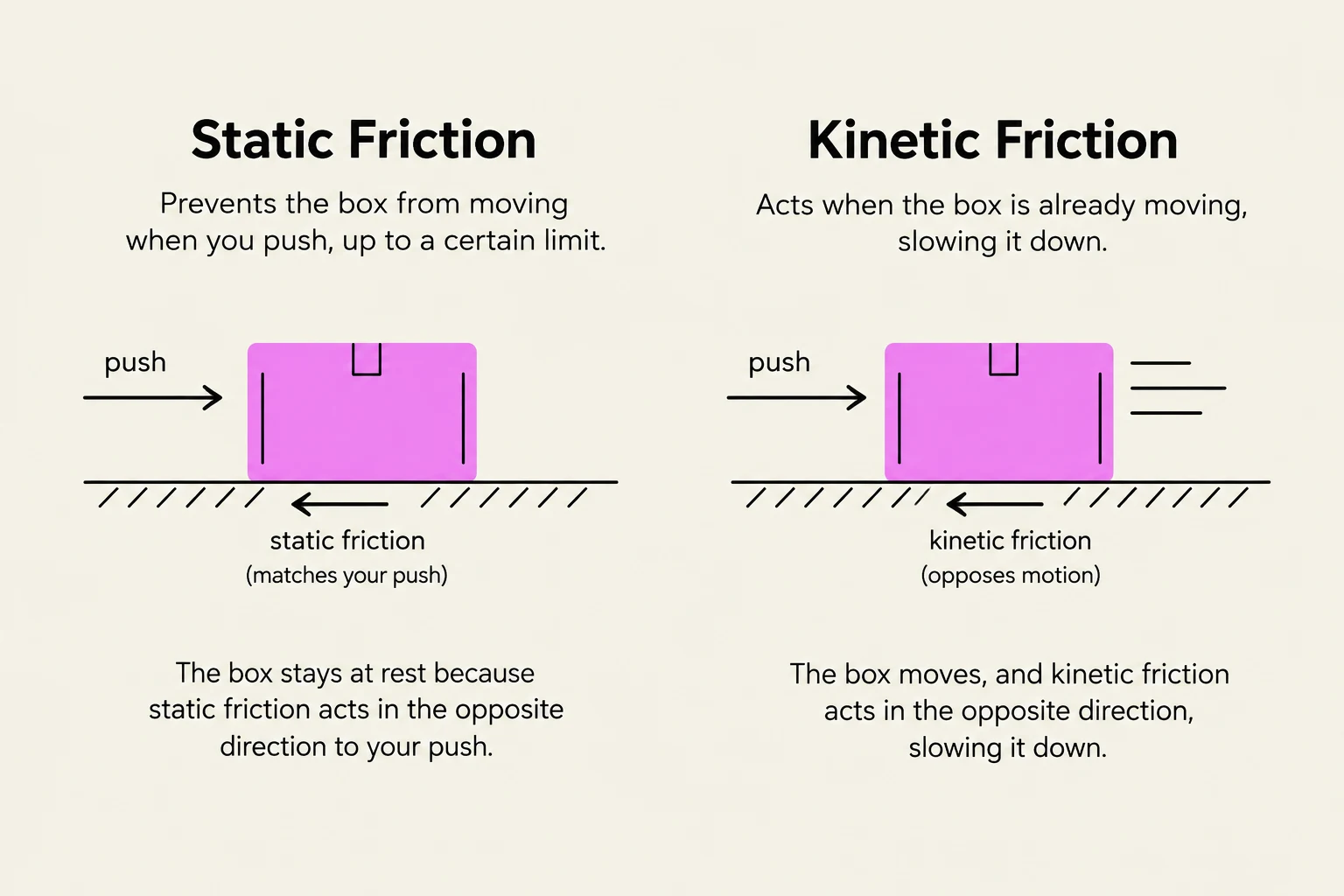
This illustration compares static friction, which prevents an object from moving, and kinetic friction, which slows down a moving object.
Worked Example: The Sliding Box
A 50-kg wooden box rests on the ground. The coefficients are μs=0.4 and μk=0.3.
To find the maximum static friction: fs,max=0.4⋅(50⋅9.8)=196 N.
If a force applied is less than 196 N, the box won't move, and the friction force exactly matches the applied force. If the force exceeds 196 N, the box slides, and we switch to kinetic friction: fk=0.3⋅(50⋅9.8)=147 N.
Air Drag and Speed
While friction occurs at the contact point of surfaces, air drag (or air resistance) is a force that acts on objects moving through a fluid, such as air. Unlike kinetic friction, which is often modeled as constant, air drag is highly dependent on the object's velocity.
As an object's speed increases, the drag force increases significantly. In many models, drag is proportional to the square of the velocity (Fdrag∝v2).
This illustration demonstrates how air drag force increases with the velocity of a car. The graph shows a non-linear relationship, indicating that drag increases faster at higher speeds. The formula F_drag \propto v^2 is also presented, signifying that air drag force is proportional to the square of the velocity.
Calculating the Drag Factor
If a car's speed increases from 69 km/h to 110 km/h, we can find the factor by which the drag force increases by using the ratio of the squares of the speeds:
Factor=(voldvnew)2Factor=(69110)2≈2.54
This means the car experiences more than double the air resistance at the higher speed.
Summary of Motion States
To solve complex problems involving these forces, always identify the state of motion:
Constant Speed (Equilibrium): The net force is zero (∑F=0). Tension equals weight, or drag equals the driving force.
Constant Acceleration: The net force is non-zero (∑F=ma). Tension will be greater than weight if accelerating upward, or friction will be calculated based on the required deceleration.
By breaking forces down into their vector components—projecting tension or friction along the x and y axes—you can systematically solve for any unknown mass or force in a system.
Keep reading for free.
Create an account to finish this reading and make it part of your study routine.