


When a government needs to fund public services—such as infrastructure, education, and national defense—it relies on tax revenue. However, not all taxes are collected in the same way. The "structure" of a tax refers to how the tax rate changes (or stays the same) as an individual's or a corporation's income increases.
Understanding these structures is essential for studying macroeconomics and fiscal policy, as the way a government collects money directly impacts income inequality, consumer spending, and overall economic growth. In this article, we will distinguish between the three primary tax structures: progressive, proportional, and regressive.
The Progressive Tax System
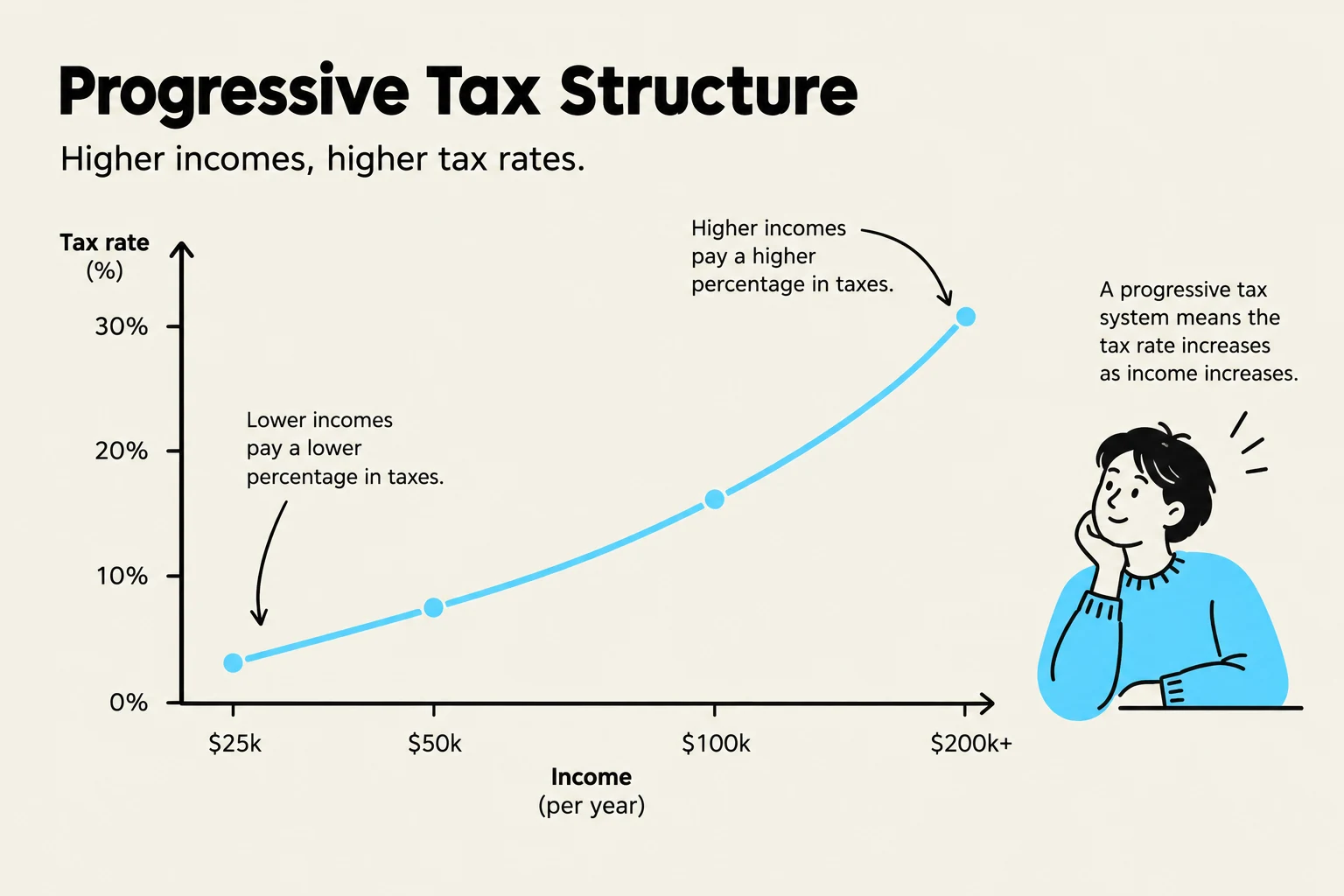
A progressive tax system is designed so that the tax rate increases as the taxable amount increases. In other words, those with higher incomes pay a higher percentage of their income in taxes than those with lower incomes. This is often referred to as "ability-to-pay" taxation.
The logic behind progressive taxation is often rooted in social equity. Proponents argue that a marginal increase in income has a smaller impact on the standard of living for a wealthy individual than it does for a low-income individual. By taxing the wealthy at a higher rate, governments can redistribute wealth and fund social safety nets that support the broader population.
To calculate the tax liability in a progressive system, we often use "tax brackets." Instead of applying one high rate to your entire income, you pay different rates on different portions of your income.
Worked Example: The Bracket Method Imagine a simplified tax system with two brackets:
- 10% on income from $$0$20,000$
- 25% on income above $$20,000$
If Person A earns $$15,000$, they pay:
If Person B earns $$30,000$, they pay:
(\$20,000 \cdot 0.10) + (\$10,000 \cdot 0.25) &= \$2,000 + \$2,500 \\ &= \$4,500 \end{aligned}$$ Notice that Person B's effective tax rate is higher than Person A's. $$$ $$$


Keep reading for free.
Create an account to finish this reading and make it part of your study routine.
Continue reading freeAlready have an account? Log in
Updated