


In the study of economics, understanding how markets function requires looking at two sides of a coin: the buyers and the sellers. While demand represents the behavior of buyers, supply represents the behavior of sellers. It describes how much of a good or service producers are willing and able to bring to the market at various price points.
The Fundamentals of Supply
To understand supply, we must distinguish between the general concept of supply and the specific amount producers want to sell at a specific price.
Quantity Supplied
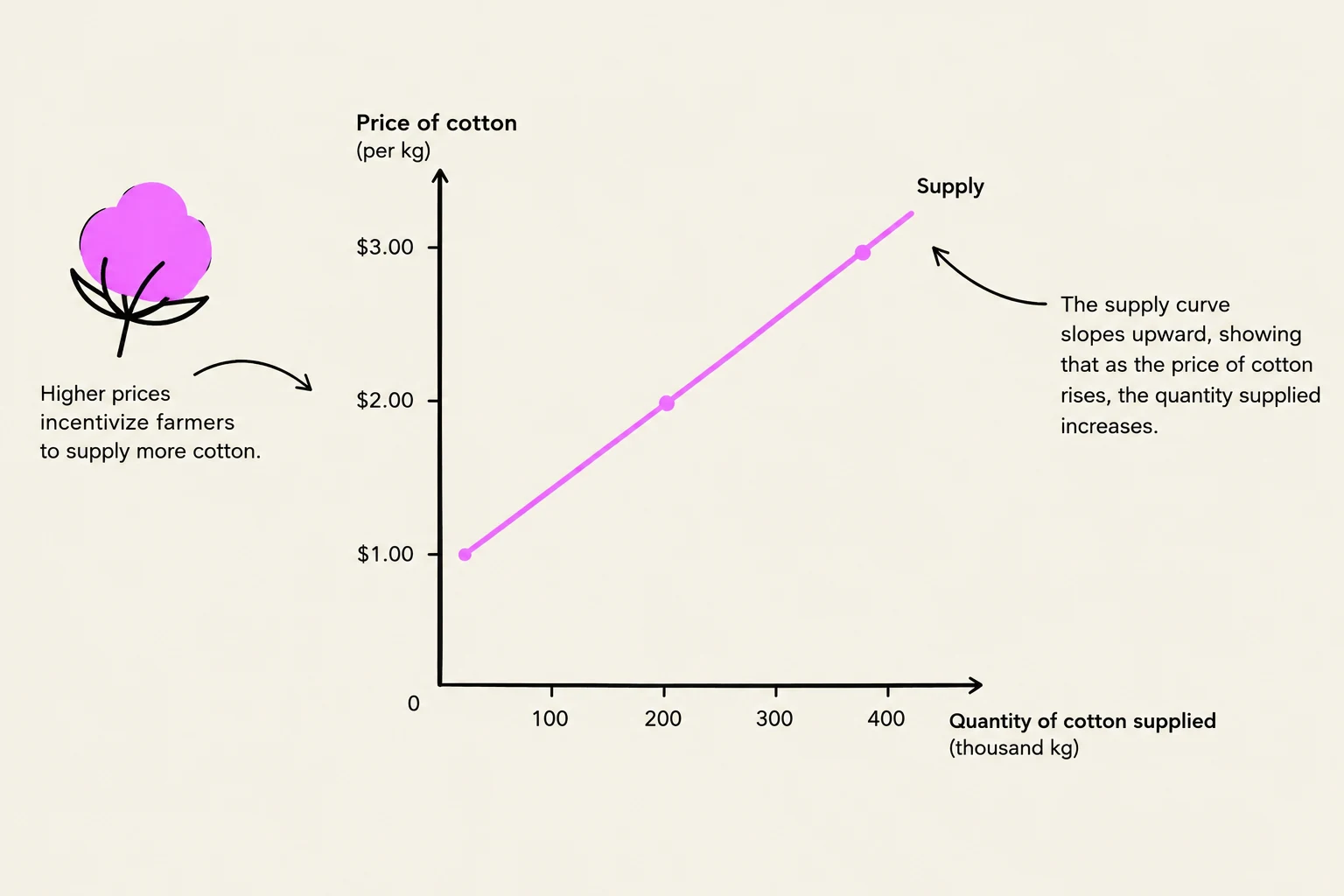
The quantity supplied is the specific amount of a good or service that producers are willing and able to sell at a particular price. It is important to note that as the price of a good rises, the quantity supplied typically rises as well.
The Supply Schedule and the Supply Curve
Economists use two primary tools to visualize this relationship:
- Supply Schedule: A table showing the quantity supplied at various prices.
- Supply Curve: A graphical representation of the supply schedule.
The supply curve typically slopes upward, illustrating that higher prices provide an incentive for producers to supply more of a product.
Individual vs. Market Supply
Supply does not exist in a vacuum; it is composed of many individual actors.
Individual Supply Curve
An individual supply curve represents the behavior of a single producer. For example, a single farmer might have a specific amount of cotton they are willing to sell at $ versus $.

Keep reading for free.
Create an account to finish this reading and make it part of your study routine.
Continue reading freeAlready have an account? Log in
Updated