Understanding Stress, Strain, and Material Properties in Orthotics and Prosthetics
This article explains fundamental concepts of stress, strain, and material strength, detailing different types of applied stress and the stress-strain curve. It also discusses time-dependent material behavior and environmental factors, with clinical applications in prosthetic liners.
In the field of Orthotics and Prosthetics (O&P), the success of a device—whether it is a rigid socket or a soft prosthetic liner—depends heavily on how the material responds to the forces of human movement. A clinician must not only understand the anatomy of the patient but also the physics of the materials used to interface with that anatomy. This article explores the fundamental relationship between applied forces (stress), the resulting deformation (strain), and the inherent properties of the plastics used in clinical practice.
Fundamental Definitions: Stress, Strain, and Strength
To analyze how a material will behave under a load, we must first distinguish between the force applied and the material's reaction to it.
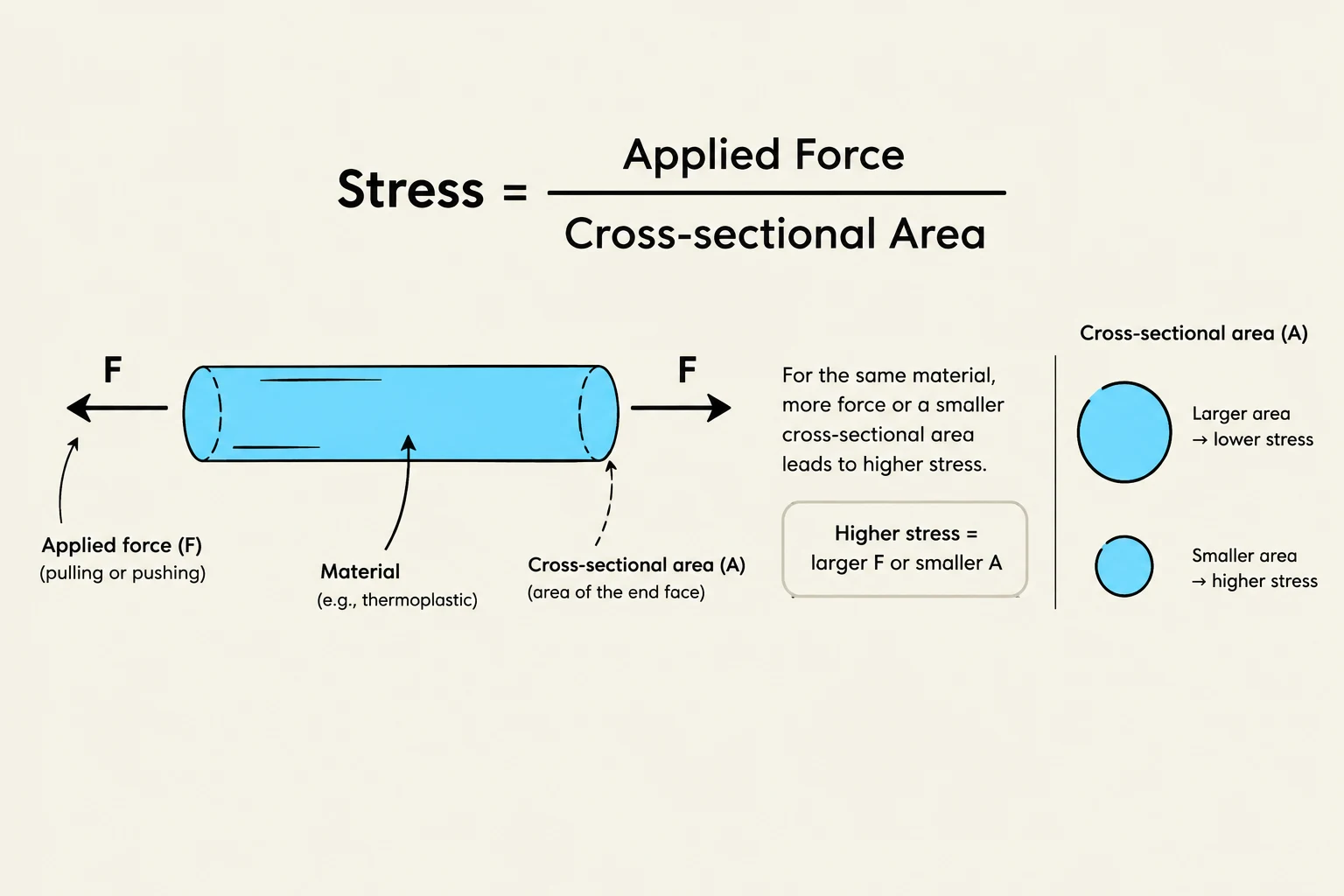
Stress is defined as the force applied per unit of cross-sectional area of a material. It is not just the total weight or force, but how concentrated that force is on the material's surface. Stress is calculated using the following formula:
Stress=Cross-sectional areaForce applied
In imperial units, stress is measured in pounds per square inch (PSI), while in metric units, it is measured in pascals (Pa) or megapascals (MPa).
Strain is the physical result of stress. It refers to the change in length (either lengthening or shortening) in the direction of the load when the material is exposed to stress.
Strength is a material property. While stress describes the magnitude of the load being applied, strength describes the material's inherent ability to resist those forces.
This diagram illustrates the concept of stress in materials, defined as applied force divided by cross-sectional area. It shows that for a given material, higher stress results from a larger applied force or a smaller cross-sectional area.
Directions of Applied Stress
Forces in O&P do not always act in a simple "push" or "pull" direction. Depending on the movement of the patient and the design of the prosthesis, materials may experience several different types of stress:
Tensile Stress: A pulling force that acts to stretch or pull an object apart (tension).
Compressive Stress: A squeezing force that acts to compress or squash an object.
Shear Stress: Forces that act parallel to the cross-sectional area, causing the internal planes of a material to slide past one another.
Flexural Stress: Also known as bending stress, this is a complex combination of both tension and compression occurring simultaneously.
Torsional Stress: A twisting force, also referred to as torque.
The Stress-Strain Curve and Material Deformation
The most critical tool for understanding material behavior is the stress-strain curve. This graph illustrates how a material deforms as load increases. By analyzing this curve, we can identify the specific points where a material changes from being "springy" to being "permanently damaged."
Elastic vs. Plastic Deformation
When a material is loaded within its linear section, it undergoes elastic deformation. In this zone, the change in shape is non-permanent; if the load is removed, the material returns to its original shape.
Once the load exceeds a specific threshold known as the yield stress, the material enters the zone of plastic deformation. At this point, the material undergoes a permanent change in shape.
Stiffness and the Modulus of Elasticity
The slope of the linear section of the stress-strain curve represents the Modulus of Elasticity (also known as Young's Modulus). This value defines the stiffness of a solid material. A steeper modulus indicates a stiffer material that resists deformation more strongly.
This graph illustrates the stress-strain relationship of a material, showing its elastic and plastic deformation regions leading to fracture.
Breaking Points
As the load continues to increase beyond the yield point, the material eventually reaches its ultimate stress. This is the maximum load the material can withstand before it begins to break. Specifically, the ultimate tensile strength refers to the maximum stress a material can endure while under tension before failure.
Exam Tip: Remember the distinction between stress and strength. Stress is the external load applied to the object, whereas strength is an internal property of the material itself.
Time-Dependent Behavior and Environmental Factors
Plastics are unique because their behavior is not static; it changes based on environmental and temporal factors. Material behavior is influenced by:
Time: The duration of the load.
Temperature: Heat can soften plastics.
Impact Loading: Sudden, high-velocity forces.
Strain: The degree of deformation already present.
A significant phenomenon in plastics is creep, also known as cold flow. Because plastics have viscous properties, they may become less stiff over time when subjected to constant stress, essentially "flowing" or deforming slowly under a steady load.
Clinical Application: Prosthetic Liners
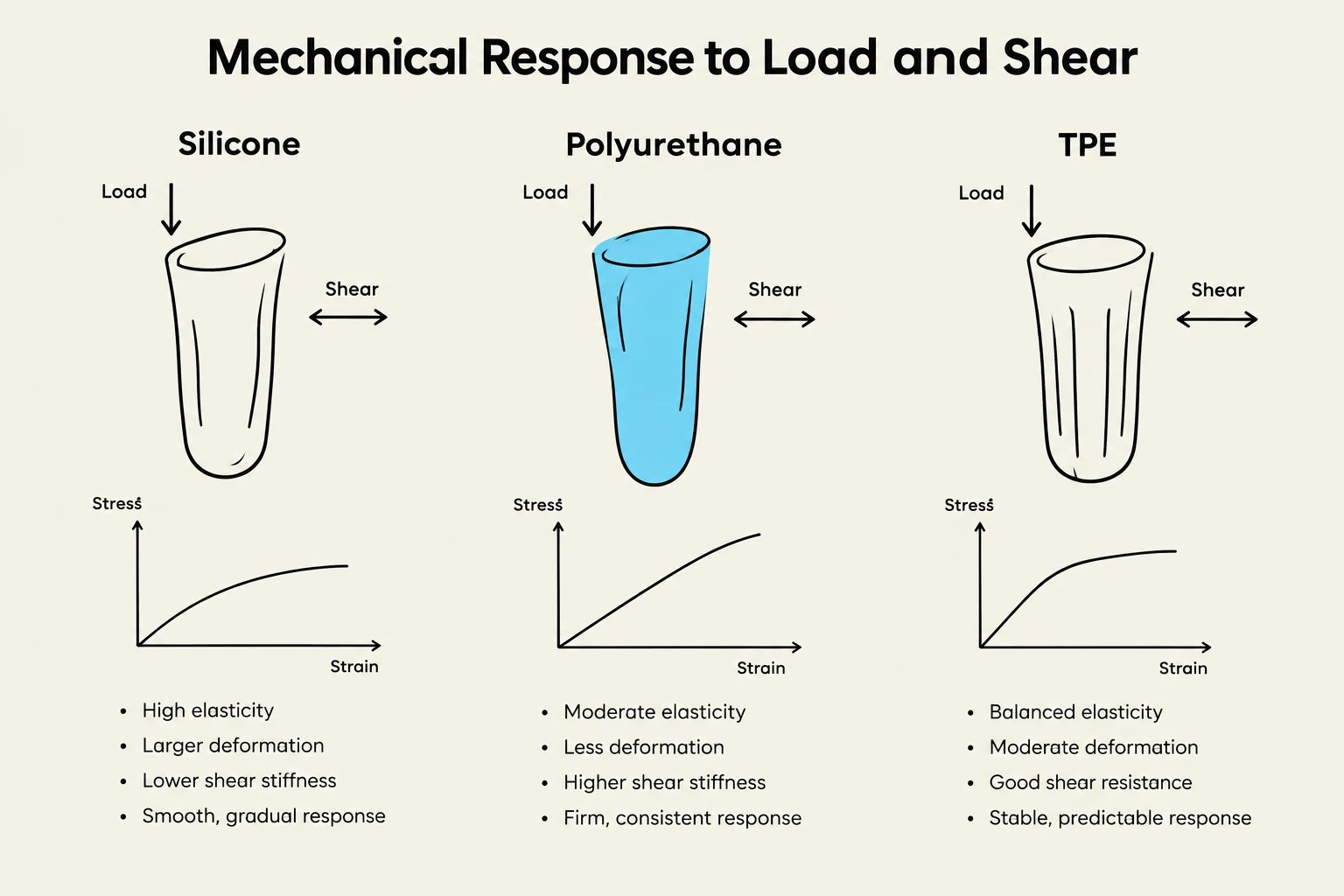
In O&P, these principles are applied directly when selecting prosthetic liners. Liners serve as the interface between the residual limb and the socket, protecting the skin and providing comfort. Different materials react differently to the stress and shear forces encountered during walking.
Material Type
Key Characteristics
Silicone
A thermoset material that is generally stiffer and less affected by temperature changes. It is chemically inert, making it good for sensitive skin.
Polyurethane
Known for its "flow" characteristic. It can distribute pressure more evenly by compressing at high-pressure areas and expanding into low-pressure areas.
TPE (Thermoplastic Elastomer)
A copolymer that combines characteristics of both elastomers and thermoplastics.
This diagram illustrates the mechanical responses of Silicone, Polyurethane, and TPE materials to load and shear forces, comparing their elasticity, deformation, stiffness, and response characteristics.
When choosing a liner, practitioners must balance the patient's need for comfort and ease of use (donning/doffing) with the functional requirements of the prosthesis, such as suspension type and durability.
Keep reading for free.
Create an account to finish this reading and make it part of your study routine.