Understanding Speciation: The Mechanisms of Biological Divergence
This content explains the biological species concept, reproductive isolation mechanisms (prezygotic and postzygotic barriers), and modes of speciation (allopatric and sympatric). It details how populations diverge genetically to form new species.
Evolution is often discussed in terms of how populations change over time, but one of its most profound outcomes is the emergence of entirely new species. This process, known as speciation, is the evolutionary mechanism by which populations evolve to become distinct, separate species. To understand how this happens, we must first define what a "species" actually is and identify the barriers that prevent different groups from mixing their genes.
Defining a Species
In biology, defining a species can be complex, but the most widely accepted framework is the Biological Species Concept. According to this concept, a species is a group of populations whose members have the potential to interbreed in nature and produce viable, fertile offspring.
This definition places a heavy emphasis on gene flow. As long as individuals from two different populations can mate and produce healthy, fertile children, they are considered part of the same species. Speciation occurs when this gene flow is interrupted, allowing the populations to diverge genetically until they can no longer successfully reproduce with one another.
Exam Tip: When applying the Biological Species Concept, remember that "fertility" is key. If two organisms mate and produce a healthy offspring, but that offspring is sterile (like a mule), the parents are still considered different species.
Reproductive Isolation: The Engine of Speciation
The core driver of speciation is reproductive isolation. These are biological barriers that prevent members of two different species from producing viable, fertile offspring. These barriers are categorized into two main stages: those that prevent mating from happening at all (prezygotic) and those that affect the offspring after fertilization has occurred (postzygotic).
Prezygotic Barriers
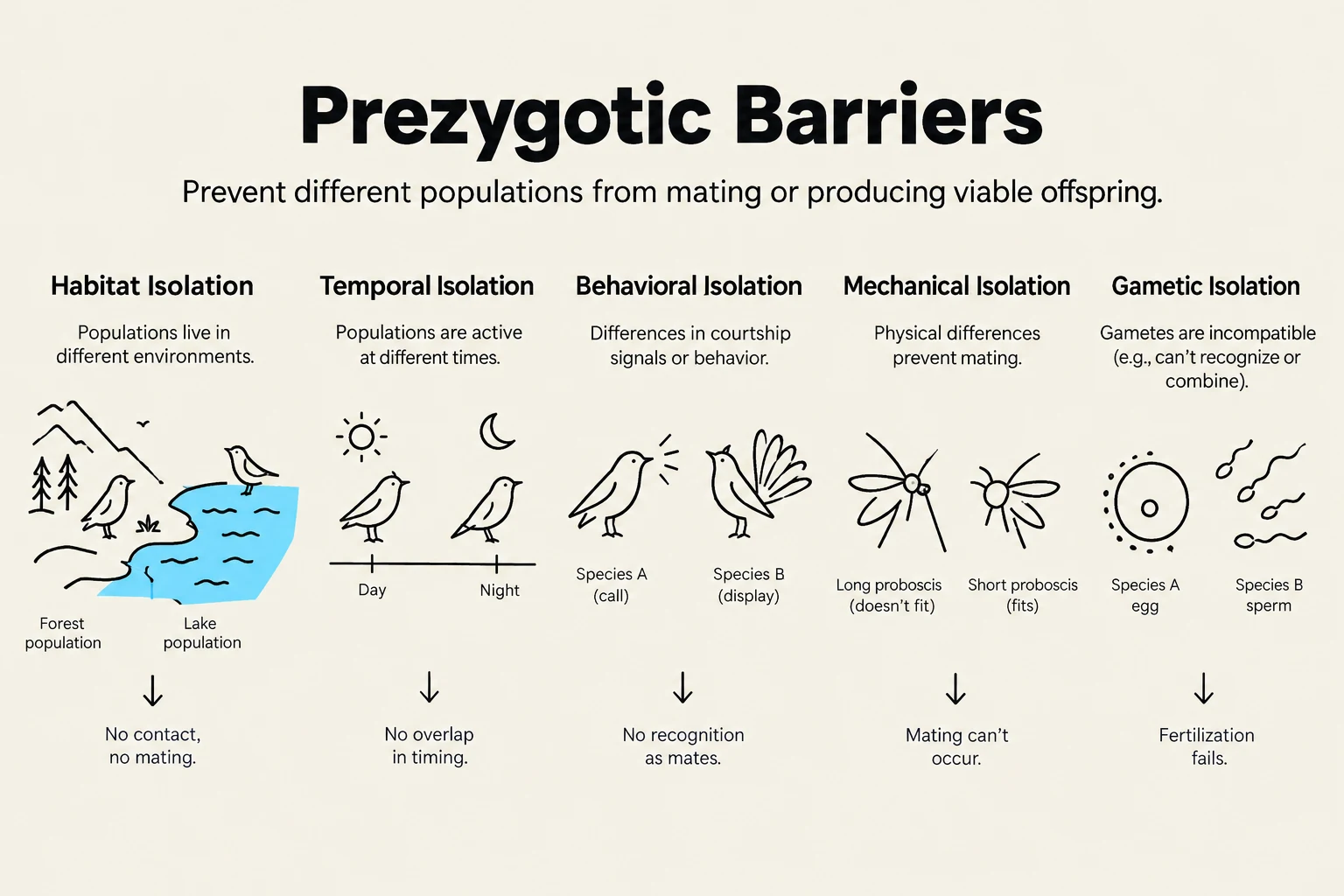
Prezygotic barriers act as "preventative" measures, stopping the formation of a zygote (a fertilized egg). These can be broken down into several specific mechanisms:
Habitat Isolation: Species live in the same general area but occupy different habitats, so they rarely encounter one another.
Temporal Isolation: Species breed at different times of the day, different seasons, or different years.
Behavioral Isolation: Unique courtship rituals or specific signals (like bird songs or firefly flashes) are required for mating; if the signal is wrong, no mating occurs.
Mechanical Isolation: Morphological or structural differences in reproductive organs prevent successful mating.
Gametic Isolation: Even if mating occurs, the sperm of one species may be chemically incompatible with the egg of another, preventing fertilization.
This diagram illustrates prezygotic barriers, which are mechanisms that prevent different populations from mating or producing viable offspring. These barriers include habitat isolation, temporal isolation, behavioral isolation, mechanical isolation, and gametic isolation.
Postzygotic Barriers
If the prezygotic barriers fail and fertilization occurs, postzygotic barriers come into play to reduce the fitness of the resulting hybrid offspring. These include:
Reduced Hybrid Viability: The hybrid zygote forms, but genetic incompatibility causes it to fail during development or die before reaching reproductive age.
Reduced Hybrid Fertility: The hybrid is healthy and survives to adulthood, but it is sterile and cannot produce its own offspring.
Hybrid Breakdown: The first generation of hybrids is fertile, but when they mate with each other or with the parent species, the next generation (F2) is weak or sterile.
Modes of Speciation: Geography Matters
While reproductive isolation describes how species stay separate, the "modes" of speciation describe the geographic context in which the divergence occurs.
Allopatric Speciation
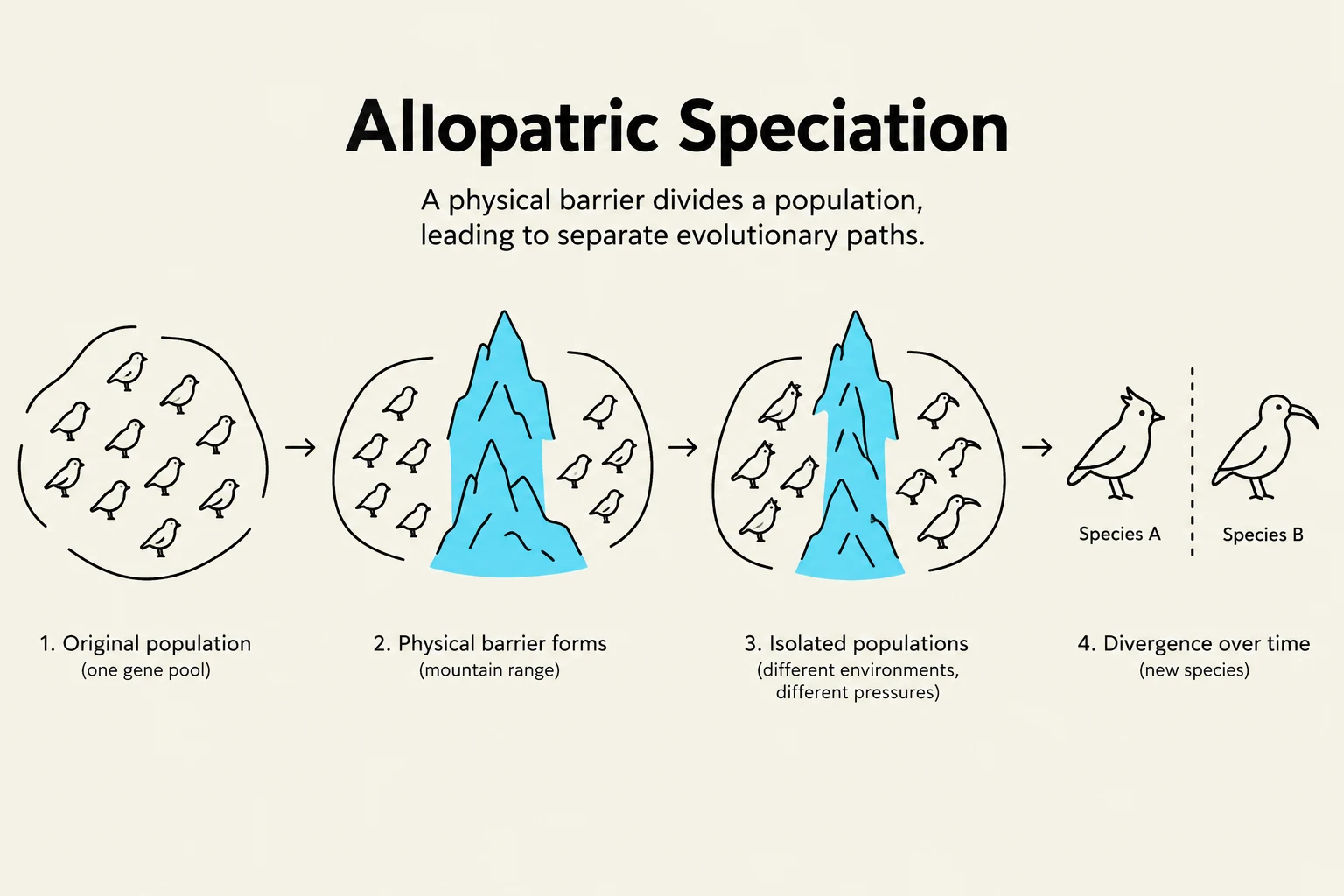
Allopatric speciation (from the Greek allos, meaning other, and patra, meaning fatherland) is the most common mode of speciation. It occurs when a population is divided into two or more geographically isolated subpopulations by a physical barrier, such as a newly formed mountain range, a canyon, or a river.
Once separated, these populations no longer exchange genes. Over time, each group accumulates its own unique genetic changes through mutation, natural selection (adapting to their specific environment), and genetic drift. Eventually, the genetic differences become so great that even if the physical barrier is removed, the populations can no longer interbreed.
Allopatric speciation occurs when a physical barrier divides a population, leading to separate evolutionary paths and eventually the formation of new species.
Sympatric Speciation
Sympatric speciation (from the Greek syn, meaning together) is more controversial and complex because it occurs when new species evolve from a single ancestral species while inhabiting the same geographic area. Because there is no physical barrier to prevent mating, other mechanisms must drive the divergence:
Polyploidy: This is common in plants, where an error in meiosis produces offspring with extra sets of chromosomes. These polyploid individuals can often self-fertilize or mate with other polyploids, but they are instantly reproductively isolated from the parent population.
Habitat Differentiation: A subpopulation may begin to utilize a different resource or niche within the same area, leading to reduced contact with the original population.
Sexual Selection: If females begin to prefer specific male traits, it can lead to reproductive isolation within a single population.
The illustration depicts sympatric speciation, where a single population in one area evolves into two distinct species. This process involves a key change creating variation, leading to groups utilizing different resources or niches within the same area, ultimately resulting in two species.
Summary of the Evolutionary Process
To tie these concepts together, remember the hierarchy of divergence:
Separation: A barrier (geographic in allopatry, or biological/behavioral in sympatry) restricts gene flow.
Divergence: Populations accumulate genetic differences via selection and drift.
Isolation: The populations develop reproductive isolation (prezygotic or postzygotic), finalizing the speciation process.
Keep reading for free.
Create an account to finish this reading and make it part of your study routine.