An in-depth explanation of the South African Deeds Registries Act, covering the lodgement and registration process for land transfers, the role and responsibilities of conveyancers, financial requirements, and special transfer types like sales in execution.
In the South African legal system, the transfer of land ownership is not merely a matter of agreement between two parties; it is a formal, highly regulated process governed by the Deeds Registries Act (DRA). Under Section 16 of the DRA, ownership of land is conveyed through a deed of transfer (Form E) that is executed or attested by the Registrar of Deeds. This process ensures the publicity of title, prevents the same land from being sold twice, and provides certainty to all parties asserting real rights over a property.
The Lodgement and Registration Process
The journey of a deed begins at the Deeds Office through a process known as lodgement. Documents are submitted in prescribed lodgement covers, which are color-coded to differentiate the nature of the documents inside. For instance, white or colored covers indicate different types of deeds, and each firm is identified by a unique firm number placed in the top left-hand corner.
To ensure the registry can process complex transactions, documents are organized using lodgement codes and linking. Common codes include:
T: Title deeds of land (transfers)
B: Mortgage bonds
BC: Bond cancellations
PA: General powers of attorney
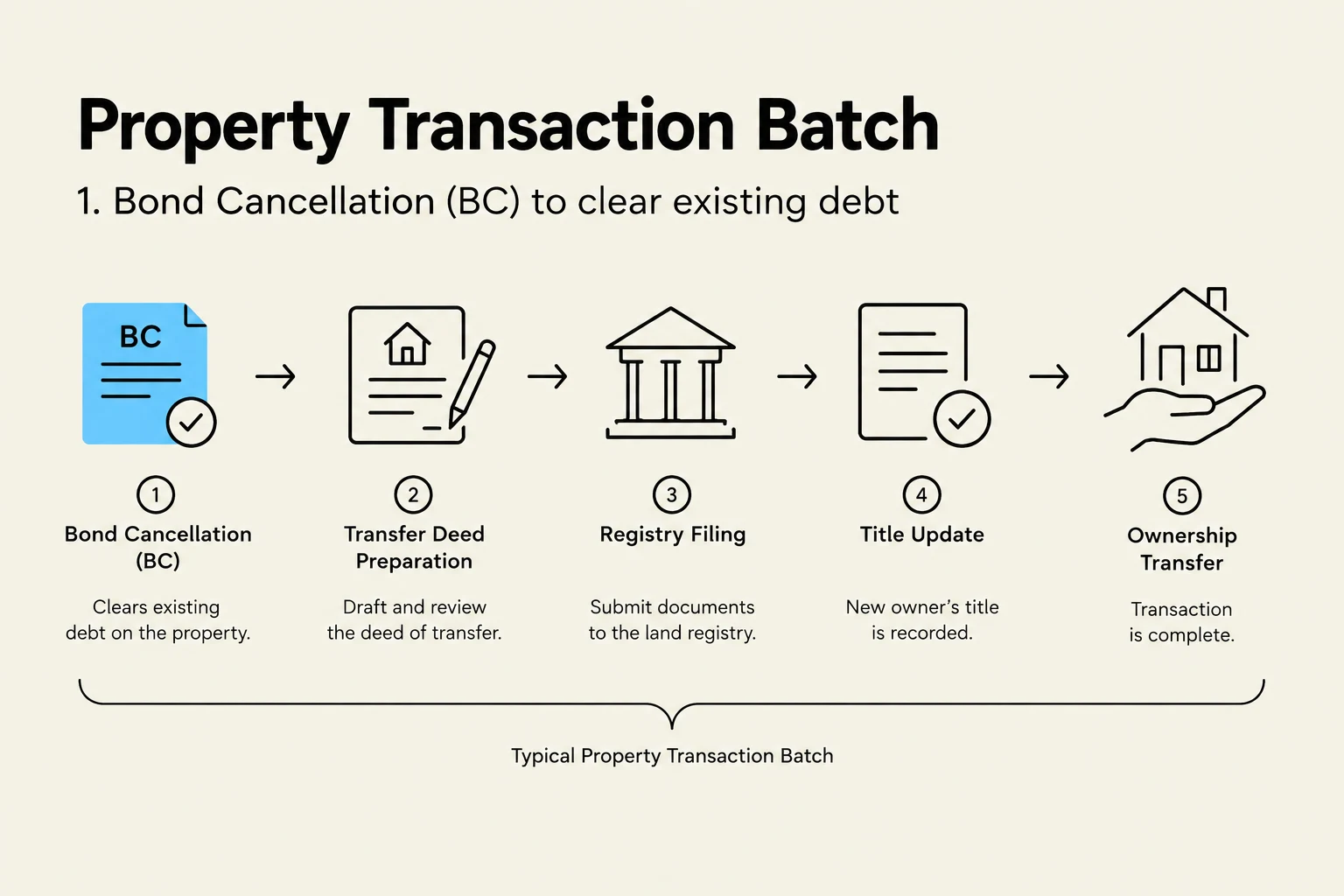
Linking is the mechanism that ties related documents together in a single batch. In a typical residential sale, a batch might include a Transfer (T), a Bond Cancellation (BC) to free the seller's property, and a new Mortgage Bond (B) for the buyer's financing. Registration only occurs once the Registrar has signed the last deed in the batch. However, if a batch is "Roman linked," the registry may reject a specific part of the batch while allowing the rest to pass, provided there is no cross-linking between the sets.
A flowchart illustrating the typical steps in a property transaction batch, starting with Bond Cancellation (BC) to clear existing debt, followed by Transfer Deed Preparation, Registry Filing, Title Update, and finally Ownership Transfer.
The Role and Responsibilities of the Conveyancer
The law imposes strict requirements on who may prepare the documents that create or transfer real rights. Per Section 15 of the DRA, only a practicing conveyancer may prepare deeds of transfer, mortgage bonds, or certificates of title. While an attorney or notary public may prepare supporting documents like Powers of Attorney or consents, these must be countersigned by a conveyancer.
The Preparation Clause (Prep Clause)
When a conveyancer signs a deed, they sign the preparation certificate (the "prep clause"), typically located in the upper right-hand corner of the first page. By signing this, the conveyancer accepts personal legal responsibility under Regulation 44A for the correctness of specific facts.
The Registrar relies on this certificate and does not require independent proof for the following facts:
Identity and Capacity: The names, ID numbers, marital status, and capacity of the parties.
Conditions of Title: That all applicable servitudes or restrictions from the existing title deed have been correctly "brought forward" into the new deed.
Authority: That representatives acting for juristic persons (companies, trusts, etc.) are duly authorized by a resolution or founding document.
Consistency: That the details in the deed (preamble and vesting clause) match the information provided in the Power of Attorney.
[!IMPORTANT]
Exam Tip: Remember that "preparation" is more than just typing. It is a legal act of assuming liability. If a conveyancer fails to correctly bring forward a servitude, they can be held liable for any resulting loss to the purchaser.
Financial Requirements and Post-Registration
Before a transfer can be registered, two critical financial documents must be produced:
Rates Clearance Certificate: A certificate from the local municipality confirming all rates and taxes are paid. This prevents the buyer from inheriting the seller's municipal debt.
Transfer Duty Receipt: Proof from SARS that the state's tax on property acquisition has been paid or that the transaction is exempt.
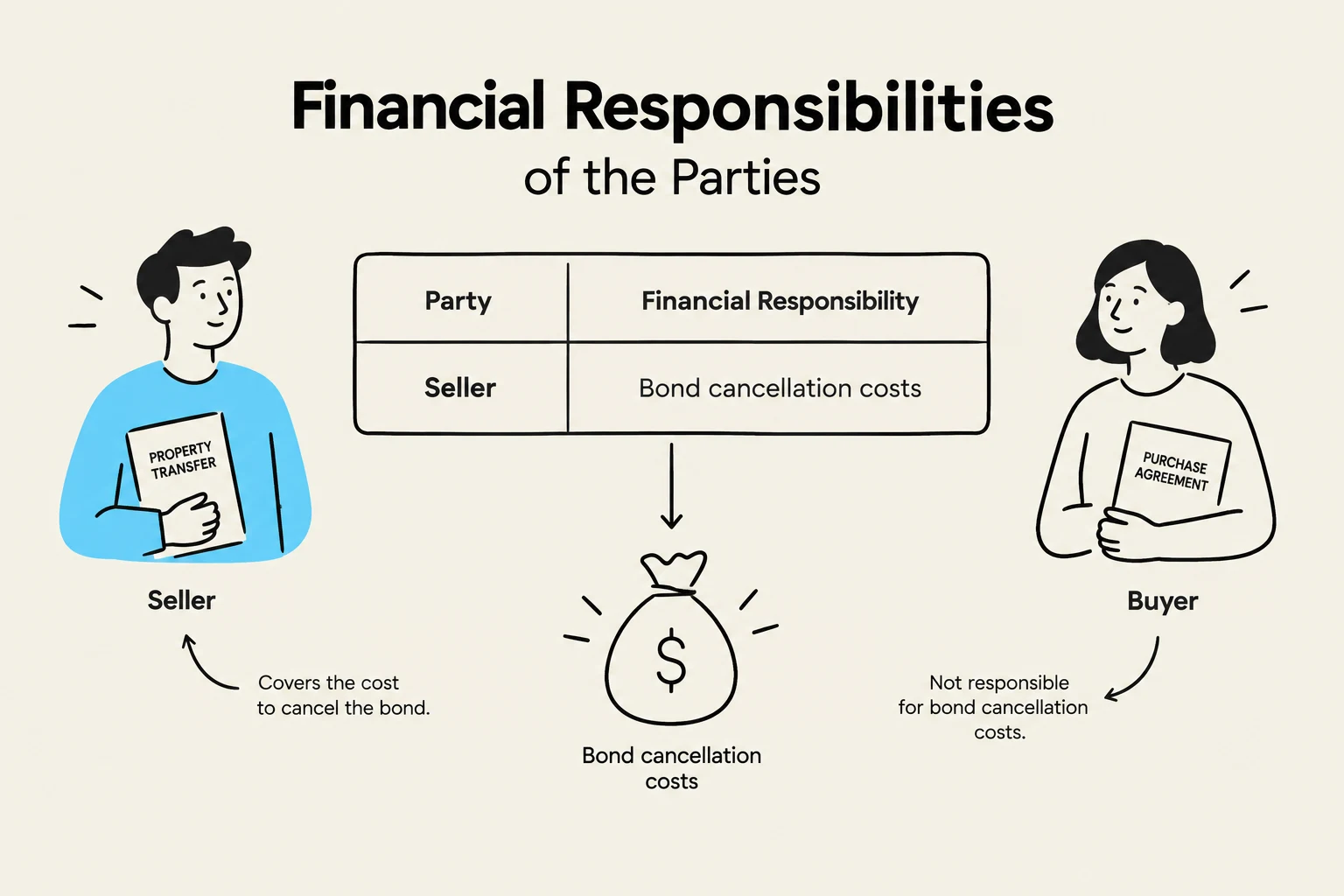
This diagram illustrates the financial responsibilities of a seller and buyer in a property transaction, specifically regarding bond cancellation costs. The seller is responsible for covering these costs, as indicated by the table and accompanying text.
Once registration is complete, the conveyancer manages the distribution of funds. They collect money from banks via guarantees (written promises to pay) and distribute the proceeds to the seller and other stakeholders. The registered documents are then returned by the Deeds Office, having been embossed with a seal and entered into the computer system.
Special Transfers and Endorsements
The Deeds Registry allows for various "miscellaneous" applications to update or correct records without a full formal transfer.
1. Marital Status and Spousal Rights
Section 45 & 45bis: If a spouse in a marriage in community of property dies, the survivor can apply for an endorsement on the title deed. This allows the survivor to deal with the property as if they had taken a formal transfer of the deceased's share.
Section 17(4): This allows owners to update deeds to reflect changes in marital status (e.g., marriage, divorce, or death).
2. Testamentary Trusts and Inheritances
Section 40 (AEA): When a will creates a trust, the executor can have the terms of the will endorsed against the title deeds. This allows the trustee to manage the property without a formal transfer.
Section 42(1) (AEA): When transferring property to an heir, the executor must provide a conveyancer's certificate stating the transfer complies with the approved liquidation and distribution account.
3. Rectification and Partition
Rectification (Section 4(1)(b)): Used to correct clerical errors in names or descriptions.
Partition (Section 26): When co-owners of land agree to divide it into specific, separate parcels, a partition transfer is used.
Sales in Execution
A sale in execution is a unique scenario where a judgment debtor's land is attached by a court order and sold by a sheriff at a public auction.
In these cases, the transfer is not passed by the owner, but by the sheriff acting as a statutory agent of the debtor. For the registry to accept this, the writ of attachment must have been previously served on the Registrar, who records it as an interdict against the property. The deed must clearly state the "causa" (the reason for transfer), including the details of the court case, the date of the auction, and the names of the plaintiff and defendant.
Keep reading for free.
Create an account to finish this reading and make it part of your study routine.