Explore the complex and living matrix of soil, examining its mineral foundation, organic matter, and fluid environments. Learn about primary and secondary minerals, the role of humus, and the ideal balance of components in loam soil for supporting life.
To the untrained eye, soil appears to be nothing more than "dirt"—a static, brown substance beneath our feet. However, to a biologist or an agronomist, soil is a complex, dynamic, and living matrix. It is a sophisticated medium that facilitates the exchange of energy, nutrients, and gases between the lithosphere, the atmosphere, and the biosphere. Understanding soil requires looking beyond the surface to examine its mineral architecture, its organic life, and the fluid environments that allow life to thrive within it.
The Mineral Foundation: Primary and Secondary Phases
The physical skeleton of any soil is composed of mineral particles, which are categorized based on their origin and chemical stability. These are divided into two fundamental groups: primary and secondary minerals.
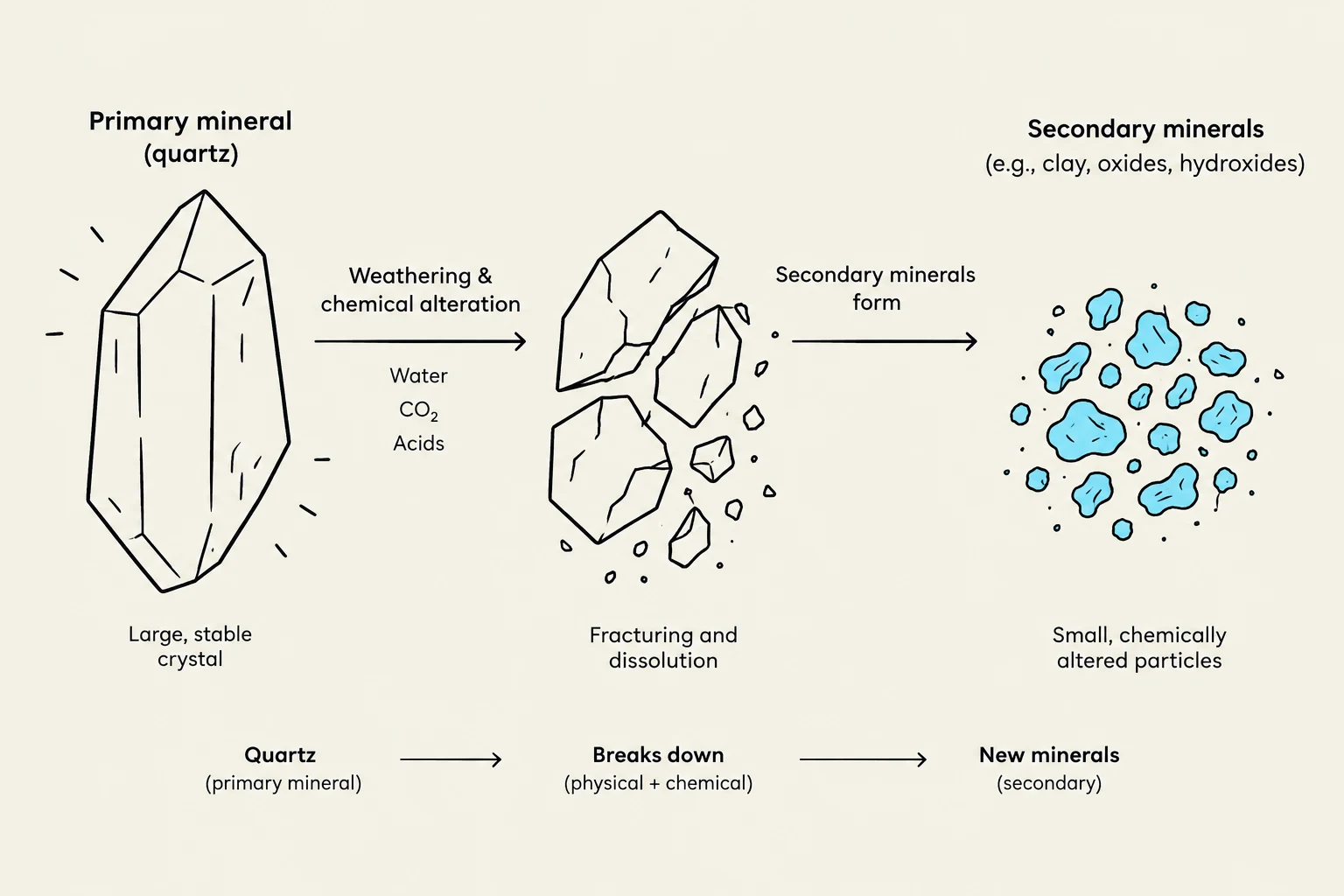
Primary minerals are those that have remained chemically unchanged since they were first formed from the cooling of molten rock (magma) or through metamorphic processes. Common examples include quartz, feldspar, and mica. These minerals are typically released into the soil through the physical weathering of parent rock—processes like freeze-thaw cycles or abrasion that break large rocks into smaller fragments without altering their internal chemical structure.
In contrast, secondary minerals are the products of chemical weathering. When primary minerals are exposed to water, oxygen, and organic acids, they undergo chemical transformations. This process often results in the formation of clay minerals. Unlike the large, rigid crystals of primary minerals, secondary minerals like kaolinite or montmorillonite are much smaller and possess unique chemical properties, such as a high surface area and the ability to hold electrical charges.
This diagram illustrates the process of mineral alteration, showing how a primary mineral like quartz weathers and breaks down through physical and chemical processes to form secondary minerals.
Exam Tip: If a question asks you to distinguish between primary and secondary minerals, look for the "origin." Primary = Parent rock; Secondary = Chemical transformation (often clay).
Organic Matter and the Role of Humus
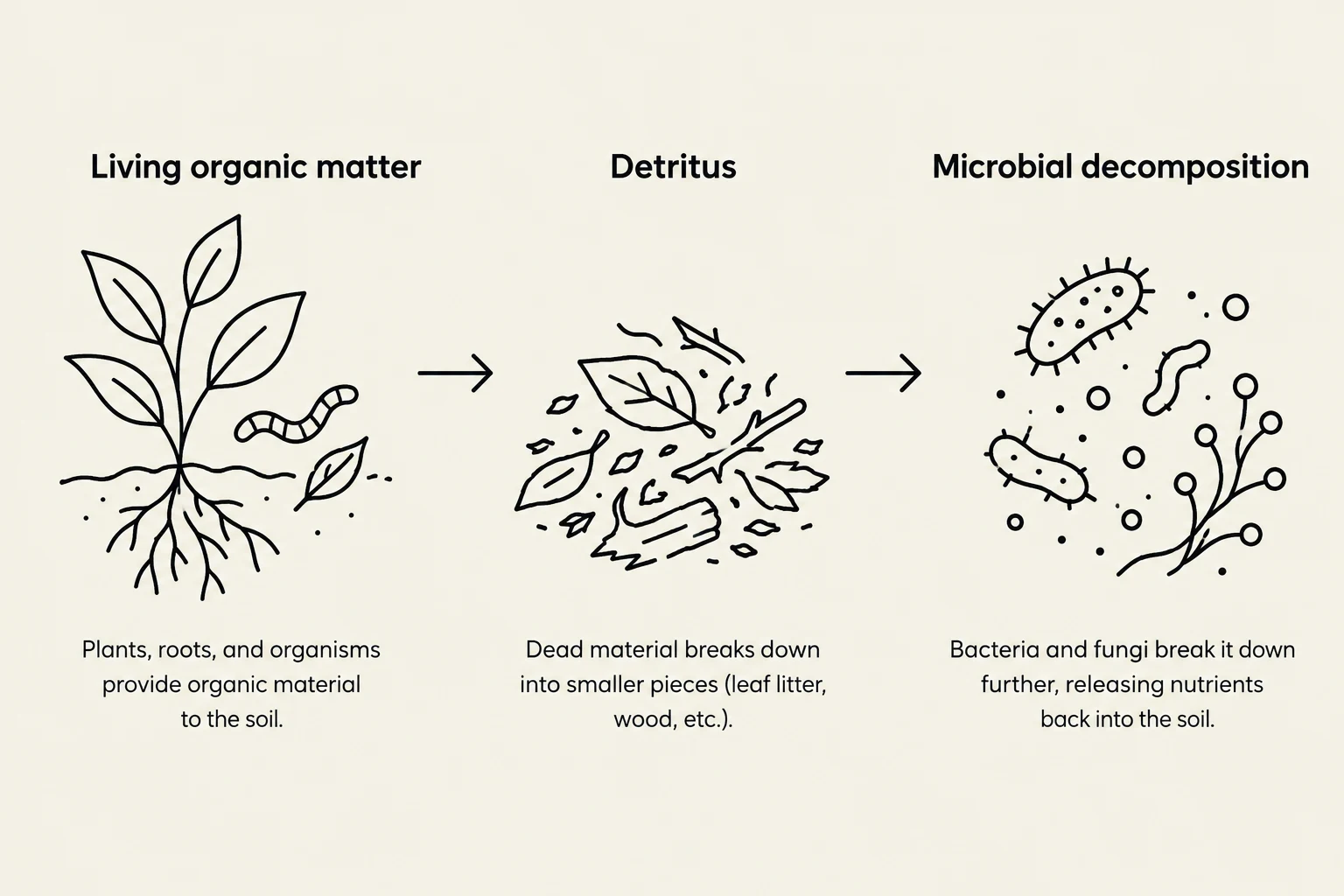
While minerals provide the structure, organic matter provides the "engine" of the soil. Soil organic matter (SOM) includes everything from living microorganisms and decaying plant roots to microscopic fragments of insects.
As these organic materials decompose, they undergo a process called humification, resulting in the formation of humus. Humus is a highly stable, dark, amorphous substance that is resistant to further rapid decay. It plays several critical roles in soil health:
Nutrient Reservoir: Humus has a high Cation Exchange Capacity (CEC), meaning it acts like a chemical sponge, holding onto essential nutrients (like Ca2+, Mg2+, and K+) and preventing them from being washed away by rain.
pH Buffering: Organic matter helps stabilize soil pH, preventing rapid shifts that could be toxic to plants.
Structure Improvement: Humus acts as a biological glue, helping mineral particles stick together into aggregates, which improves soil aeration and water infiltration.
This diagram illustrates the process of decomposition in soil, starting with living organic matter, progressing to detritus, and finally microbial decomposition by bacteria and fungi, which returns nutrients to the soil.
The Fluid Environments: Soil Solution and Atmosphere
Soil is not a solid block; it is a porous medium filled with fluids. For a plant to survive, it must interact with two distinct "atmospheres" within the soil: the liquid phase and the gaseous phase.
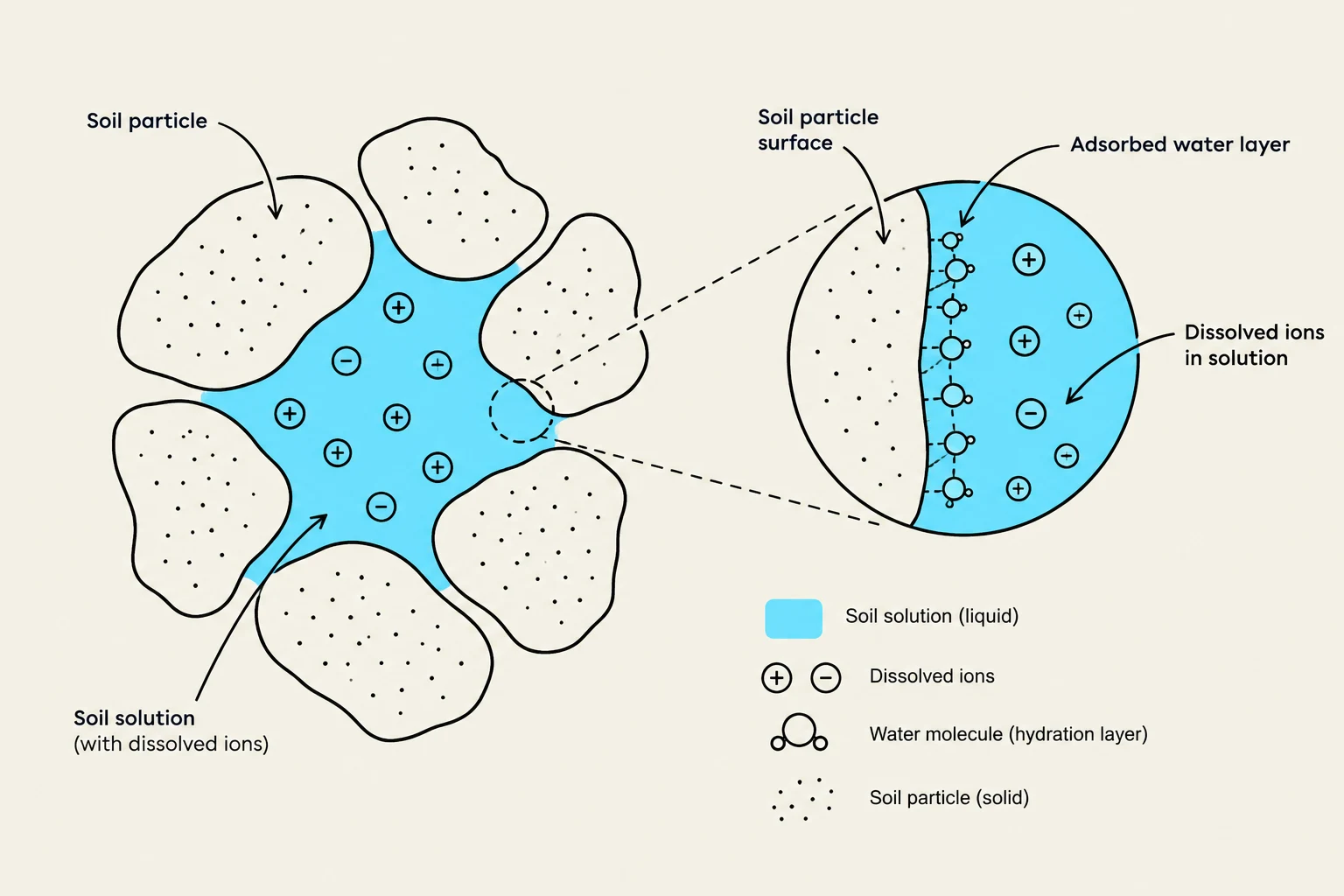
The soil solution is the water held within the soil pores that contains dissolved nutrients. This is the primary medium through which plants "drink." Nutrients must be in a dissolved state to be taken up by root hairs via osmosis and active transport. The chemistry of this solution—its concentration of salts, its acidity (pH), and its dissolved oxygen levels—determines the health of the entire ecosystem.
Simultaneously, the soil atmosphere consists of the air trapped in the pore spaces not occupied by water. While the atmosphere in the soil is similar to the Earth's atmosphere, it is not identical. Because soil organisms are constantly breathing (respiring), the soil atmosphere often has higher concentrations of carbon dioxide (CO2) and lower concentrations of oxygen (O2) than the air above ground.
This diagram illustrates the interaction between soil particles, soil solution, and dissolved ions, showing an adsorbed water layer on the soil particle surface.
The Ideal Balance: Loam Soil Proportions
The functionality of a soil is largely determined by its "texture"—the relative proportion of sand, silt, and clay—and its "composition"—the ratio of solids to fluids. The gold standard for agriculture is loam soil.
Loam is considered ideal because it achieves a perfect balance between the various components. In a typical loam soil, the distribution of components follows a specific pattern to ensure that plants have access to both stability and mobility.
A healthy loam soil is generally composed of:
45% Mineral Matter: A balanced mix of sand (for drainage), silt (for nutrient retention), and clay (for chemical activity).
5% Organic Matter: Providing the biological life and humus mentioned previously.
25% Water (Soil Solution): Occupying the smaller pores to provide hydration and nutrient transport.
25% Air (Soil Atmosphere): Occupying the larger pores to allow for gas exchange and root respiration.
If the water proportion becomes too high (as in waterlogged soil), the air spaces are lost, leading to anaerobic conditions that can suffocate roots. Conversely, if the air proportion is too high (as in sandy soil), the soil cannot hold enough water or nutrients to support life.
Summary Table for Students
Component
Function
Ideal Proportion (Loam)
Minerals
Physical structure & base nutrients
~45%
Organic Matter
Nutrient storage & biological activity
~5%
Water
Nutrient transport & hydration
~25%
Air
Respiration & gas exchange
~25%
By understanding these interconnected layers—from the microscopic chemical changes in secondary minerals to the macroscopic balance of a loam profile—we can better manage the earth to support sustainable life.
Keep reading for free.
Create an account to finish this reading and make it part of your study routine.