An analysis of social movement militias, defining them by their local embeddedness, political autonomy, and economic self-sufficiency, and exploring their role in modern conflict and governance.
In the study of modern conflict and political science, the term "militia" often evokes images of disorganized ragtag groups or formal state reserves. However, a more complex and increasingly prevalent phenomenon is the Social Movement Militia. These are armed groups that are deeply embedded within local social, religious, or ethnic networks, possessing their own independent political agendas and autonomous revenue streams. Unlike traditional insurgencies that may seek to overthrow a state, or state-sponsored paramilitaries that act as proxies, social movement militias operate as hybrid actors that bridge the gap between civil society and organized violence.
Defining the Social Movement Militia
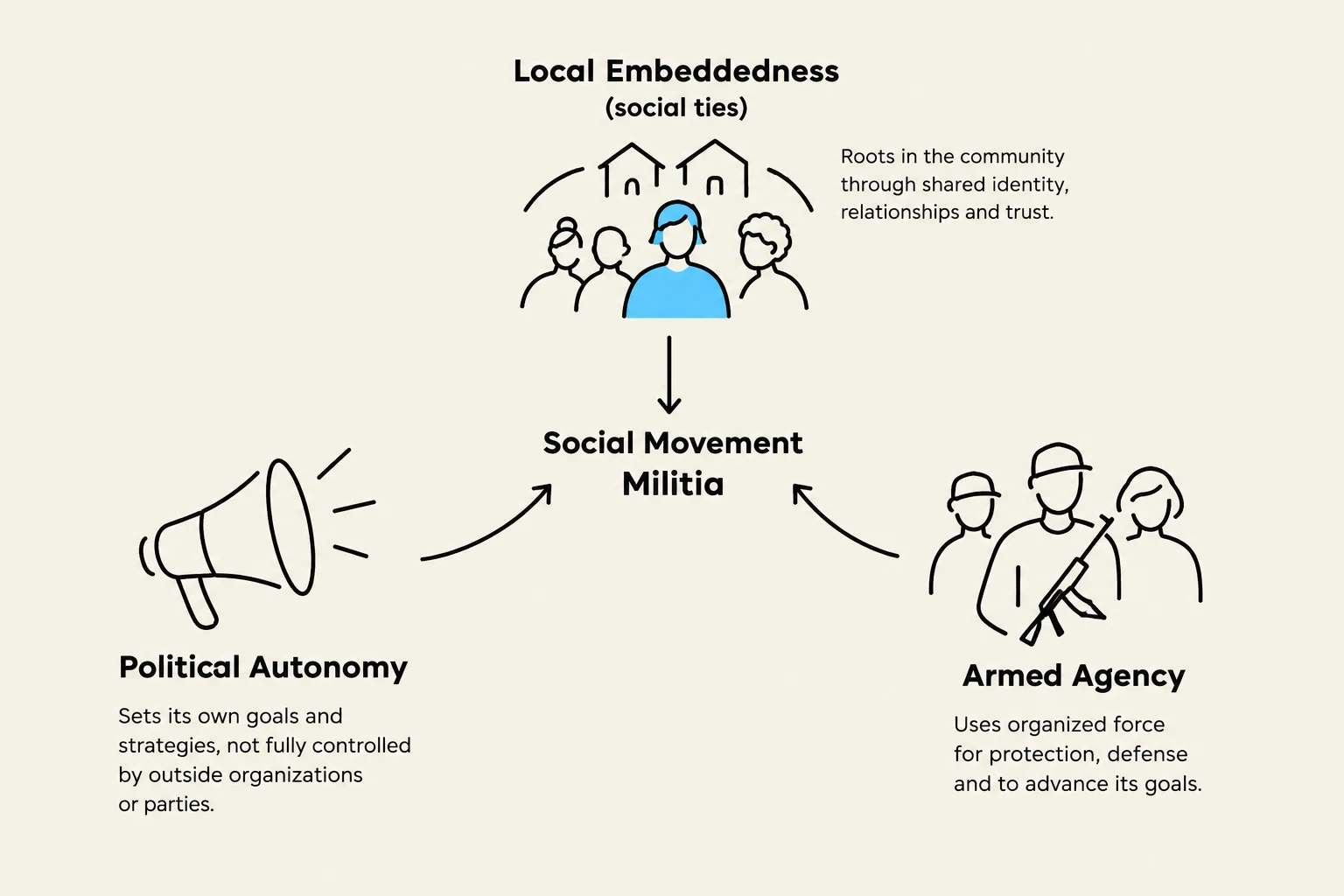
To understand these groups, one must look beyond their weaponry and focus on their sociology. A social movement militia is characterized by three core pillars:
Local Embeddedness: They are not "outsiders" invading a territory; they are composed of members from the local community, often drawn from existing social movements, religious organizations, or neighborhood defense committees.
Political Autonomy: While they may occasionally align with a state or a larger regional power, they maintain an independent political agenda that serves their specific community interests or ideological goals.
Economic Self-Sufficiency: They often develop independent revenue streams—ranging from local taxation and protection rackets to involvement in illicit trade—which allows them to operate without total reliance on a central patron.
Study Tip: When analyzing a conflict, ask: "Does this group rely entirely on a foreign state for funding, or do they have a local economic base?" If they have a local base, they are more likely to function as a social movement militia rather than a mere proxy.
This diagram illustrates the interconnectedness of local embeddedness, political autonomy, and armed agency in the context of a social movement militia.
The Logic of Embeddedness and Sectarianization
One of the primary drivers for the rise of these militias is the process of sectarianization. This occurs when political identities are reframed through the lens of religious or ethnic division, often to consolidate power or mobilize support.
When a state fails to provide security or services, local populations turn to their own social networks for protection. This "securitization" of social identity means that a religious or ethnic group may form an armed wing to defend its members. Over time, these defensive measures evolve into political tools. The militia becomes the "muscle" of the social movement, ensuring that the group's interests are represented in the political arena, often through coercion.
Revenue Streams and the Autonomy Trap
The ability to generate independent revenue is what separates a social movement militia from a temporary protest group. This economic independence creates an "autonomy trap" for the state. Because the militia does not need the state to pay its fighters, the state loses its primary lever of control: the monopoly on the legitimate use of force and the distribution of resources.
Common revenue models include:
Informal Taxation: Collecting "fees" from local businesses for "protection."
Resource Control: Dominating local markets, checkpoints, or transit routes.
Transnational Networks: Leveraging social or religious ties to move goods or funds across borders.
Strategic Depth and Regional Dynamics
In a broader geopolitical context, social movement militias can be utilized by regional powers to achieve "strategic depth." Instead of engaging in direct conventional warfare, a regional power may support or allow these militias to flourish within a neighboring state.
By fostering groups that are locally embedded, a regional power gains influence without the political cost of a formal military occupation. The militia acts as a buffer or a forward operating base that is difficult for the target state to dismantle because the militia is woven into the very fabric of the local population.
Worked Example: The Hybrid Actor Model
Consider a hypothetical scenario where a religious minority in a conflict-prone region feels threatened by the central government.
Phase 1 (Social): The minority forms a community center and a local charity to provide services the state ignores.
Phase 2 (Militia): To protect the charity and community center, young men form a "neighborhood watch."
Phase 3 (Political/Economic): The "watch" begins controlling local grain shipments to ensure their community is fed, using the surplus to fund their operations. They now have a political agenda: demanding autonomy for their region.
Mathematically, we can view the "Influence Factor" (I) of such a group as a function of their social integration (S), their economic independence (E), and their military capability (M):
I=S⋅E⋅M
If any of these variables approach zero, the group's ability to act as an independent political force diminishes significantly. For a social movement militia, S, E, and M are all high, leading to a high I.
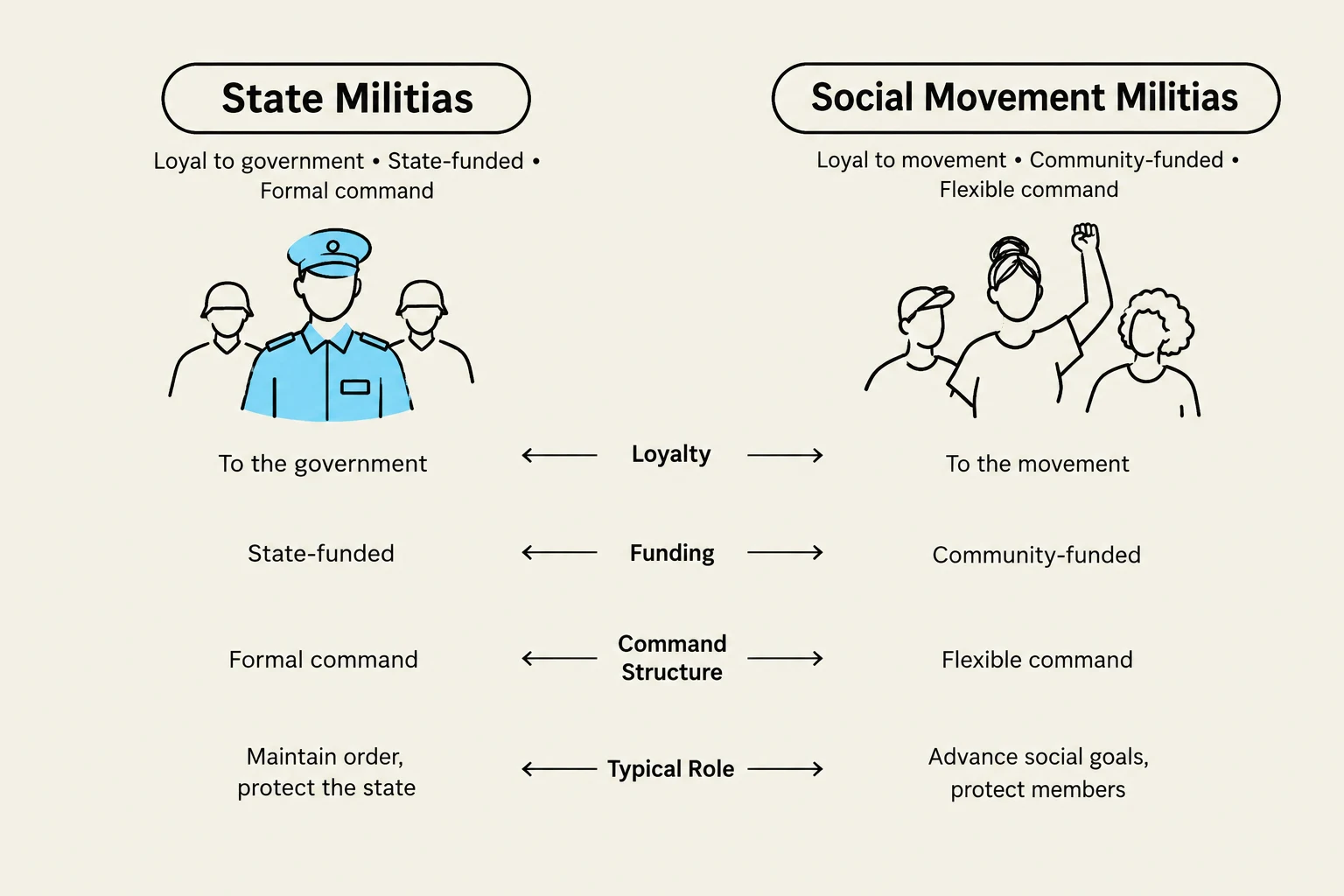
This diagram compares state militias and social movement militias based on loyalty, funding, command structure, and typical role.
Conclusion
Social movement militias represent a significant challenge to the traditional Westphalian model of the state, where the government holds a monopoly on violence. By combining deep social roots with independent economic and political structures, these groups create a new layer of governance and conflict that is highly resilient to traditional state intervention. Understanding them requires looking past the guns and into the social and economic networks that sustain them.
Keep reading for free.
Create an account to finish this reading and make it part of your study routine.