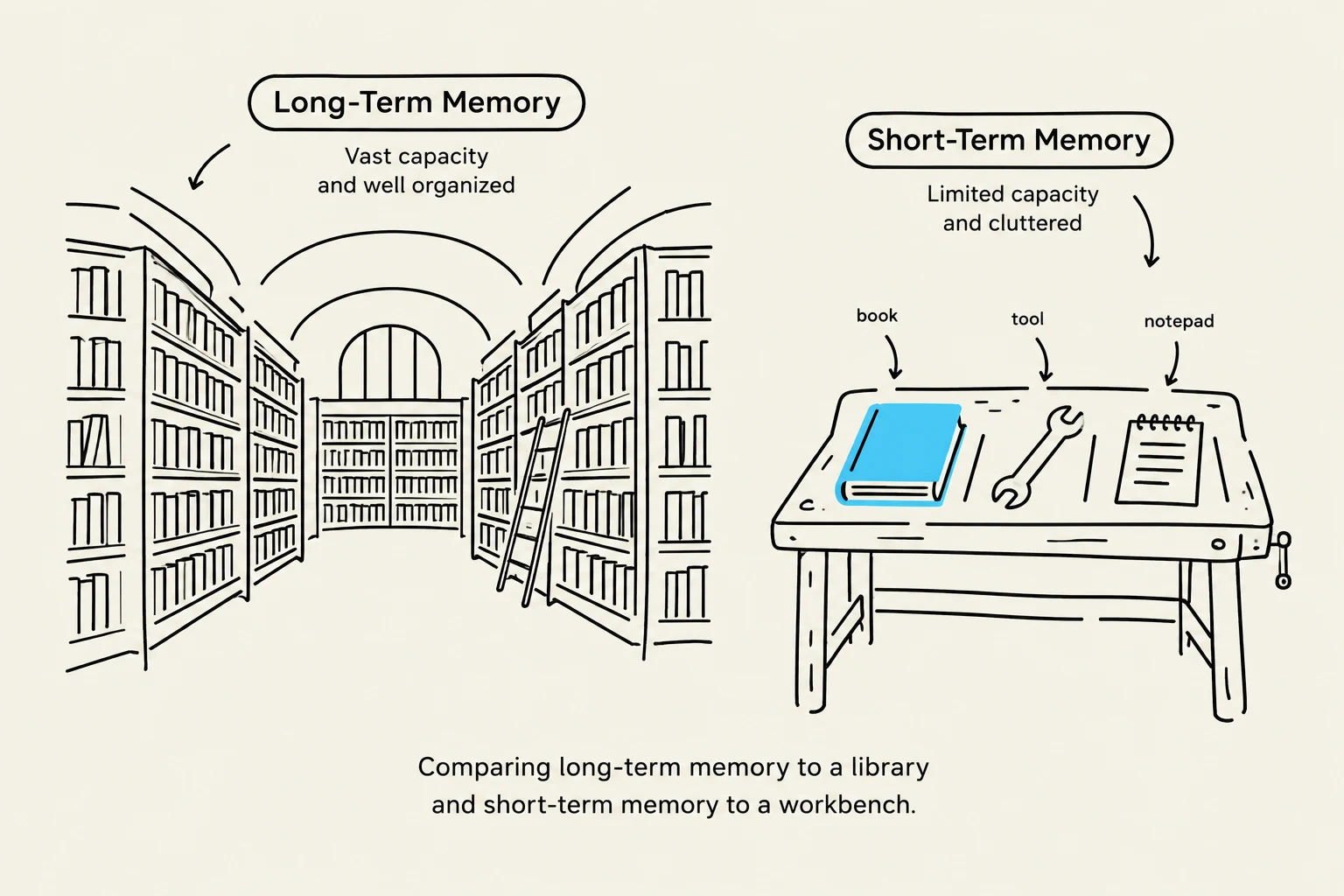
Imagine someone reads a phone number to you, but they speak very slowly, one digit at a time. By the time they reach the last digit, you find yourself mentally repeating the first few numbers just to keep them from slipping away. This mental struggle is a direct encounter with your short-term memory (STM). Unlike long-term memory, which acts as a vast, permanent library, short-term memory is more like a small workbench where you hold information temporarily to process it or prepare it for long-term storage.
This illustration compares long-term memory to a library, emphasizing its vast capacity and organization, and short-term memory to a workbench, highlighting its limited and cluttered nature.
In this article, we will explore the fundamental constraints of this system: how much it can hold, how long it lasts, and the clever cognitive trick known as "chunking" that allows us to bypass these limits.
The Capacity of Short-Term Memory: Miller's Magic Number
One of the most famous questions in cognitive psychology is: How much information can the human mind hold at once? In 1956, psychologist George Miller proposed a groundbreaking theory regarding the capacity of our short-term memory system.
Miller suggested that while the number of individual items we can remember varies, there is a consistent limit to the number of "units" or "chunks" we can process. He famously termed this "The Magical Number Seven, Plus or Minus Two".
Understanding "Units"
It is important to distinguish between "bits" of information and "units" of information. If you are trying to remember a sequence of letters like $A, B, C, D, E, F, G, H, I$, you are dealing with nine individual units. According to Miller's rule, this exceeds the typical capacity of most people, making it difficult to recall the sequence perfectly without rehearsal.
Exam Tip: When a question asks about the capacity of short-term memory, look for the term "chunks" rather than "bits." The capacity refers to the number of meaningful groups, not necessarily the number of individual characters or digits.
The Duration of Short-Term Memory
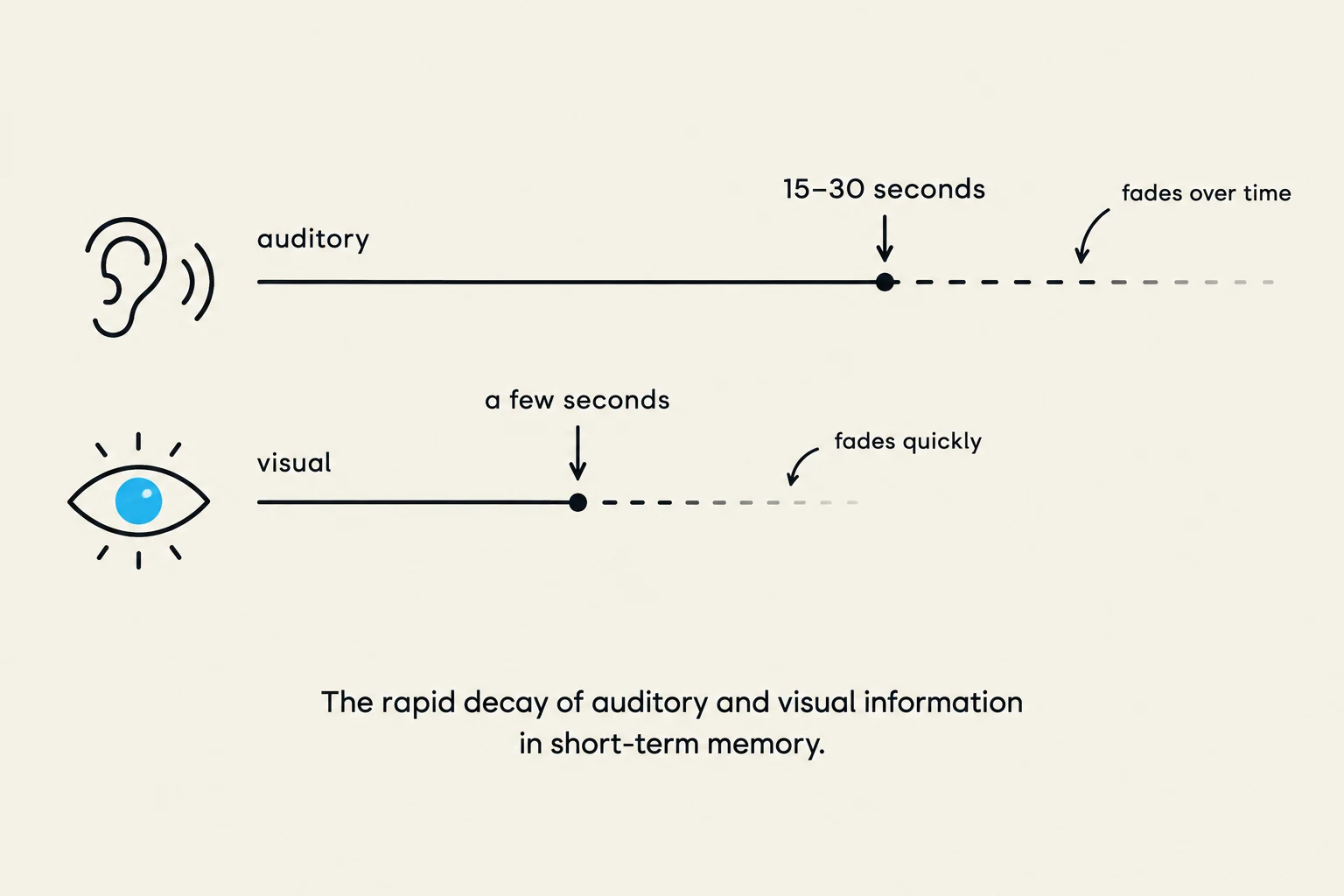
This diagram illustrates the decay rates of auditory and visual information in short-term memory, showing that visual information fades more quickly than auditory information.
Capacity is only half of the equation; the other half is time. Short-term memory is inherently transient. If information is not actively attended to or rehearsed, it decays rapidly.
The duration of short-term memory depends heavily on the type of information being processed:
Acoustic Encoding: Most verbal and auditory information stays in the STM for approximately 15 to 30 seconds.
Visual Encoding: Visual information (often referred to as the "iconic memory" component of the sensory buffer) tends to decay even faster than auditory information.
Without active maintenance—such as repeating a word over and over in your head (maintenance rehearsal)—the "trace" of that memory will fade, and the information will be lost to the environment.
Expanding the Workbench: The Process of Chunking
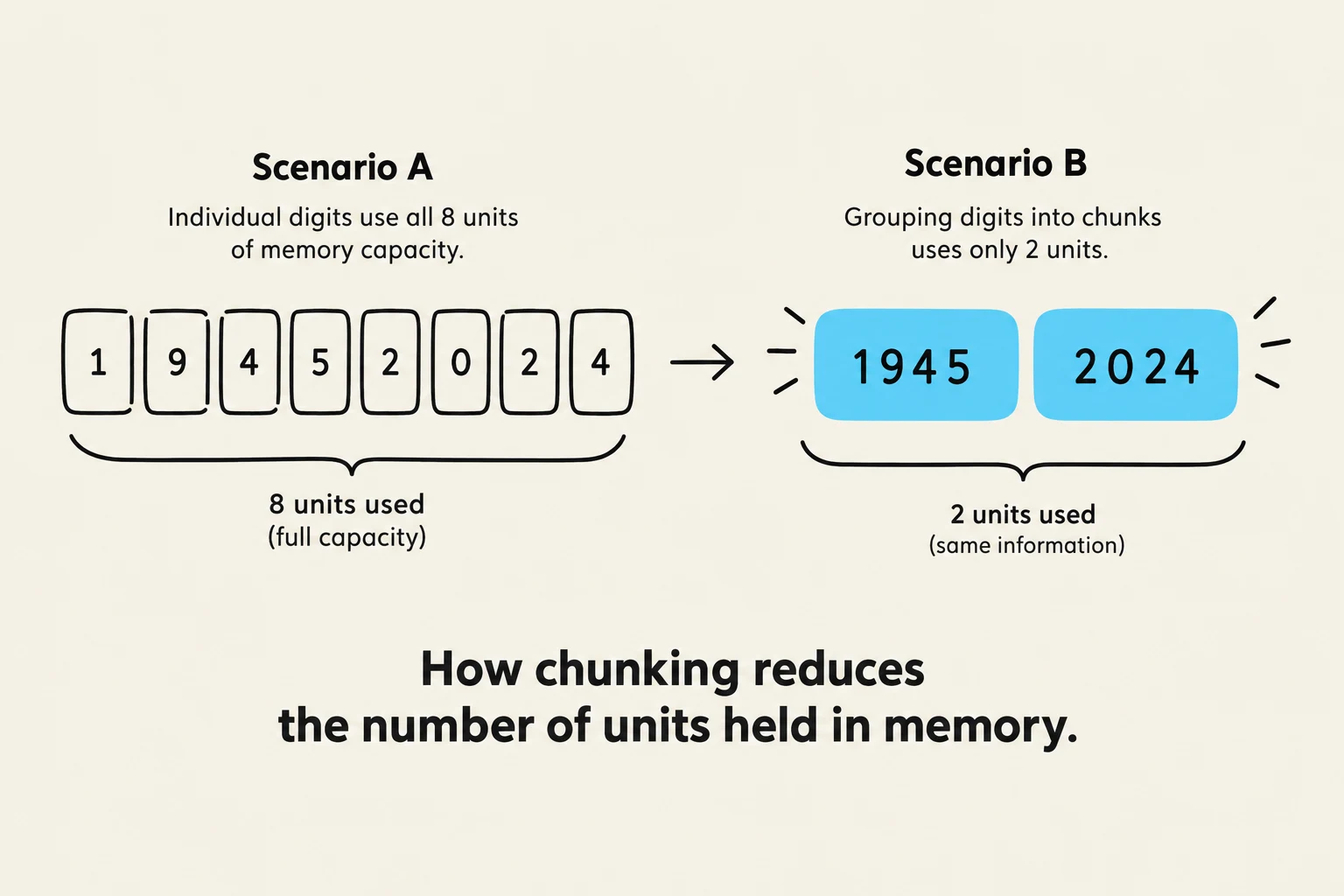
This illustration demonstrates how chunking information, such as grouping digits into larger units, reduces the number of memory units required to hold the same information.
If our capacity is limited to roughly 7±2 units, how are we able to function in a world filled with complex data? How can a programmer remember a long string of code, or a mathematician remember a complex formula? The answer lies in chunking.
What is Chunking?
Chunking is the cognitive process of grouping individual pieces of information into larger, more meaningful units. By organizing data into patterns, we effectively increase the amount of information we can hold without increasing the number of "slots" used in our short-term memory.
A Worked Example
Consider the following two strings of information. In the first example, the numbers are presented as individual digits. In the second, they are grouped into meaningful patterns.
Scenario A (Individual Digits):
$1, 9, 4, 5, 2, 0, 2, 4$
Count: 8 units. This is at the very edge of (or slightly exceeds) the average capacity, making it difficult to memorize quickly.
Scenario B (Chunked):
$(1945), (2024)$
Count: 2 units. By grouping the digits into years (historical dates), the brain only has to hold two "chunks" in the short-term memory workbench.
The Role of Prior Knowledge
Chunking is not a magic trick; it relies heavily on your existing long-term memory. To chunk effectively, you must already possess the knowledge required to recognize the pattern. For instance:
A beginner chess player sees 32 individual pieces on a board.
A grandmaster sees 3 or 4 "chunks" representing strategic formations and patterns.
The grandmaster isn't actually "seeing" more; they are simply using their long-term knowledge to compress the information into fewer, more efficient units.
Summary Table: STM Constraints
Feature
Description
Key Limitation
Capacity
The amount of info held at once
7±2 chunks
Duration
How long info stays active
~15–30 seconds (auditory)
Strategy
How to overcome limits
Chunking: Grouping items into units
By understanding these mechanics, you can apply better study strategies. Instead of trying to memorize raw, disconnected facts, focus on finding the underlying patterns and "chunking" them into meaningful concepts. This reduces the cognitive load on your short-term memory and paves the way for successful transfer into long-term memory.
Keep reading for free.
Create an account to finish this reading and make it part of your study routine.