Have you ever looked at a bright light and seen a lingering glow after you closed your eyes, or felt as though you could still "hear" the last word of a sentence even after the speaker fell silent? These experiences are not hallucinations; they are the result of sensory memory. Sensory memory is the system responsible for holding a brief, fleeting "sensory trace" of a stimulus immediately after the physical stimulus has disappeared. This system is vital because it provides a mechanism to briefly retain information, allowing the brain to integrate sensory data into higher-level cognitive processes.
The Nature of Sensory Memory
While sensory memory applies to all our senses, research focuses most heavily on the visual and auditory systems. It is important to distinguish between perception (the immediate processing of a stimulus) and memory (the retention of that stimulus). Sensory memory acts as the bridge between the two, maintaining a trace that is extremely short-lived.
There are two primary modalities discussed in research:
Iconic Memory: The specific term for visual sensory memory.
Echoic Memory: The auditory version of sensory memory, which holds sound information for a slightly longer duration (approximately 2 seconds).
Exam Tip: When studying these, remember that sensory memory is defined by its duration and its role as a trace. It is not a permanent store, but a temporary buffer for integration.
Iconic Memory and the Sperling (1960) Study
One of the most influential investigations into visual sensory memory was conducted by George Sperling in 1960. Sperling wanted to answer two fundamental questions: How much information can the iconic memory store, and how quickly is that information lost?.
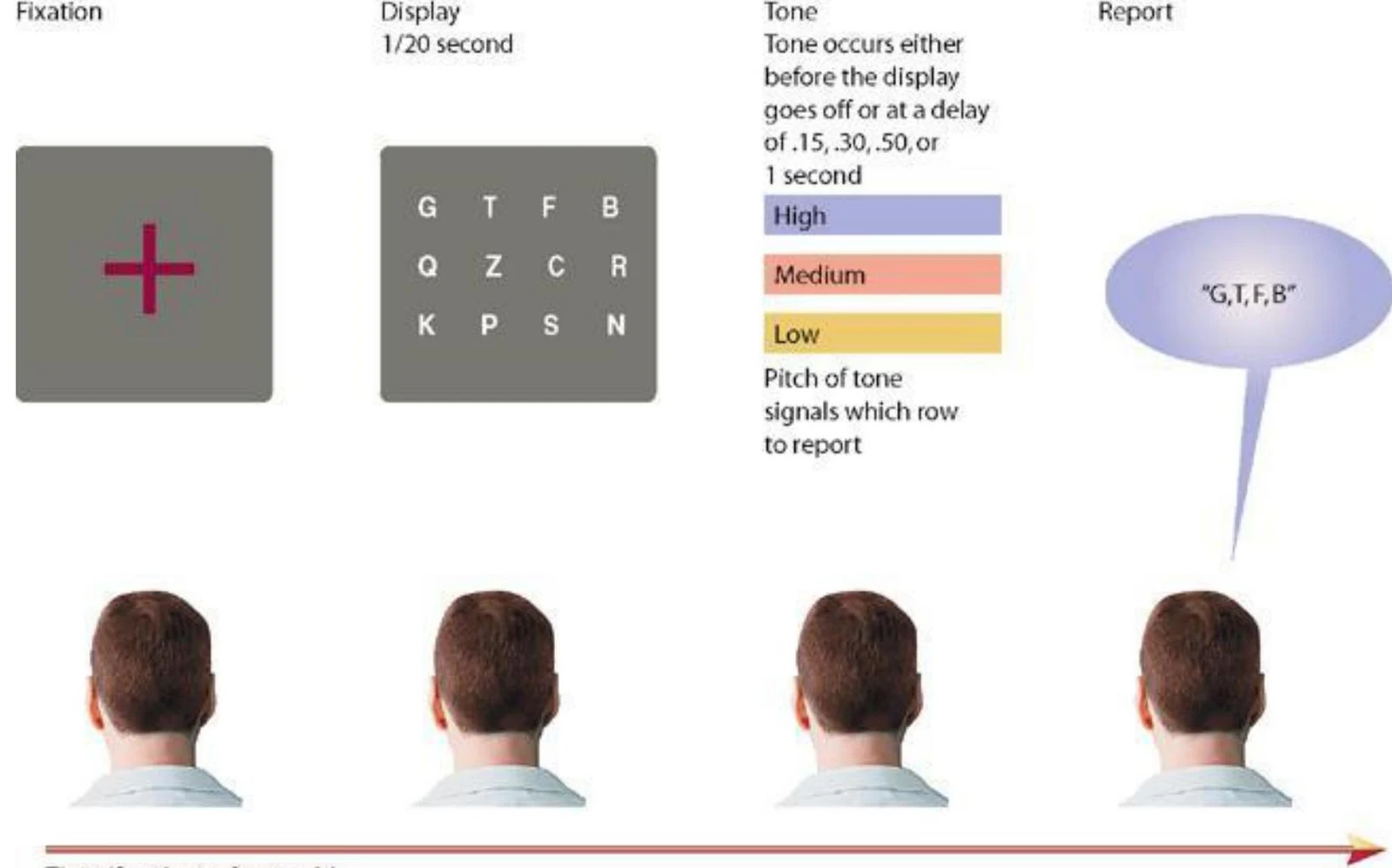
To test this, Sperling used a specific experimental sequence:
Visual Fixation: The participant focuses on a cross to prepare for the stimulus.
Display: A flash array of stimuli (such as letters) is presented very briefly, typically for about 1/20 of a second (50 ms).
Stimulus Offset: The moment the visual array disappears.
Cue Onset: A tone is played at varying delays after the stimulus has vanished.
Report: The participant recalls the information.
This diagram illustrates a visual experiment where participants are shown a grid of letters for a brief period, followed by a tone. The pitch of the tone indicates which row of letters the participant should report.
Whole Report vs. Partial Report
Sperling utilized two different reporting methods to uncover the true capacity of iconic memory:
The Whole Report Method
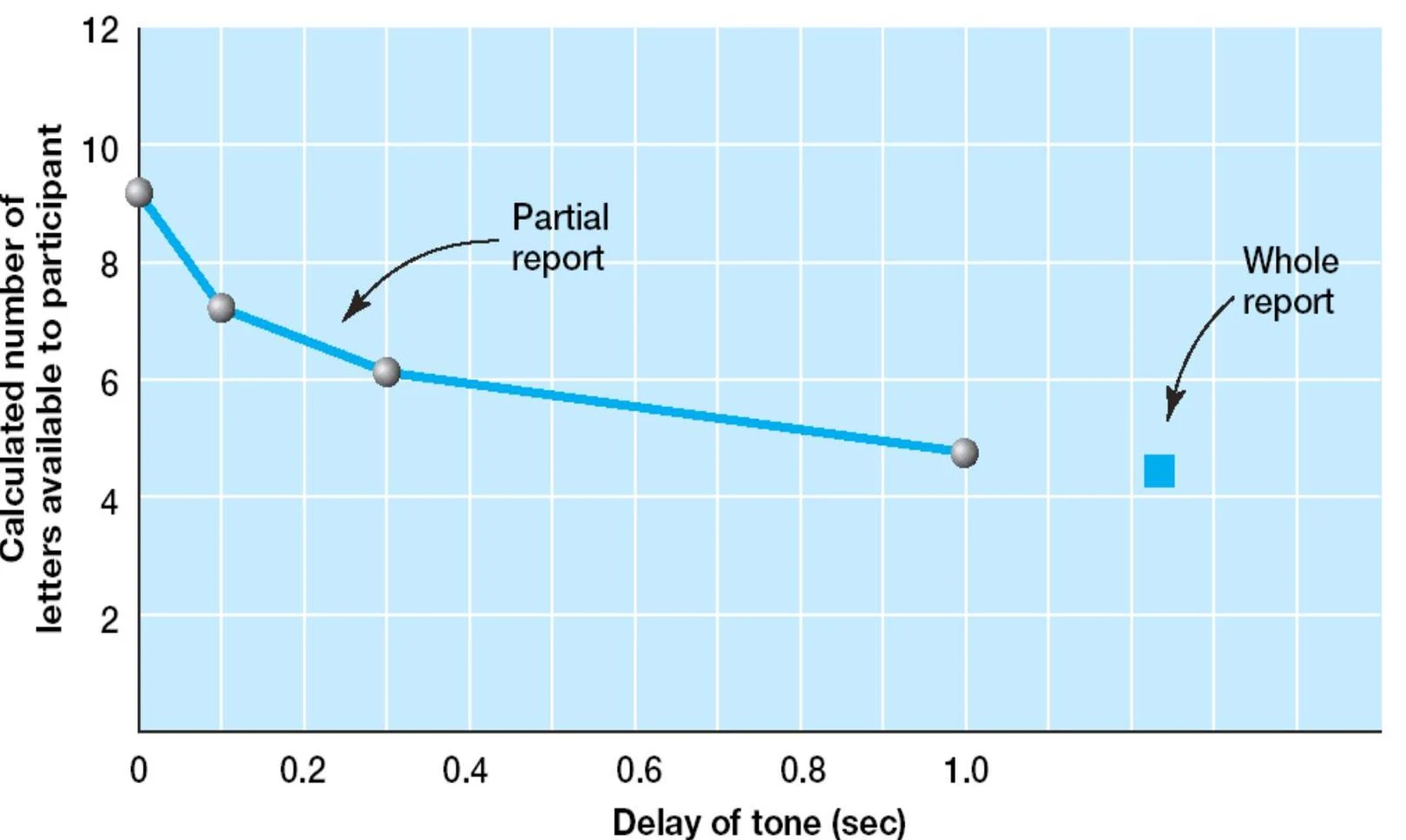
In this condition, participants are asked to recall as many letters from the entire display as possible. Results showed that participants could only recall about 4.5 items on average. Interestingly, subjects often reported seeing more letters than they were actually able to verbalize. This suggested that the information was present, but it vanished before it could be reported.
The Partial Report Method
To see if more information was actually available, Sperling used a "partial report." After the stimulus vanished, a tone (high, medium, or low pitch) would act as a cue to tell the participant which specific row of letters to report.
By using a cue, researchers could demonstrate that the initial capacity of iconic memory is much larger than the whole report suggests. However, the ability to report these items depends heavily on the delay between the stimulus offset and the cue onset.
Findings and Decay Rates
Sperling's results revealed a crucial characteristic of iconic memory: it decays incredibly fast. As the delay between the display and the tone increases, the number of letters correctly reported drops significantly.
This graph illustrates the relationship between the delay of tone and the calculated number of letters available to a participant. The data shows a decrease in available letters as the delay increases, with a distinction made between partial and whole report conditions.
The data showed that sensory information is maintained in the visual system for only a very brief period, with almost complete decay occurring by 800 ms to 1 second. Sperling interpreted this as a "rapidly-decaying visual store".
Summary of Sperling's Interpretation: Iconic memory is decaying (it lasts a short time regardless of input) and visual (it should not depend on information from other modalities).
Echoic Memory and the Modality Effect
While iconic memory deals with vision, echoic memory deals with the auditory modality. Research by Crowder and Morton (1969) suggested that certain auditory phenomena are consequences of echoic memory.
The Serial Position Curve
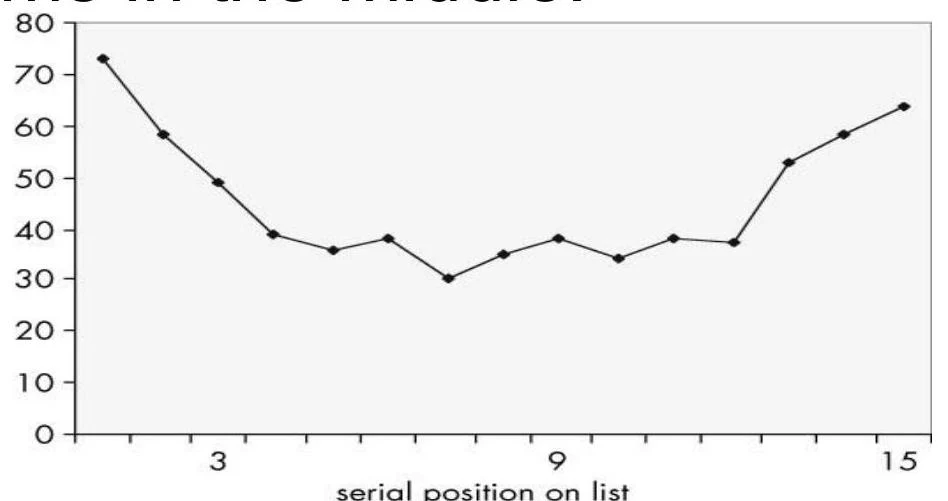
When recalling a series of auditory stimuli, we often see a "U-shaped" curve known as the serial position curve. This includes:
Primacy Effect: An advantage for the items at the beginning of the list.
Recency Effect: An advantage for the items at the end of the list.
A line graph shows a trend where the y-axis represents a value from 0 to 80, and the x-axis is labeled "serial position on list" with markers at 3, 9, and 15. The graph depicts a curve that initially decreases and then increases, suggesting a pattern related to the serial position of items in a list.
Modality and Suffix Effects
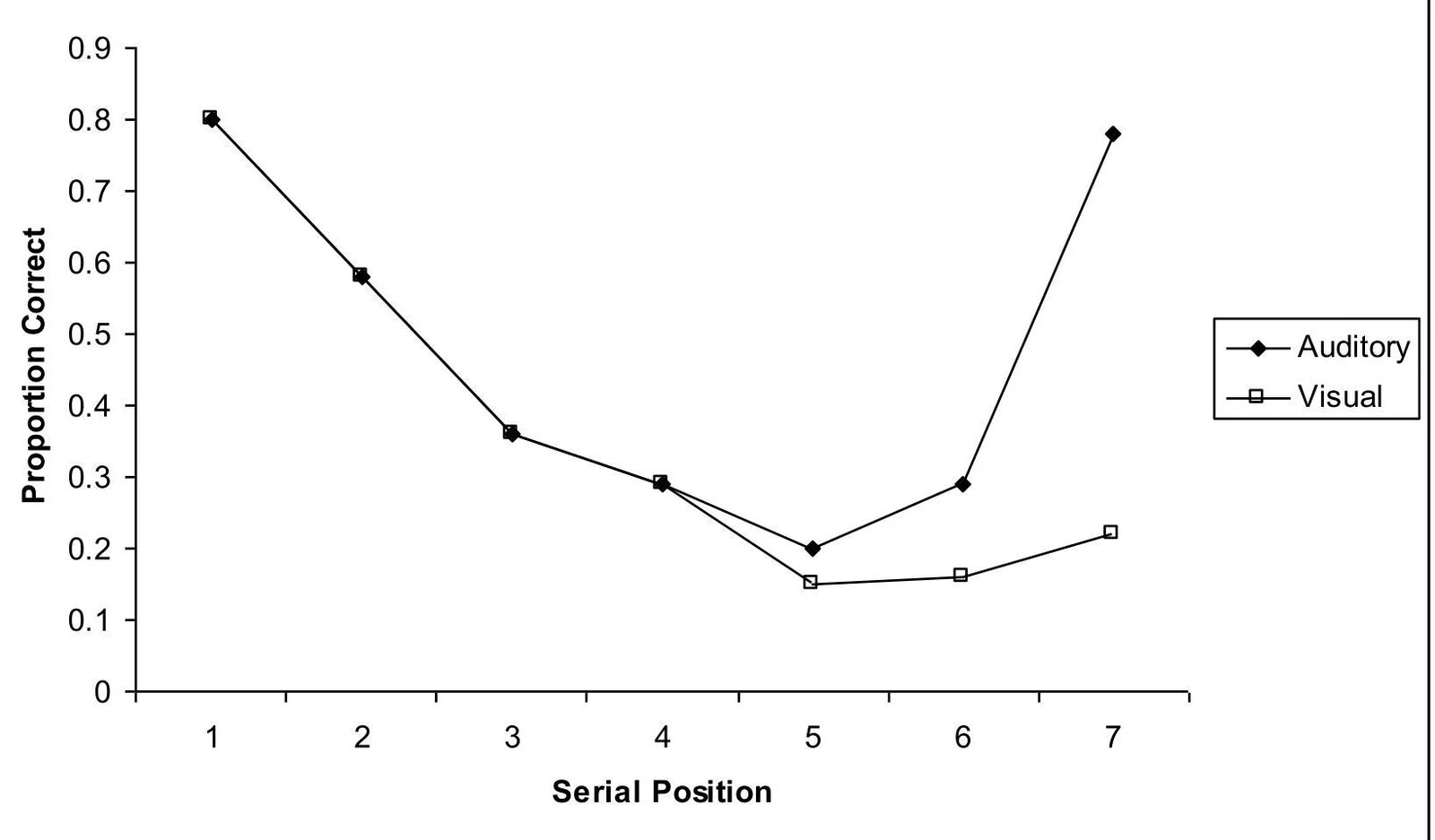
The modality effect refers to changes in the size of the recency effect depending on whether words are seen or heard. For example, recency is often superior when words are read aloud.
A graph showing the proportion of correct responses for auditory and visual stimuli across different serial positions.
Additionally, the suffix effect occurs when extra material (a "suffix") is added to the end of a list. If the suffix is a word that resembles speech (like the word "zero"), the recency effect often disappears. This suggests that the echoic memory trace is subject to interference from new auditory input.
Beyond Memory: Mental Imagery
While sensory memory is a passive trace of a stimulus, mental imagery is the active experience of a sensory impression in the absence of actual sensory input. For example, if you close your eyes and try to "see" an elephant, you are utilizing mental imagery.
Researchers debate two main theories on how these images are represented in the mind:
Depictive Theory: Suggests that mental images are "depictive representations" that preserve the spatial relations of real vision. This is supported by research showing that "mental scanning" takes longer for parts of an image that are spatially further apart.
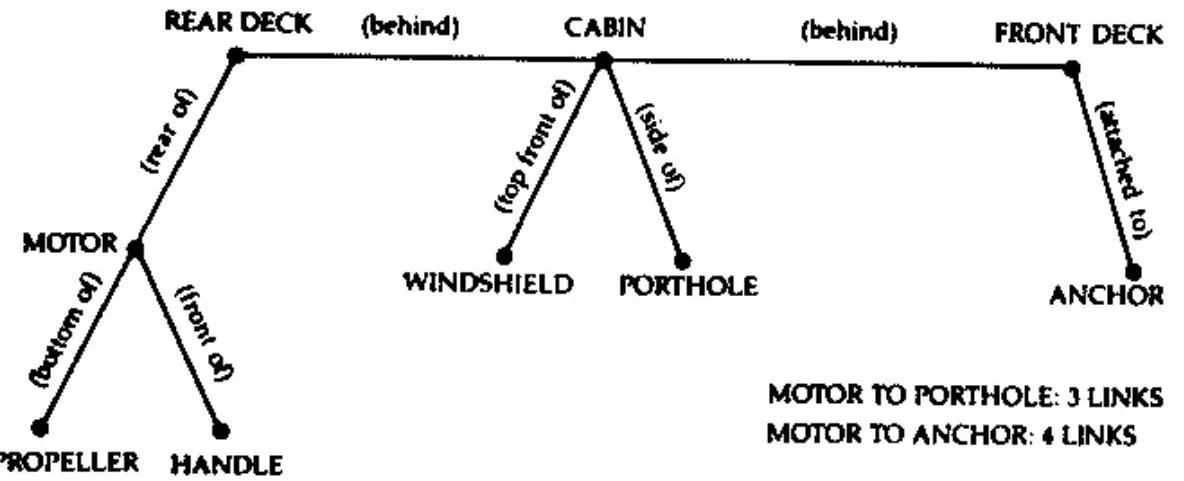
Propositional Theory: Suggests that images are actually stored as abstract "propositions" or relationships between objects (e.g., ON(Ball, Box)). This theory is often favored in computational models of the mind because propositions are easier to program.
A diagram illustrating the components and relationships of a boat, including the motor, decks, cabin, windshield, porthole, propeller, handle, and anchor, with links specified between certain components.
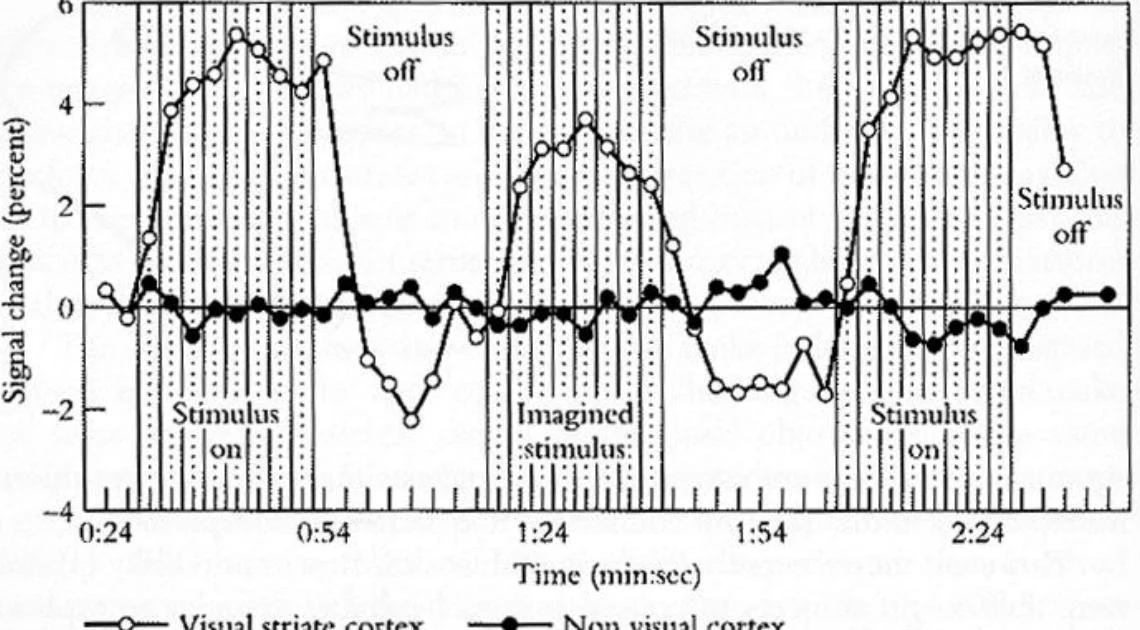
Despite these debates, neuroscientific evidence suggests that imagery is closely linked to actual perception. Studies have shown that imagining a stimulus can trigger increased signal changes in the visual cortex, similar to actually seeing the stimulus.
This graph shows the signal change in the visual striate cortex and non-visual cortex over time during periods of stimulus presentation, imagined stimulus, and stimulus withdrawal.
Keep reading for free.
Create an account to finish this reading and make it part of your study routine.