Explore the fundamental legal and philosophical principle that every right corresponds to a duty, examining its implications for social contracts, legal systems, and human interaction. Learn about positive and negative duties, and how this concept shapes our understanding of justice.
In the study of jurisprudence and moral philosophy, we often speak of "rights" as if they are independent qualities possessed by an individual—something one has, like a talent or a physical attribute. However, a more rigorous analysis reveals that a right cannot exist in a vacuum. For every right held by one person, there is a corresponding obligation or duty imposed upon another. This principle is known as Rights and Duties Correlativity. Understanding this relationship is fundamental to grasping how legal systems, social contracts, and moral frameworks actually function to regulate human interaction.
The Core Concept: The Relational Nature of Rights
At its heart, correlativity suggests that rights are inherently relational rather than absolute. If person A has a right to life, that right is meaningless unless person B (and the state) has a corresponding duty not to infringe upon that life. Without the duty, the "right" is merely a wish or a preference without any social or legal force.
In legal theory, this is often expressed through the distinction between "rights in rem" (rights against the world) and "rights in personam" (rights against a specific individual). Regardless of the type, the logic remains: a right is a claim that triggers a duty.
Key Concept: A right is a "claim-right" if it imposes a duty on others to act or refrain from acting in a certain way.
This diagram illustrates the relationship between rights and duties, showing that Person A, the holder of a right, has the right to receive, claim, or be protected, while Person B, the bearer of duty, owes the duty to respect, fulfill, or not violate that right.
Categorizing Correlative Duties
To understand how this works in practice, we can categorize the duties that arise from various types of rights. Generally, these duties fall into two categories: positive duties and negative duties.
1. Negative Duties (Duties of Forbearance)
A negative duty requires someone to refrain from doing something. Most fundamental human rights are protected by negative duties. For example, your right to privacy creates a negative duty for others to refrain from intruding upon your private affairs.
2. Positive Duties (Duties of Performance)
A positive duty requires someone to act or provide something. For example, if you have a contractual right to receive a service, the other party has a positive duty to perform that service.
Type of Right
Corresponding Duty
Nature of Duty
Right to Property
Duty not to steal/trespass
Negative (Forbearance)
Right to Contractual Payment
Duty to pay the agreed sum
Positive (Performance)
Right to Bodily Integrity
Duty not to cause harm
Negative (Forbearance)
Right to Legal Counsel
Duty of State to provide aid
Positive (Provision)
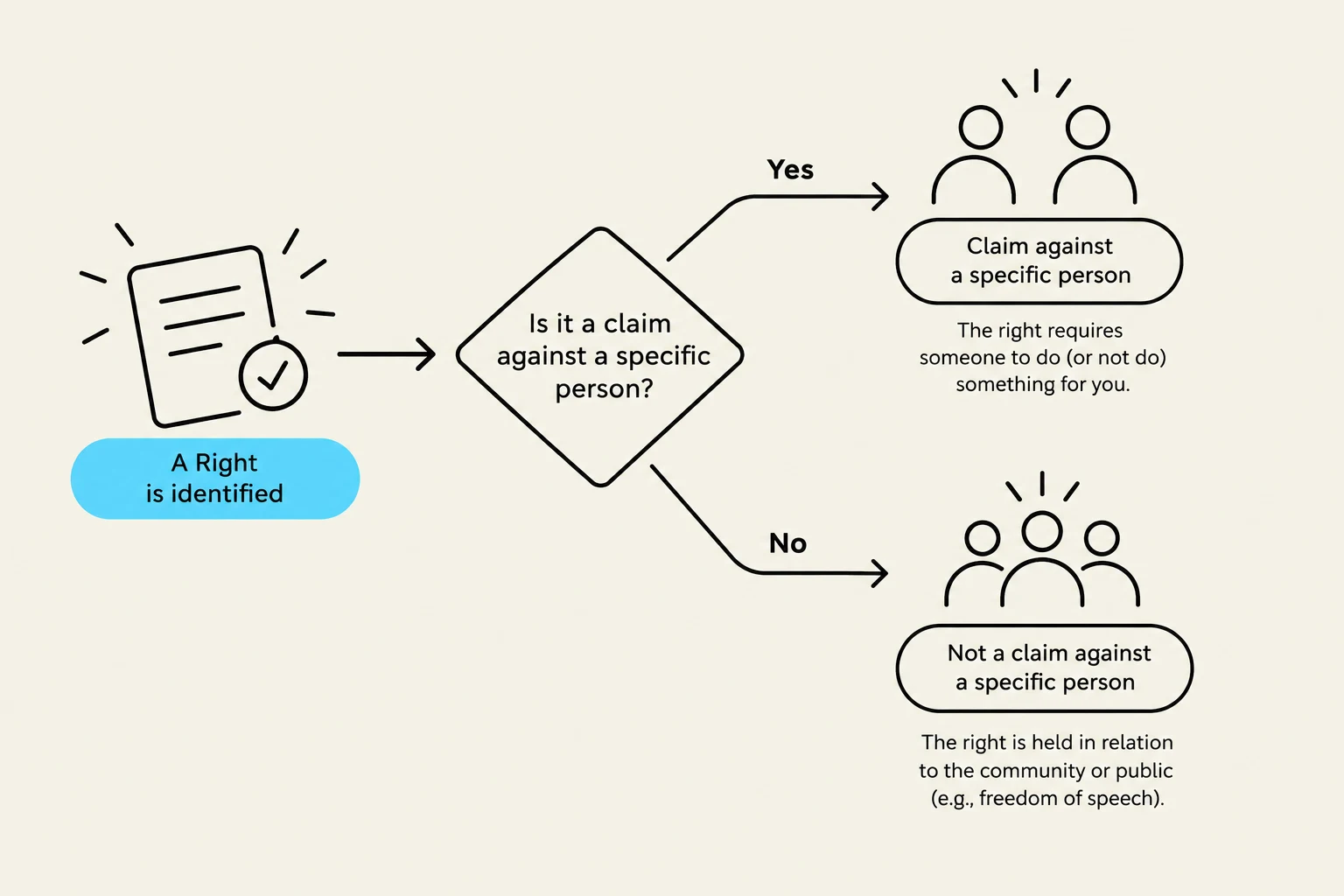
This flowchart illustrates how to distinguish between a claim against a specific person and a claim held in relation to the community or public, using the example of freedom of speech.
The Social Contract Perspective
The concept of correlativity is a cornerstone of Social Contract theory. From this perspective, individuals enter into a societal agreement where they trade certain absolute freedoms for the protection of specific rights.
In this exchange, the "correlativity" is systemic. When you agree to follow the laws of a state, you are accepting a duty. In return, the state assumes the duty to protect your rights. If the state fails to perform its duty (e.g., failing to protect citizens from crime), the correlative balance is broken, often leading to a crisis of legitimacy in the legal or moral framework.
Mathematically, we can think of the stability of a social system (S) as a function of the balance between the sum of rights (R) and the fulfillment of duties (D):
S=i=1∑n(Ri−Di)
Where Di represents the failure to meet the duty corresponding to right Ri. If Di is high, the stability of the system decreases.
Worked Example: The Contractual Relationship
To solidify this concept, let's look at a standard commercial transaction.
Scenario: Alice enters into a contract to buy a laptop from Bob for $1,000.
Alice's Right: Alice has a legal right to receive the laptop.
Bob's Correlative Duty: Bob has a duty to deliver the laptop in the agreed condition.
Bob's Right: Bob has a legal right to receive $1,000.
Alice's Correlative Duty: Alice has a duty to pay the $1,000.
If Alice pays the money but Bob refuses to deliver the laptop, Bob has violated his correlative duty. Because the right and duty are two sides of the same coin, the violation of the duty is simultaneously a violation of Alice's right.
Exam Tip: When analyzing a legal problem, don't just ask "What is the right?" Always follow up with "Who owes the duty, and what is the specific nature of that duty (positive or negative)?" This ensures you capture the full scope of the legal relationship.
Summary of Key Takeaways
Interdependence: Rights and duties are not separate entities but are two aspects of a single relationship.
Relationality: A right is only meaningful if there is a corresponding duty to uphold it.
Directionality: Rights can be negative (requiring others to stop) or positive (requiring others to act).
Systemic Importance: In social and legal structures, the enforcement of duties is what gives substance to the existence of rights.
Keep reading for free.
Create an account to finish this reading and make it part of your study routine.