This content explains the concept of resting membrane potential (RMP) in cells, detailing the relative charge across the cell membrane, the role of ion distribution and gradients (sodium, potassium, proteins), and the mechanisms for maintaining the steady state, such as the sodium-potassium pump. It also covers changes
Every living cell in your body maintains a specific electrical state. If the electrical charge difference across a cell's membrane ever reaches zero, the cell is dead. This fundamental electrical difference is known as the membrane potential. When a cell is not actively sending a signal—such as a neuron during a period of inactivity—this state is referred to as the resting membrane potential (RMP).
The Concept of Relative Charge
The membrane potential is not an absolute measurement of a single side of the cell. Instead, it is a measurement of the difference in electrical charge between the intracellular fluid (the fluid inside the cell) and the extracellular fluid (the fluid outside the cell).
By scientific convention, we always express the potential as the charge of the inside of the cell relative to the outside. This leads to two types of polarity:
Negative Values: A value like −70 mV means the inside of the cell is more negative than the outside.
Positive Values: A positive value would indicate the inside is more positive than the outside.
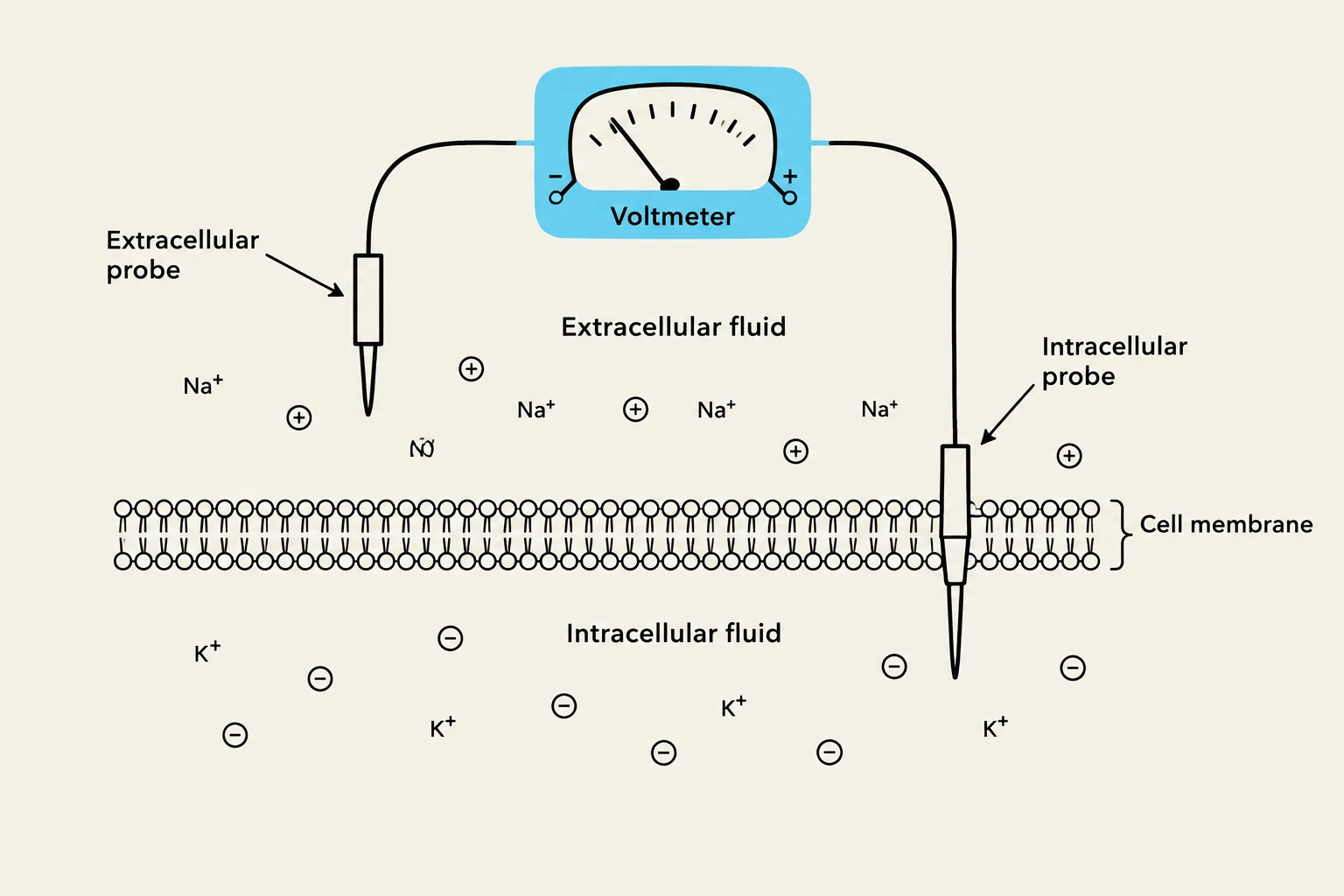
To measure this, researchers use a voltmeter equipped with two probes: one placed inside the cell and one in the extracellular fluid. When the internal probe successfully enters a healthy cell, the voltmeter will show the voltage "dive" from zero down to a negative value.
Diagram illustrating the measurement of membrane potential across a cell membrane using a voltmeter and probes inserted into the extracellular and intracellular fluids. The diagram shows the distribution of ions like Na+ and K+.
Ionic Distribution and Gradients
The membrane potential is created by the unequal distribution of ions (charged particles) across the plasma membrane. While many ions exist on both sides of the membrane, their concentrations differ significantly.
The most important ions to understand are:
Sodium (Na+): Concentrated heavily in the extracellular fluid.
Potassium ($K^+$): Concentrated heavily in the intracellular fluid.
Proteins: Large, negatively charged proteins are trapped inside the cell, contributing to the negative internal charge.
Because these ions are charged, they are subject to two different forces that determine their movement, collectively known as the electrochemical gradient:
Chemical (Concentration) Gradient: Ions naturally want to move from areas of high concentration to low concentration (diffusion).
Electrical Gradient: Opposite charges attract. Since the inside of the cell is negative, positive ions are pulled toward the interior.
Exam Tip: Remember that for most ions, the chemical gradient is much stronger than the electrical gradient. Therefore, ions will generally move in the direction of their concentration gradient.
Maintaining the Steady State
If ions were left to move freely through "leak channels" (protein channels that are always slightly open), the cell would eventually reach equilibrium, and the membrane potential would disappear. To prevent this, the cell uses active transport to maintain its "battery-like" state.
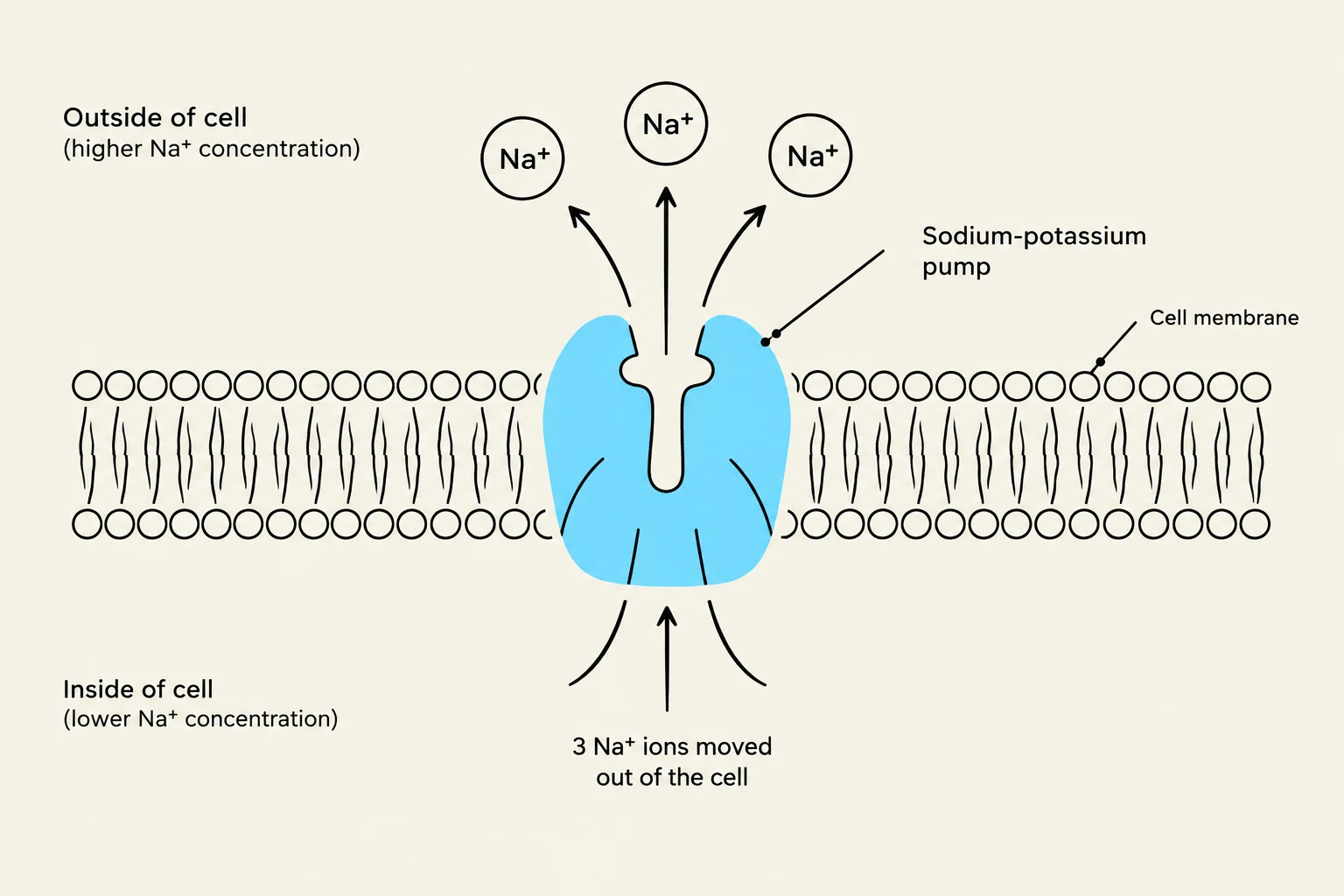
The primary mechanism is the sodium-potassium pump (also known as Na+/K+-ATPase). This pump uses energy in the form of ATP to move ions against their concentration gradients through a process called active transport. Specifically, the pump moves:
Three sodium (Na+) ions out of the cell.
Two potassium ($K^+$) ions into the cell.
Because more positive charge is being pumped out (3) than is being pumped in (2), this process helps maintain the negative charge inside the cell.
Diagram illustrating the sodium-potassium pump actively transporting sodium ions out of a cell across the cell membrane, maintaining concentration gradients.
Excitable Cells and Different Potentials
Not all cells have the same resting potential. Excitable cells are a special category of tissues—primarily neurons and muscle tissues—that can deliberately change their membrane potential to perform a function, such as sending a nerve impulse or contracting a muscle.
Different cell types maintain different baseline values:
Neuron: Approximately −70 mV.
Skeletal muscle: Approximately −90 mV.
Cardiac muscle: Between −60 mV and −90 mV.
Smooth muscle: Approximately −55 mV.
Changing the Potential: Depolarization vs. Hyperpolarization
To initiate activity, an excitable cell must move ions through gated channels (channels that open only in response to a specific stimulus).
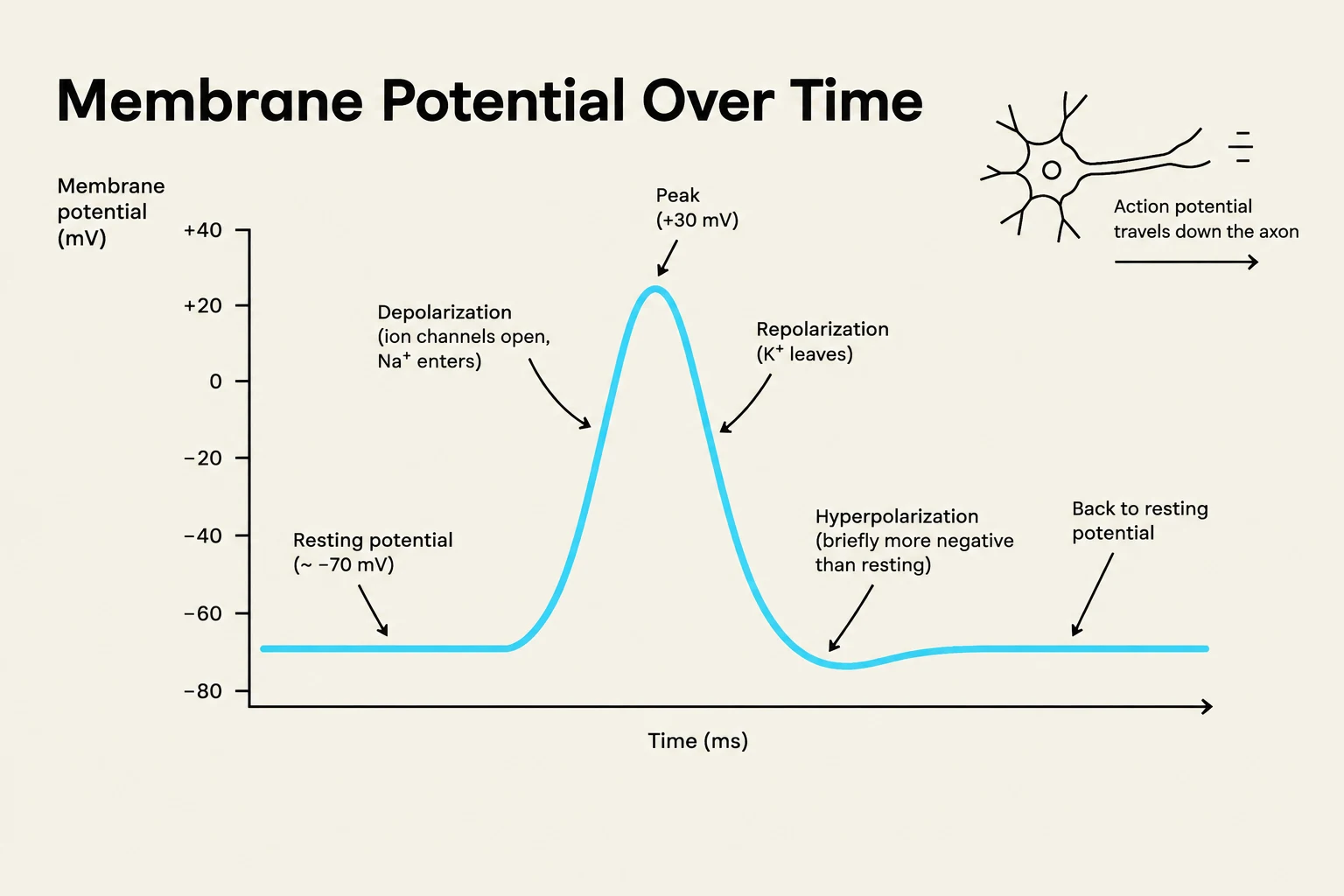
Depolarization: This occurs when the membrane potential becomes more positive (e.g., moving from −70 mV toward 0 mV or above). This is typically caused by opening sodium channels, allowing Na+ to rush into the cell.
Repolarization: This is the process of the membrane potential returning to the resting state from a more positive (depolarized) state.
Hyperpolarization: This occurs when the membrane potential becomes more negative than the resting potential (e.g., moving from −70 mV to −80 mV). This can happen if potassium channels open (allowing $K^+$ to leave the cell) or if chloride channels open (allowing negative $Cl^-$ to enter the cell).
This graph illustrates the changes in membrane potential over time during an action potential, showing phases like resting potential, depolarization, repolarization, and hyperpolarization.
Graded vs. Action Potentials
In excitable cells like neurons, changes in potential can be categorized by how far they travel:
Graded Potentials: These are local changes that only affect a specific part of the membrane. The effect is greatest at the site of the stimulus and weakens as it moves away from the gate.
Action Potentials: These are electrical changes that conduct across the entire membrane of the cell very rapidly.
In a neuron, graded potentials typically occur in the dendrites and the soma (cell body), while action potentials are conducted along the axon.
Summary Table: Ion Movement and Potential
Ion Movement
Charge Change
Effect on Potential
Na+ enters cell
Adds positive charge
Depolarization
$K^+$ leaves cell
Removes positive charge
Hyperpolarization
$Cl^-$ enters cell
Adds negative charge
Hyperpolarization
Ca2+ enters cell
Adds positive charge
Depolarization
Keep reading for free.
Create an account to finish this reading and make it part of your study routine.