An explanation of the principles and features of responsible government in Canada, detailing the relationship between the executive and legislative branches, the dual executive model, and the importance of convention, confidence, and ministerial responsibility.
In the Canadian political landscape, the term "government" often refers specifically to the executive branch—the group of people who administer and implement the laws of the land. However, the way this power is exercised is not defined solely by the written text of the Constitution. Instead, Canada operates under a system of responsible government, a principle characterized by a unique and close relationship between the executive and the legislative branches.
Unlike systems with a strict separation of powers, where the people who make the laws are entirely distinct from those who carry them out, the Canadian system integrates these branches to ensure that those in power remain accountable to the people's representatives.
The Core Features of Responsible Government
Responsible government is built upon three fundamental pillars: the dual executive, the requirement of elected office, and a heavy reliance on convention.
1. The Dual Executive
Canada employs a "dual executive" model, which distinguishes between the person who holds the legal authority and the person who holds the actual political power.
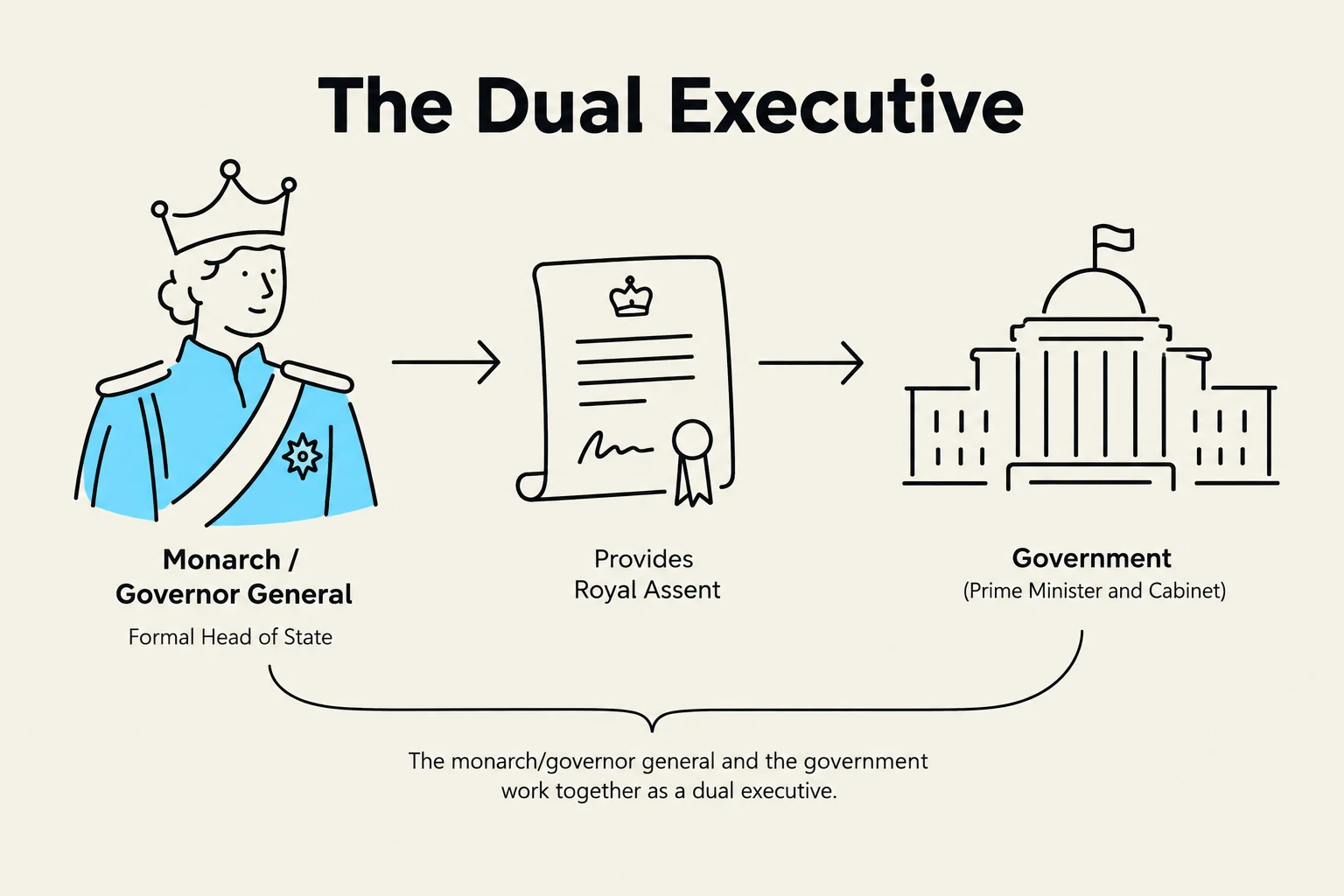
The Formal Head of State: This is the Monarch, who is represented at the federal level by the Governor General and at the provincial level by Lieutenant Governors. While they hold significant ceremonial roles and are responsible for providing Royal Assent to bills to turn them into law, they do not make political decisions independently.
The Political Head of State: This is the Prime Minister at the federal level or the Premier at the provincial level. These individuals are the leaders of the political parties that hold the majority of seats in the legislature and they exercise the actual executive power of the country.
This diagram illustrates the concept of a dual executive, where a monarch or governor general, serving as the formal head of state, works in conjunction with the government (comprising the Prime Minister and Cabinet) to provide royal assent and govern.
2. Elected Office
A key requirement of responsible government is that members of the executive must be part of the legislature. For example, a Member of Parliament (MP) is elected to the House of Commons (the legislative branch) and can then be appointed to the Cabinet (the executive branch). This ensures that the executive is not a separate, untouchable entity, but is composed of individuals who must answer to their constituents.
3. Reliance on Convention
Perhaps the most complex aspect of the Canadian system is its reliance on convention. While the Constitution Act outlines the structure of the House of Commons and the Senate, it says very little about how the executive actually functions in practice.
Much of what we recognize as "government"—such as the vast powers of the Prime Minister or the specific process of appointing ministers—is governed by customary practice or unwritten traditions rather than explicit statutory text.
Exam Tip: When studying, remember that "convention" refers to unwritten, customary practices that are followed as if they were law, even if they aren't explicitly written in the Constitution.
Accountability: Confidence and Responsibility
Because the executive is drawn from the legislature, it must remain "responsible" to that legislature to stay in power. This is managed through two critical concepts: the confidence convention and ministerial responsibility.
The Confidence Convention
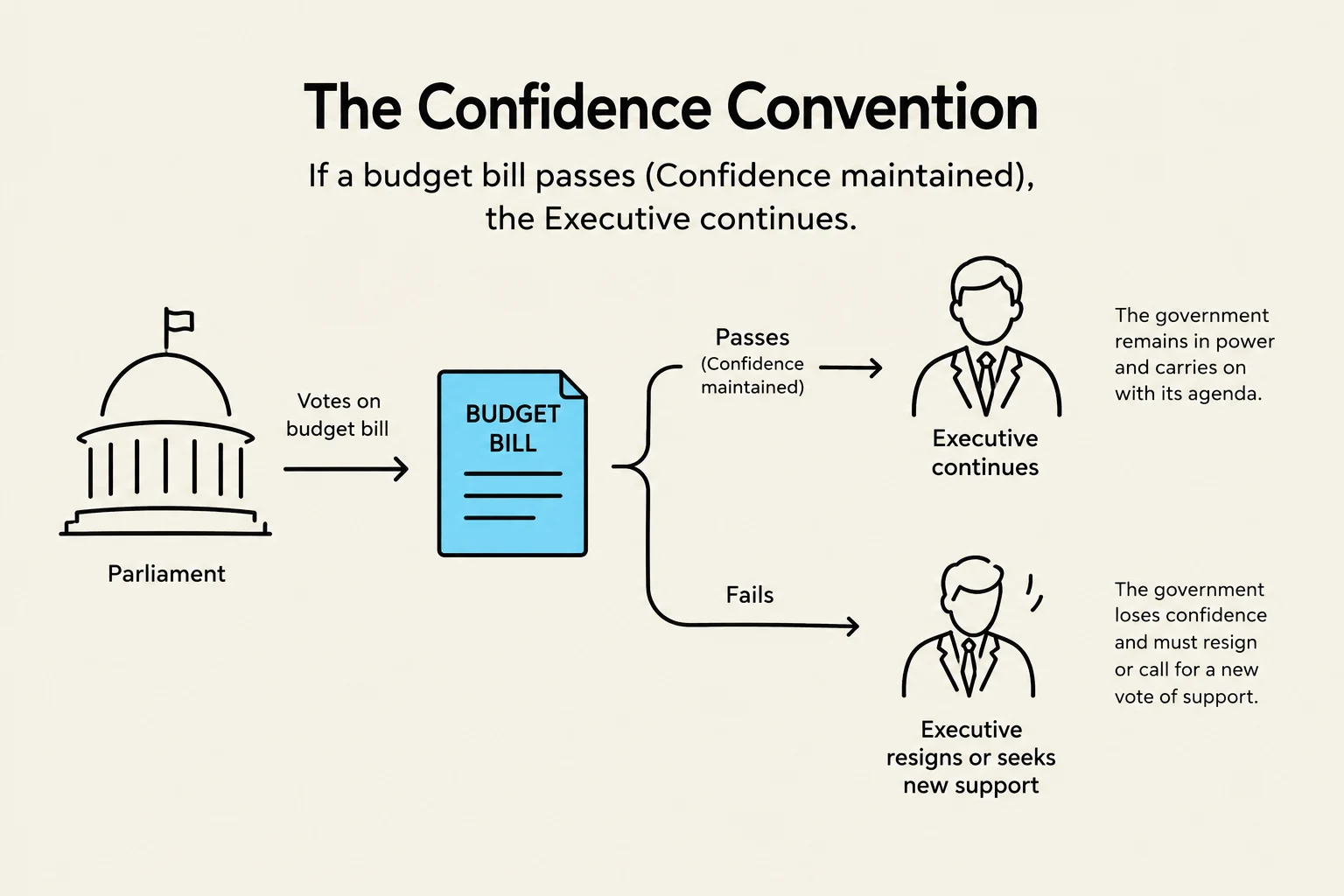
The confidence convention is arguably the most important rule in Canadian politics. It dictates that the executive (the Prime Minister and Cabinet) must maintain the support—or "confidence"—of the majority of the elected members in the legislature.
If the government loses a vote on a major issue, such as a budget bill, it is considered a "loss of confidence". In such an event, the government must either resign or call an election.
Ministerial Responsibility
Under the principle of ministerial responsibility, individual ministers are held accountable for the conduct of their specific departments or "portfolios". A minister is responsible not only for their own personal actions but also for the actions and decisions of the subordinates working within their ministry.
This diagram illustrates the concept of a confidence convention in parliamentary systems, where the executive branch's continuation in power is contingent upon maintaining the confidence of the legislature, often demonstrated through the passage of a budget bill.
Limits on Executive Power
While the executive branch is powerful, its influence is not absolute. There are several legal and constitutional "boxes" that keep executive power in check.
Jurisdiction: Ministers are limited to the specific areas of responsibility assigned to them by law. For example, a Minister of Fisheries cannot exercise authority over matters related to Finance.
The Charter of Rights and Freedoms: The executive cannot implement policies or actions that infringe upon the civil liberties protected by the Charter, which is the supreme law of Canada.
Judicial Independence: There is a strict separation between the executive and the judicial branch. The executive is prohibited from interfering in court proceedings or attempting to influence judges.
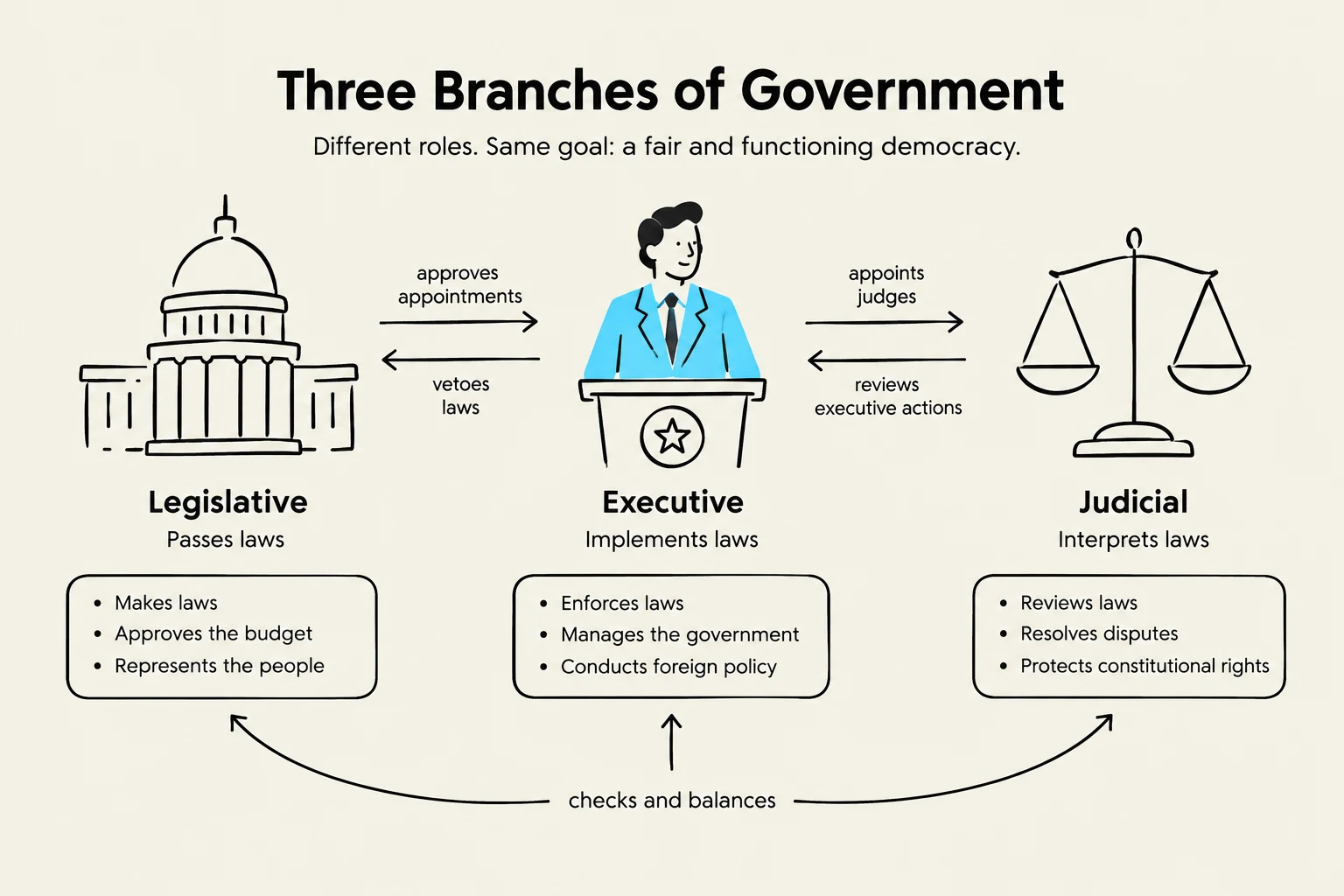
This diagram illustrates the three branches of the U.S. government: Legislative, Executive, and Judicial, along with their respective roles and the system of checks and balances.
Summary Table: The Three Branches
To understand how these concepts interact, it is helpful to view the three branches of the Canadian state together:
Branch
Primary Role
Key Members
Legislative
Proposes, reviews, and passes laws
House of Commons (MPs), Senate
Executive
Administers and implements laws
Prime Minister, Cabinet, Governor General
Judicial
Interprets laws and ensures constitutionality
Judges and the Court system
Study Note: Note the overlap! Members of the Cabinet are members of the Legislative branch (MPs or MPPs) while simultaneously serving in the Executive branch.
Keep reading for free.
Create an account to finish this reading and make it part of your study routine.