Understanding Respiratory Health: History and Social Determinants
A comprehensive guide to assessing respiratory health, focusing on subjective history taking, social determinants of health, environmental factors, and lifespan considerations. Learn to identify risk factors and red flag symptoms for respiratory illnesses.
A comprehensive respiratory assessment begins long before a stethoscope touches the patient's skin. To understand a patient's breathing status, a clinician must look beyond the physical chest wall and investigate the environmental, social, and behavioral factors that shape lung health. By combining an understanding of social determinants with a structured subjective history, healthcare providers can identify high-risk patterns and recognize "red flag" symptoms that require immediate intervention.
Social Determinants and Environmental Risk Factors
Respiratory health is not determined solely by biology; it is deeply influenced by where people live, work, and grow. Socioeconomic and environmental factors play a massive role in the prevalence of respiratory diseases.
Tuberculosis and Population Disparities
Tuberculosis (TB) serves as a primary example of how social determinants impact health. In Canada, the incidence of TB is significantly higher among Indigenous populations—up to 300 times higher than other groups. Furthermore, TB incidence is often highest in western provinces and territories, such as Nunavut. In these remote areas, staff shortages can lead to dangerous delays in diagnosis, isolation, and necessary treatment.
Preventable Risks: Smoke and Air Quality
Two of the most significant preventable risk factors for respiratory illness are tobacco smoke and poor air quality. It is vital to assess for all levels of exposure:
Personal use: Direct smoking of cigarettes, cigars, pipes, or vaping.
Secondhand smoke: Inhaling smoke from others in the home or car.
Thirdhand smoke: Residual nicotine and other chemicals left on indoor surfaces.
Environmental quality: Exposure to mold, wood stoves, or occupational hazards like asbestos, silica, and coal.
Lung Cancer
Lung cancer remains a critical concern for clinicians, as it is the leading cause of cancer death for both males and females.
Conducting a Subjective Respiratory History
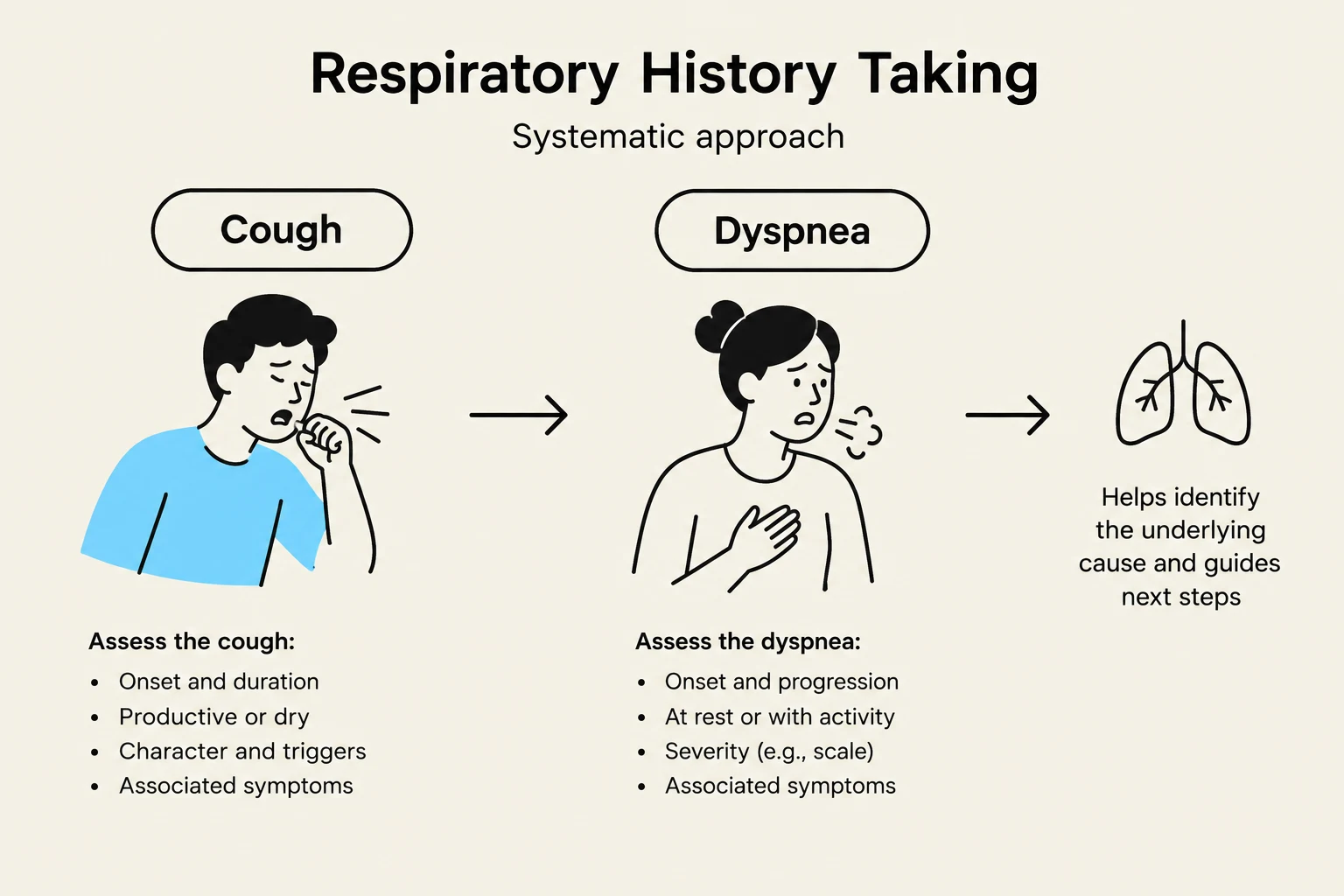
When gathering subjective data, clinicians should use a systematic approach such as OLDCARTS or OPQRSTU to analyze each symptom. The respiratory history is generally organized into seven key areas:
1. Cough Analysis and Sputum Characteristics
A cough can provide immediate diagnostic clues based on its sound and the characteristics of the sputum produced.
Sputum Color
Possible Cause
White or Clear
Colds, bronchitis, or viral infections
Yellow or Green
Bacterial infection
Rust-colored
Tuberculosis (TB) or pneumococcal pneumonia
Pink and Frothy
Pulmonary edema
In addition to color, note if the patient experiences hemoptysis (the coughing up of blood).
2. Dyspnea (Shortness of Breath)
Dyspnea assessment must determine the onset (sudden vs. gradual), triggers (activity, allergens, or position), and how it impacts Activities of Daily Living (ADLs).
Clinical Red Flag: A sudden onset of dyspnea accompanied by chest pain is a medical emergency, potentially indicating a pneumothorax or pulmonary embolism.
Clinicians should specifically ask about:
Orthopnea: Difficulty breathing while lying flat, often requiring the patient to use multiple pillows to sleep.
Paroxysmal Nocturnal Dyspnea (PND): Waking up suddenly at night feeling breathless.
3. Chest Pain with Breathing
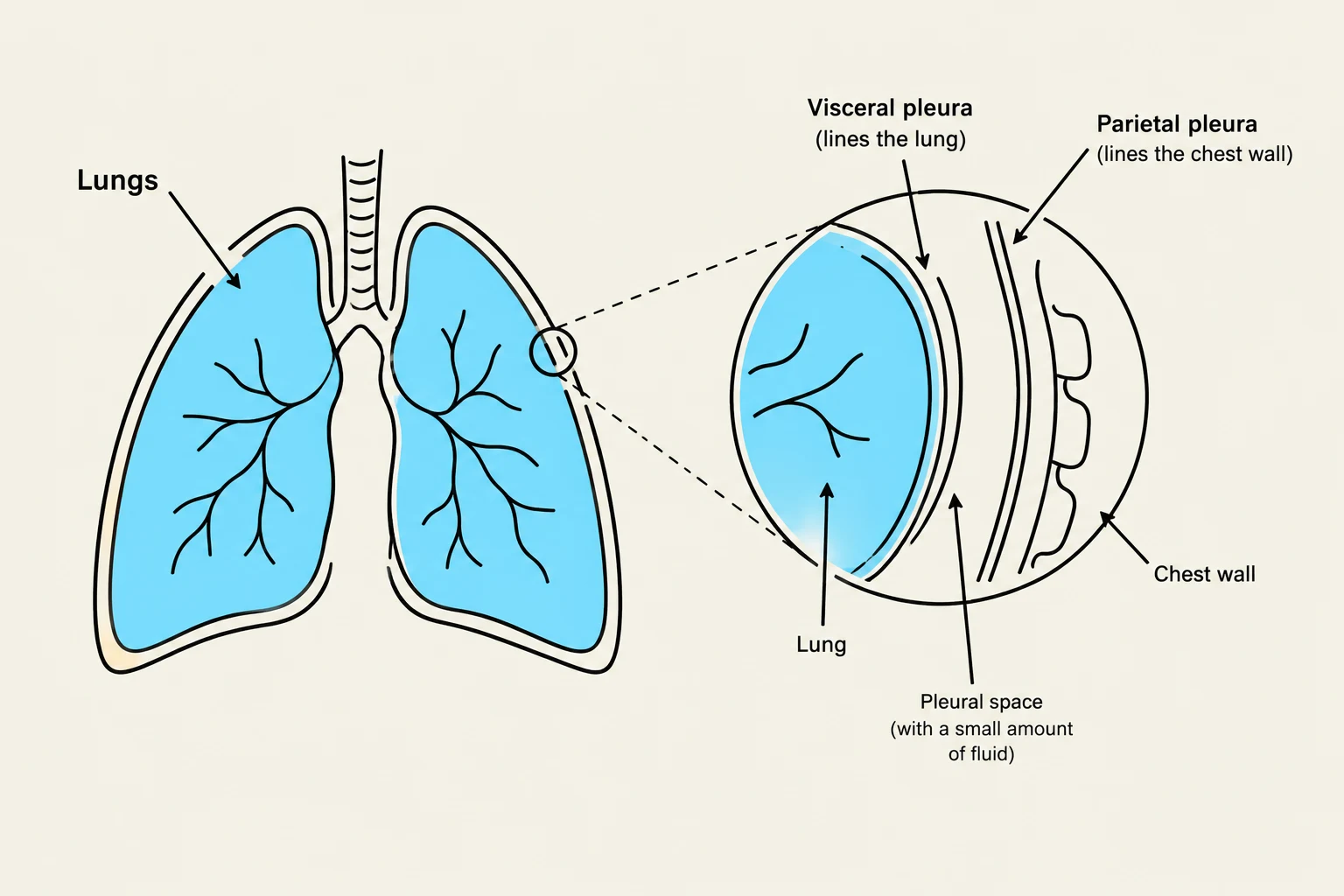
Because lung tissue itself lacks pain fibers, pain experienced during respiration usually originates from the parietal pleura (the lining of the chest wall) or the chest wall muscles/ribs. Always differentiate this from cardiac-related pain.
Diagram illustrating the lungs, visceral pleura, parietal pleura, pleural space, and chest wall.
4. Infection and Immunization History
Review past respiratory illnesses such as pneumonia, asthma, COPD, or TB. It is equally important to verify immunization status for influenza, pneumococcal disease, and COVID-19.
5. Smoking History and Pack-Years
To accurately quantify a patient's smoking history, clinicians calculate pack-years. This provides a standardized measure of cumulative exposure.
Pack-years=packs per day×years smoked
Example: A patient who smoked 2 packs per day for 30 years has a 60 pack-year history.
6. Environmental Exposure
Inquire about occupational risks (e.g., dust, chemicals, asbestos) and home environments (e.g., mold, pets, or wood-burning stoves).
7. Self-Care Behaviors
Assess how the patient manages their respiratory health, including the use of inhalers, oxygen therapy, nebulizers, or CPAP machines.
A diagram illustrating the systematic approach to respiratory history taking, focusing on assessing cough and dyspnea to identify underlying causes and guide next steps.
Lifespan Respiratory Considerations
Respiratory function changes significantly across the human lifespan, requiring clinicians to tailor their assessments.
Infants and Children
The respiratory system is unique because it is the only system that does not function until birth. Children have small, immature airways, making them highly vulnerable to smoke exposure, which can lead to asthma, otitis media, or even SIDS.
Pregnant Individuals
During pregnancy, the growing uterus elevates the diaphragm by approximately 4 cm. While tidal volume increases by 40%, many patients experience "physiologic dyspnea," which does not typically impact their ability to perform daily activities.
Older Adults
The aging lung becomes a more rigid structure. Key changes include:
Decreased Elastic Recoil: Lungs become less distensible.
Muscle Weakness: Respiratory muscle strength declines after age 50.
Reduced Gas Exchange: Loss of alveolar septa reduces the surface area available for oxygenation.
As a result, older adults are at higher risk for shortness of breath during exertion and post-operative complications like atelectasis due to a weaker cough and fewer airway reflexes.
Comparison of a healthy young lung with high alveolar surface area and an older/diseased lung with reduced alveolar surface area, illustrating the impact on gas exchange, oxygenation, and breathing efficiency.
Exam Tip: When assessing an older adult, always ask about changes in their ability to perform Activities of Daily Living (ADLs) and any recent weight changes, as these can be subtle indicators of declining respiratory or cardiac function.
Keep reading for free.
Create an account to finish this reading and make it part of your study routine.