Understanding Research Designs: From Experiments to Correlations
This content explains the different types of research designs used in quantitative research, including true experimental, quasi-experimental, pre-experimental, and non-experimental designs. It covers key concepts like independent and dependent variables, randomization, internal and external validity, and the goals of e
In quantitative research, the design of a study serves as the fundamental blueprint that dictates how data is collected, measured, and analyzed. Whether a researcher aims to describe a phenomenon, predict an outcome, or explain a cause-and-effect relationship, the chosen design determines the strength of the conclusions that can be drawn. Understanding the spectrum of research designs—ranging from highly controlled experiments to descriptive non-experimental observations—is essential for interpreting scientific literature and conducting rigorous investigations.
The Gold Standard: True Experimental Design
When a researcher's primary goal is to establish a definitive cause-and-effect relationship, the true experimental design is the most powerful tool available. These studies are often conducted in highly controlled environments, such as laboratories, to minimize outside interference.
At the heart of a true experiment are two primary components: the independent variable (IV) and the dependent variable (DV). The independent variable is the factor that the researcher manipulates (the "cause"), while the dependent variable is the outcome being measured (the "effect"). To ensure the results are valid, participants are divided into two distinct groups:
Experimental Group: The group that receives the treatment or manipulation.
Control Group: The group that does not receive the treatment, serving as a baseline for comparison.
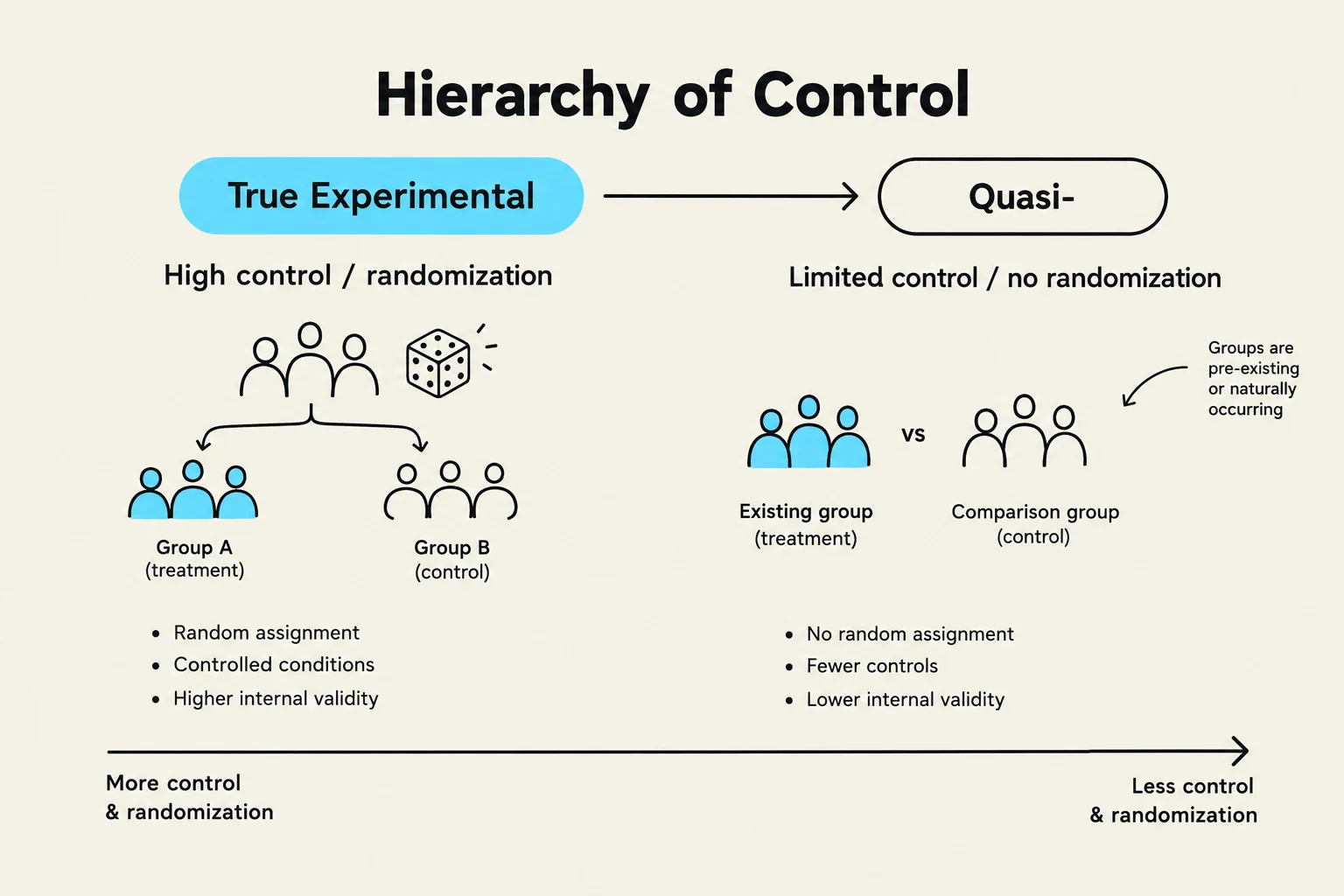
A hallmark of this design is the Randomized Control Trial (RCT). An RCT relies on randomization, the process of assigning participants to groups using pure chance.
Exam Tip: Remember that randomization is not just about picking people; it is about assigning them to groups. Randomization reduces bias by ensuring individual differences (like age or fitness level) are distributed evenly across groups, allowing researchers to claim that the IV actually caused the change in the DV.
This diagram illustrates a randomized controlled trial design, where participants are randomly assigned to either an experimental group receiving a treatment or a control group not receiving the treatment. Outcomes are then measured for both groups.
Validity in Experiments
Researchers must balance two types of validity when designing experiments:
Internal Validity: The degree to which we can confidently say the manipulation of the IV caused the change in the DV, free from confounding variables.
External Validity: The extent to which the findings can be generalized to other populations, settings, or real-world scenarios.
Quasi-Experimental and Pre-Experimental Designs
In many real-world settings, it is impossible or unethical to use full randomization. This leads us to "weaker" or less controlled designs.
Quasi-Experimental Research Design
Quasi-experimental designs are described as being "sort of" experimental. They involve the manipulation of an independent variable and the measurement of a dependent variable, but they lack randomization. Because researchers often study people in natural settings (like a specific classroom or hospital ward), these studies typically have lower internal validity but often boast higher external validity because they reflect real-world conditions.
Pre-Experimental Research Design
Pre-experimental designs are even less controlled and are often used as a "prequel" or precursor to more rigorous RCTs. Common examples include:
One-group post-test design: Measuring a group after a treatment without a baseline or control group.
One-group pre-test/post-test design: Measuring a group before and after a treatment.
While these designs are useful for initial observations, they pose significant challenges to both internal and external validity because there is no way to prove that the change wasn't caused by something other than the treatment.
Pilot and Feasibility Studies
Before committing to a massive, expensive RCT, researchers often conduct smaller studies to test the waters:
Feasibility Study: Used to assess whether a planned study is practical and if the intended elements can actually be executed.
Pilot Study: A small-scale, preliminary version of the main study used to test critical elements and refine the research process.
This diagram illustrates the hierarchy of control in experimental design, differentiating between true experimental and quasi-experimental approaches based on randomization and control levels.
Non-Experimental Research Design
When a researcher is not interested in manipulating variables but rather in observing how they naturally relate to one another, they use non-experimental research design. These designs are characterized by three things: no randomization, no groups to randomize to, and no manipulation of the independent variable.
Instead of proving causation, non-experimental designs are used to report correlations or associations among variables. These studies are often descriptive in nature and can be categorized into two main types:
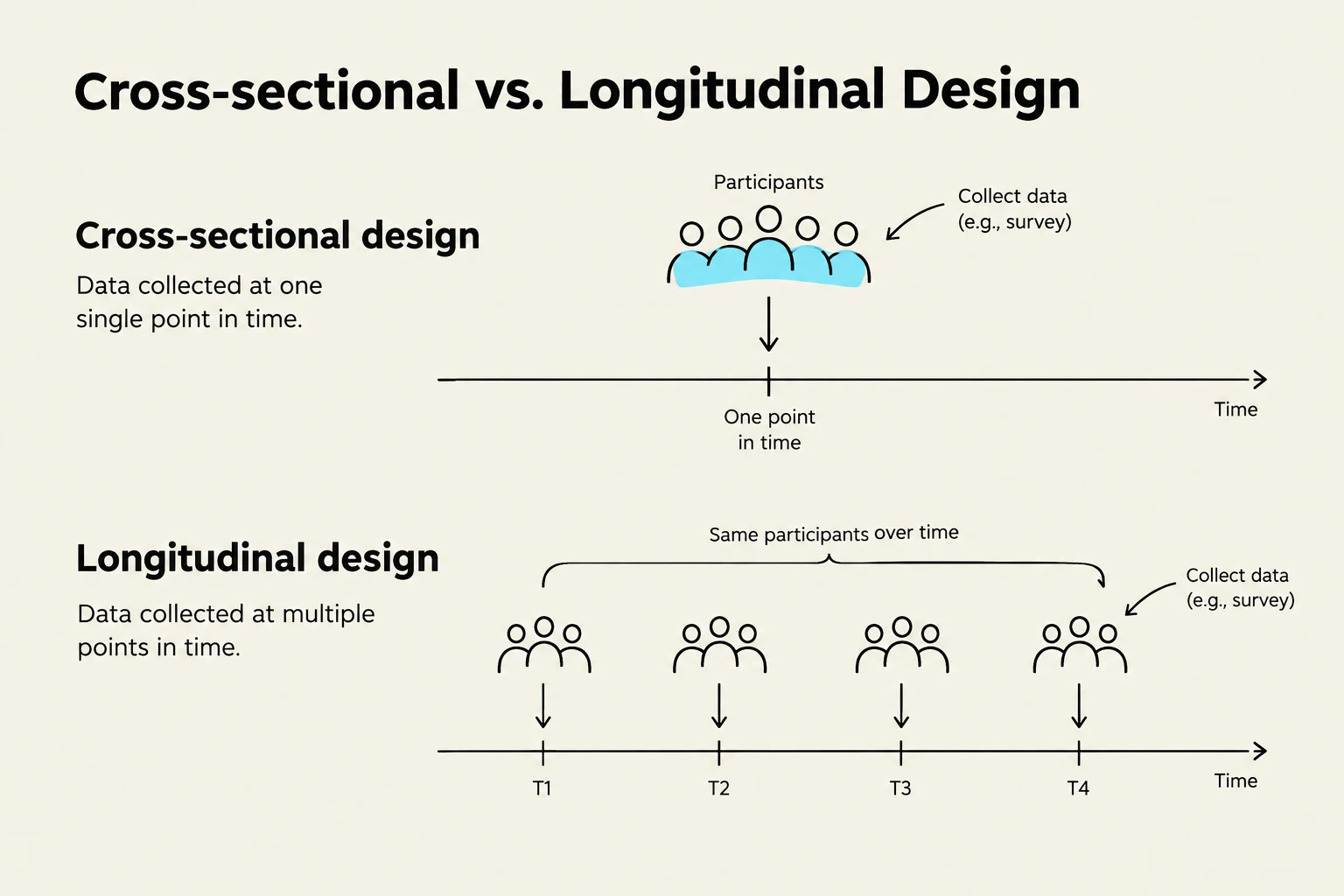
Cross-sectional Studies: These observe a population at a single point in time (a "snapshot").
Longitudinal Studies: These follow the same subjects over an extended period to observe changes over time.
For example, a researcher might use a prospective cohort design to see if there is an association between smoking during pregnancy and the birth weight of offspring. In this case, the researcher isn't making people smoke (which would be unethical); they are simply observing the existing behavior and its outcomes.
This illustration compares cross-sectional and longitudinal research designs, showing how data is collected at a single point in time for the former and over multiple points in time for the latter, using the same participants.
Summary Table: Choosing Your Design
Design Type
Manipulation of IV?
Randomization?
Primary Goal
True Experimental
Yes
Yes
Establish Causation
Quasi-Experimental
Yes
No
Study real-world effects
Pre-Experimental
Yes
No
Preliminary observation
Non-Experimental
No
No
Identify Correlations
Source: Derived from
By selecting the appropriate design, researchers can ensure that their methods align with their purpose, ultimately leading to more credible and impactful scientific discoveries.
Keep reading for free.
Create an account to finish this reading and make it part of your study routine.