Understanding Reliability and Validity in Measurement
This content explains the concepts of reliability and validity in measurement, crucial for evaluating the quality of scientific research. It details different types of reliability (test-retest, inter-rater, internal consistency) and their importance in ensuring stable and consistent results.
In the realm of scientific research, particularly within the psychological and social sciences, the quality of a finding depends entirely on the quality of the measurement used to collect data. If you are trying to measure a person's intelligence, their anxiety levels, or the temperature of a chemical reaction, you must ask one fundamental question: Can I trust these numbers? To answer this, researchers look for reliability and consistency.
Reliability refers to the degree to which a measurement tool produces stable and consistent results across multiple observations. If a scale tells you that you weigh 150 pounds at 9:00 AM, 170 pounds at 9:01 AM, and 130 pounds at 9:02 AM, the scale is not reliable. It is providing "noise" rather than meaningful data. Understanding how to determine if a measurement is stable is a cornerstone of evaluating scientific research.
The Core Concept: Reliability vs. Validity
Before diving into the specific types of reliability, it is crucial to distinguish between reliability and validity. While they are often discussed together, they represent two different aspects of measurement quality.
Reliability is about consistency. Does the tool give the same result every time under the same conditions?
Validity is about accuracy. Does the tool actually measure what it claims to measure?
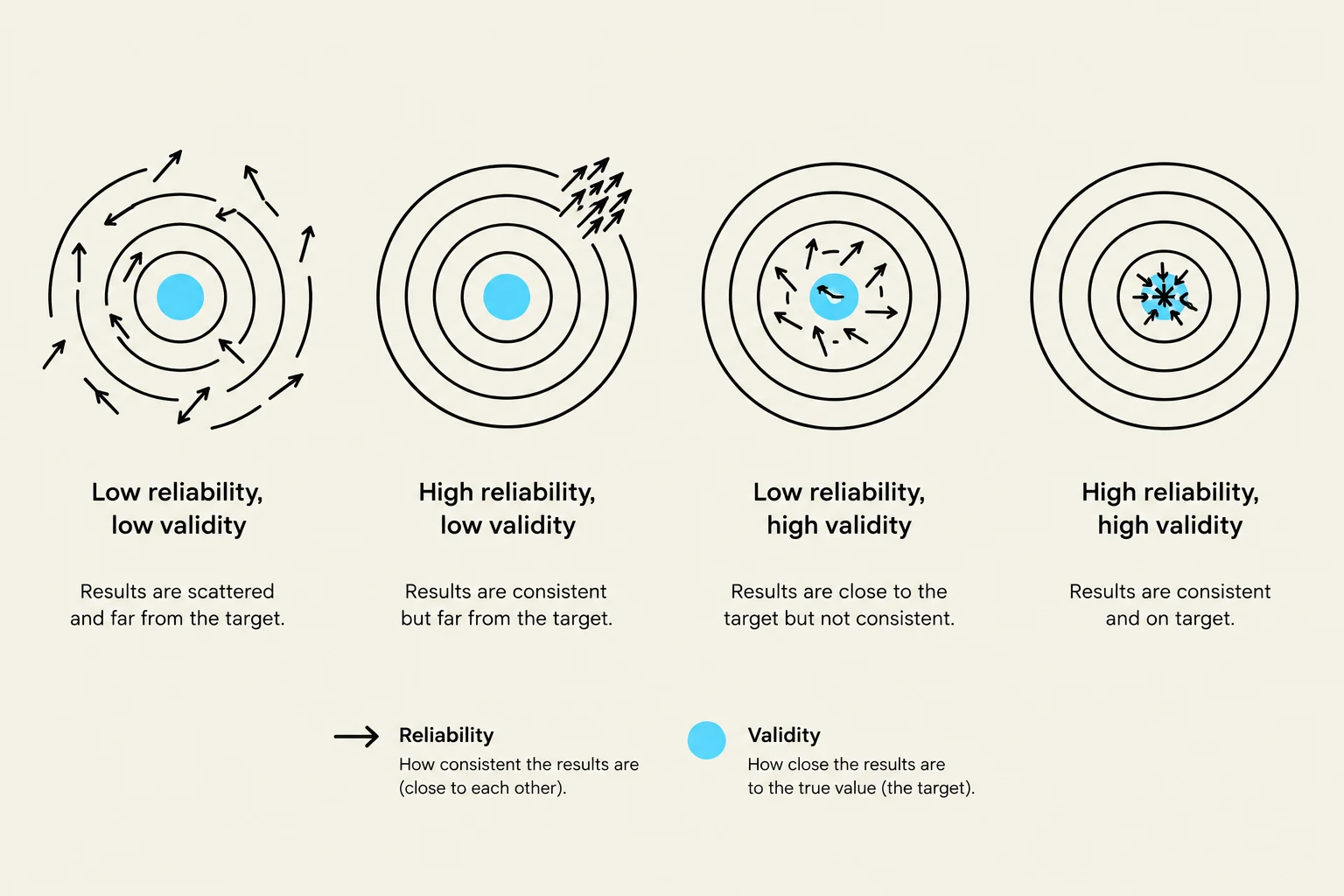
A common way to visualize this is through a target metaphor. If you are shooting arrows at a bullseye:
If all your arrows hit the same spot, but that spot is far from the center, you are reliable but not valid.
If your arrows are scattered all over the target, you are neither reliable nor valid.
If your arrows are tightly clustered in the center, you are both reliable and valid.
Exam Tip: Remember that a measurement can be reliable without being valid, but it cannot be truly valid if it is not reliable. Reliability is a prerequisite for validity.
This diagram illustrates the concepts of reliability and validity using target analogies. It shows four scenarios: low reliability/low validity, high reliability/low validity, low reliability/high validity, and high reliability/high validity, explaining the characteristics of results in each case.
Types of Reliability
Researchers use different methods to test for consistency depending on what aspect of the measurement they are investigating. The three most common types are test-retest reliability, inter-rater reliability, and internal consistency.
1. Test-Retest Reliability
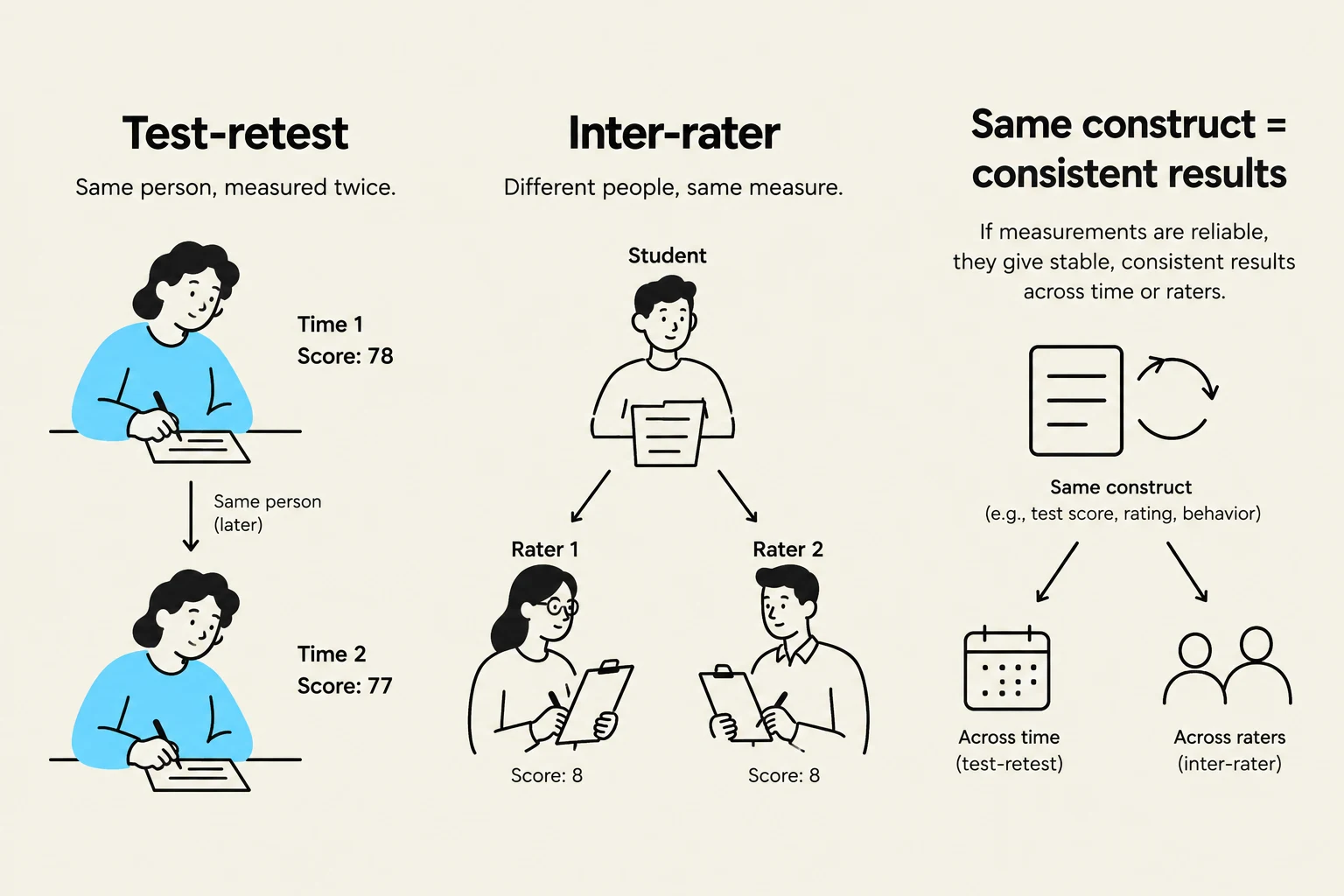
Test-retest reliability measures the stability of a measurement over time. To assess this, a researcher administers the same test to the same group of people at two different points in time. If the scores are highly correlated, the measure is considered stable.
For example, if a student takes an IQ test on Monday and takes the exact same test on Friday, we would expect their scores to be very similar. If the scores vary wildly, the test lacks test-retest reliability.
2. Inter-Rater Reliability
Sometimes, measurement depends on human observation rather than a standardized test. In these cases, we look for inter-rater reliability. This measures the level of agreement between two or more independent observers (raters) who are measuring the same phenomenon.
Imagine two psychologists observing a child in a classroom to count how many times the child interrupts others. If Psychologist A counts 5 interruptions and Psychologist B counts 20, the measurement method lacks inter-rater reliability. High inter-rater reliability ensures that the data is not just a result of one person's subjective bias.
This diagram illustrates different methods for assessing the reliability of measurements: test-retest, inter-rater, and the concept of same construct yielding consistent results.
3. Internal Consistency
Internal consistency looks at how well the individual items within a single test work together to measure a single construct. If you are creating a survey to measure "happiness," all the questions should relate to happiness.
If a survey asks:
"How often do you smile?"
"How much joy do you feel daily?"
"How much do you enjoy your hobbies?"
These items should yield similar patterns of answers. If a respondent answers "very high" to the first two but "very low" to the third, the third item might not be measuring happiness correctly, suggesting low internal consistency for that specific item.
Quantifying Reliability
In professional research, reliability isn't just a "feeling"—it is calculated using statistical coefficients. The most common way to express the relationship between two sets of measurements is through a correlation coefficient, often denoted as r.
The correlation coefficient ranges from −1 to +1:
A value of +1 indicates perfect positive correlation (perfect reliability).
A value of 0 indicates no relationship at all.
A value of −1 indicates perfect negative correlation.
In practice, researchers look for high positive values (e.g., r>0.70 or 0.80) to claim that a measurement is sufficiently reliable.
Summary Table: Reliability Checklist
To help students evaluate research, use the following table to identify which type of reliability is being addressed:
Type of Reliability
What it asks
When to use it
Test-Retest
Is the score stable over time?
When measuring traits that shouldn't change quickly (e.g., personality).
Inter-Rater
Do different observers agree?
When using observations or subjective judgments.
Internal Consistency
Do all parts of the test agree?
When using multi-item scales or surveys.
By ensuring that measurements are both reliable and consistent, scientists can build a foundation of data that is sturdy enough to support meaningful conclusions about the world.
Keep reading for free.
Create an account to finish this reading and make it part of your study routine.