How do we know what we know? In the study of psychology, the answer is rarely a simple "yes" or "no." Instead, researchers look at the quality of our thinking through the lens of rationality. To understand human decision-making, we must distinguish between what we want to do and what is actually true. This distinction forms the foundation of the study of reasoning and judgement.
The Two Faces of Rationality
Cognitive scientists generally divide rationality into two distinct categories: instrumental rationality and epistemic rationality.
Instrumental Rationality (Practical Rationality): This is about "what to do." It focuses on the optimization of goal fulfillment—behaving in a way that uses available resources to achieve your specific desires.
Epistemic Rationality (Theoretical Rationality): This is about "what is true." It concerns how well your internal beliefs map onto the actual structure of the external world.
While these are different, they are deeply interconnected. To take actions that fulfill your goals (instrumental), you must first hold beliefs that are accurately calibrated to reality (epistemic).
Dual-Process Theory: How We Think
To explain why humans often fail to be perfectly rational, psychologists use Dual-Process Theory. This model suggests that our cognition is driven by two different systems with different strengths and weaknesses.
Type 1 Processing: The Fast Lane
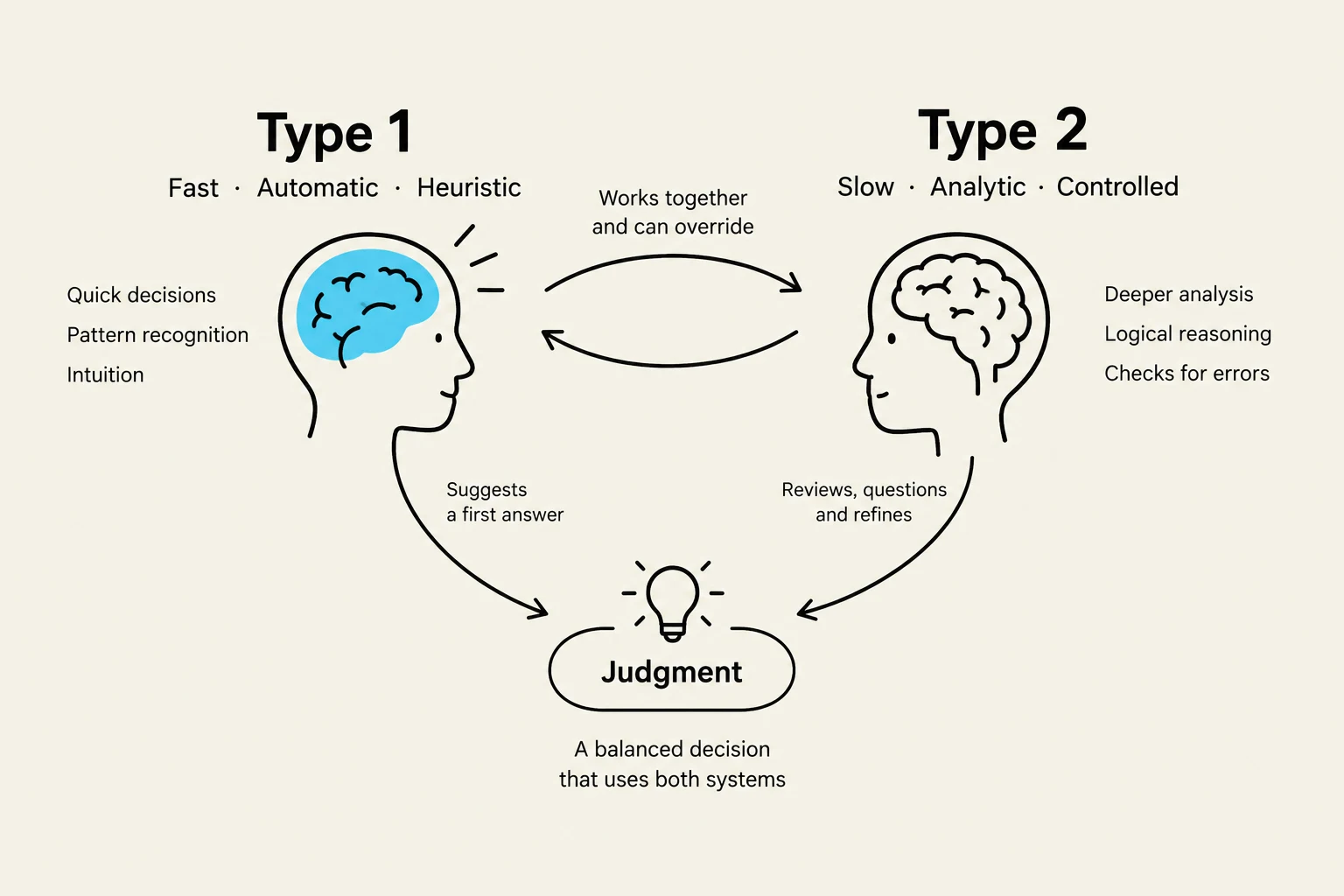
Type 1 processing is automatic, fast, and heuristic-driven. It is often described as "miserly" because it seeks to reduce cognitive load by using mental shortcuts. A common error in Type 1 processing is attribute substitution, where a person replaces a difficult, complex question with an easier one that is correlated with the original. For example, instead of calculating the actual statistical probability of a disease, a person might simply rely on how "vivid" or "salient" a recent news story about that disease was.
Type 2 Processing: The Slow Lane
Type 2 processing is slow, analytic, and computationally expensive. It requires conscious attention and is often language- or rule-based. Its primary evolutionary function is to provide "controlled processing" that can override erroneous Type 1 responses.
This diagram illustrates the two types of thinking: Type 1 (fast, automatic, heuristic) and Type 2 (slow, analytic, controlled). Type 1 suggests a first answer based on quick decisions, pattern recognition, and intuition. Type 2 reviews, questions, and refines the answer through deeper analysis, logical reasoning, and error checks. Both systems work together and can override each other to form a balanced decision, represented by 'Judgment'.
Exam Tip: When asked about the difference between the two processes, remember that Type 1 is "automatic and parallel" (many things can happen at once), while Type 2 is "serial and limited" (you can only focus on a few things at a time).
Heuristics, Biases, and Calibration Errors
When Type 1 processes dominate, we often fall prey to systematic errors known as heuristics and biases.
Knowledge Calibration and Overconfidence
Probabilistic calibration is the measure of how accurately a person's subjective confidence matches their actual accuracy. A well-calibrated person knows the limits of their knowledge. However, humans frequently suffer from the overconfidence effect. This often happens because we fixate on a "focal hypothesis"—the first answer that comes to mind—and then ignore alternative possibilities to save mental energy.
Common Reasoning Fallacies
The Gambler’s Fallacy: The mistaken belief that independent events are linked (e.g., thinking a coin is "due" to land on heads because it has landed on tails five times in a row).
The Planning Fallacy: The tendency to underestimate the time and resources required to complete future tasks.
The Conjunction Fallacy: The error of believing that a specific combination of events is more likely than a single, more general event.
The Logic of Falsification
A major hurdle in human reasoning is our tendency to seek confirmation rather than challenge our beliefs. This is famously demonstrated in the four-card selection task.
In this task, participants are given a rule: "If a card has a vowel on one side, then it has an even number on the other." Most people incorrectly choose cards that would confirm the rule (like a vowel or an even number). However, to truly test the rule using the falsifiability principle, one must look for the case that would prove the rule false: the P∧¬Q case (a vowel paired with an odd number).
Deontic vs. Indicative Reasoning
Why do we struggle with this? The answer may lie in the type of rule being presented.
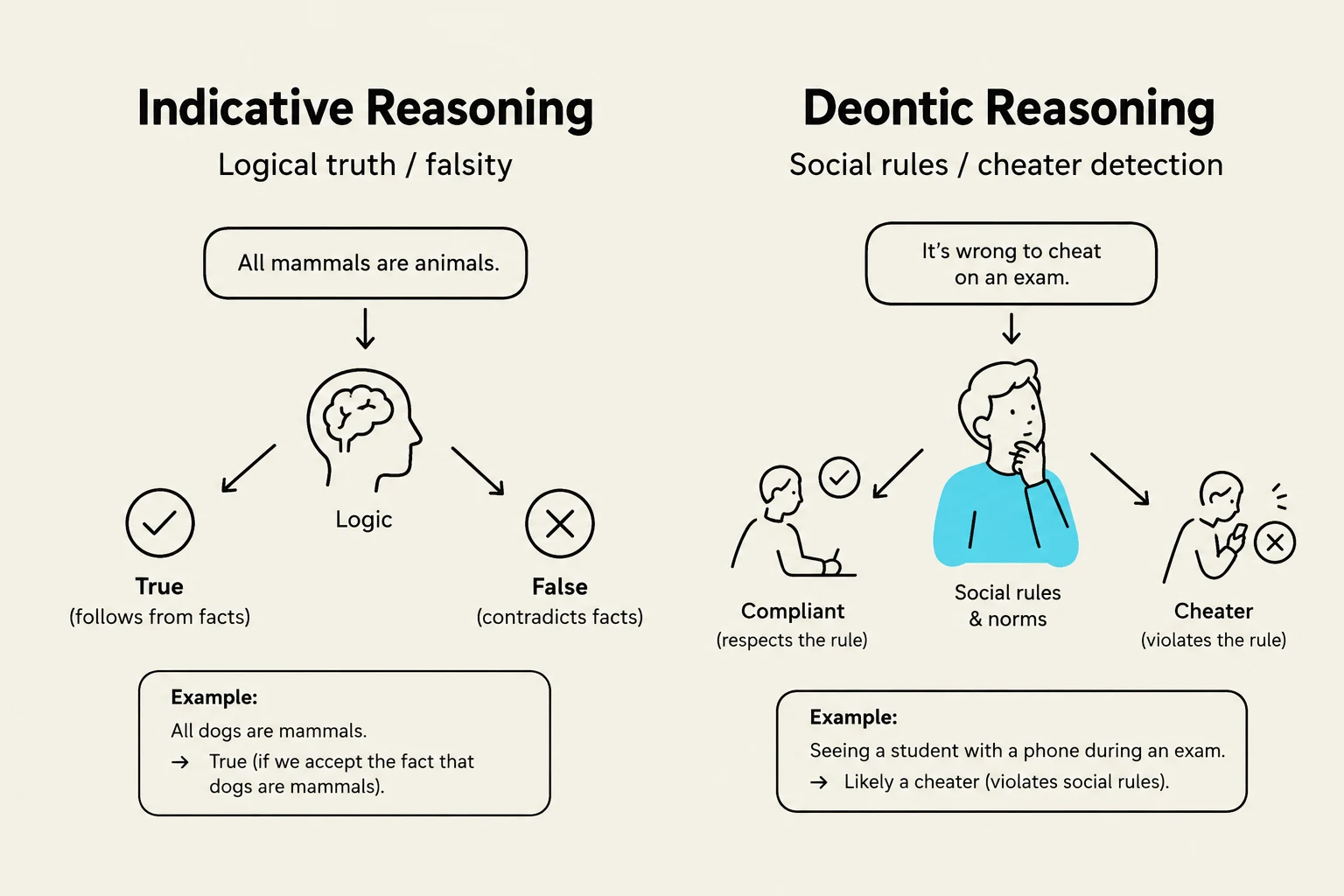
Indicative Rules concern logical facts about the world.
Deontic Rules concern social or moral "oughts" (e.g., "If you are underage, you must not drink").
Research suggests that humans are much better at "cheater detection"—a deontic reasoning skill evolved for social survival—than they are at abstract logical falsification.
This illustration contrasts Indicative Reasoning, which deals with logical truth and falsity based on facts, with Deontic Reasoning, which concerns social rules and the detection of rule violations.
Mathematical Precision: Bayes' Theorem
To move beyond "guesstimates" and achieve true epistemic rationality, we must use probability calculus. The gold standard for belief updating—adjusting our confidence in a hypothesis based on new data—is Bayes' Theorem.
The formula for updating the probability of a hypothesis (H) given new data (D) is:
P(H∣D)=P(H)×P(D∣H)+P(¬H)×P(D∣¬H)P(H)×P(D∣H)
A critical error in human judgment is the failure to consider the denominator's second term: P(D∣¬H)—the probability of the evidence occurring if the alternative hypothesis were true. If you ignore the alternative, you ignore the "base rate," leading to massive errors in clinical or scientific judgment.
Can We Learn to be Rational?
If humans are naturally biased, can education fix it? This touches on the formal discipline hypothesis: the idea that learning abstract rules in one subject can improve reasoning in everyday life.
Research suggests a qualified formal discipline hypothesis. While education can improve specific skills—such as statistical reasoning (understanding base rates), methodological reasoning (recognizing bias), or conditional reasoning (if-then logic)—these improvements are often context-specific. You might become a better statistician without necessarily becoming a better logical thinker in social situations.
This diagram illustrates Bayes' Rule, a fundamental concept in probability theory. It shows how to update a prior belief (initial probability) with new evidence to arrive at an updated belief (posterior probability) using a mathematical formula.
Summary Table: Reasoning Skills
Reasoning Type
Focus Area
Key Challenge
Statistical
Sample size, base rates, variability
Ignoring base rates
Methodological
Research design, control groups, bias
Failing to see confounds
Conditional
If-then logic, falsification
Seeking confirmation only
Keep reading for free.
Create an account to finish this reading and make it part of your study routine.