In the study of motor learning, we often focus on the elegance of a finished movement—the perfect tennis serve or the precise strike of a soccer ball. However, before any physical grace can be displayed, the brain must undergo a rapid-fire sequence of cognitive events. This sequence is known as reaction time. Understanding the distinction between the mental processing of a stimulus and the physical execution of a movement is fundamental for coaches, therapists, and athletes aiming to optimize performance.
Reaction Time vs. Movement Time
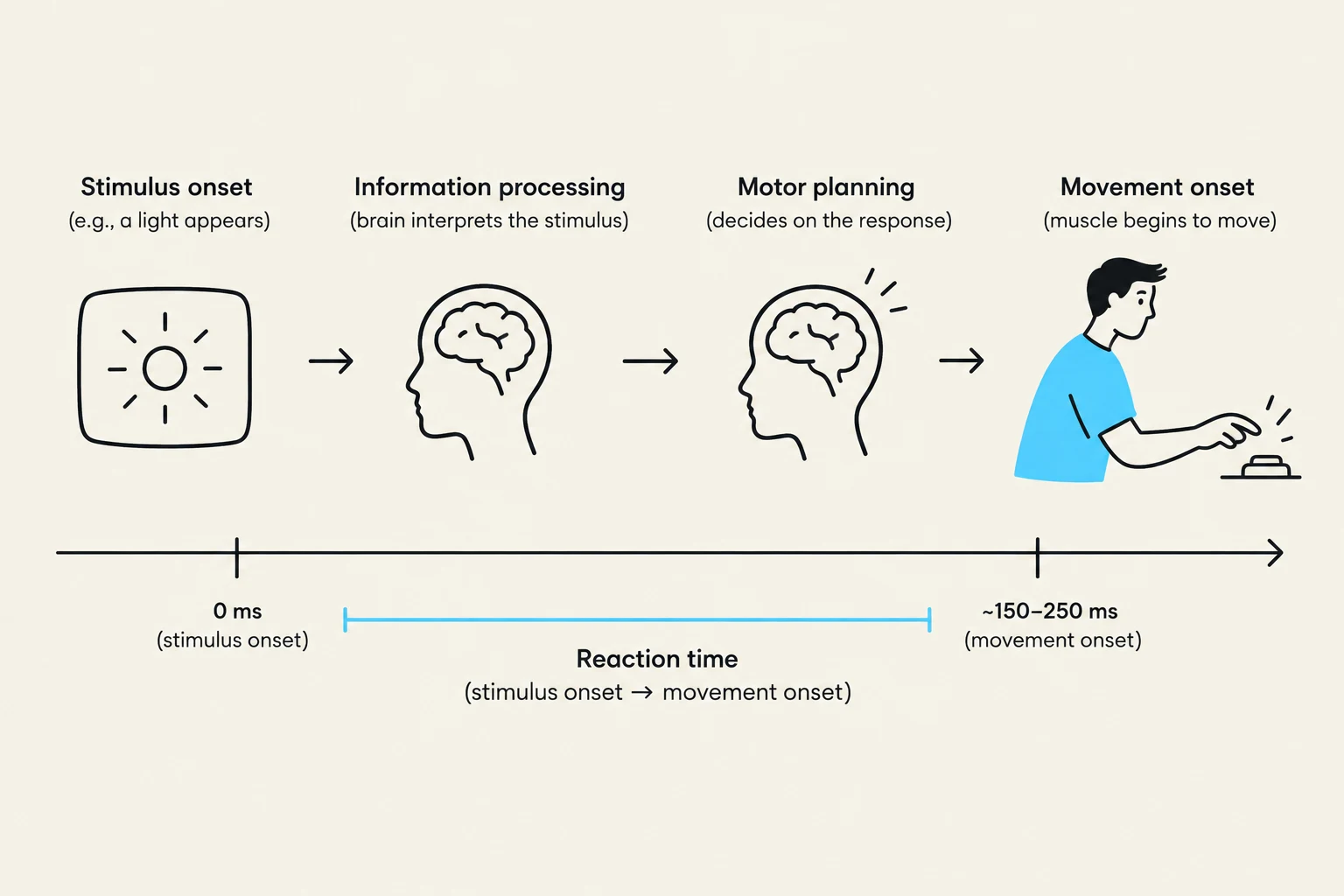
To understand how quickly an individual responds, we must first distinguish between two distinct temporal components: reaction time and movement time. Reaction time is the interval between the onset of a stimulus (such as a starting whistle or a visual cue) and the very first moment of physical movement. In contrast, movement time is the duration from the start of that movement until it is completed.
When we combine these two, we arrive at the total response time:
Response Time=Reaction Time+Movement Time
This distinction is vital for diagnostic purposes. If an athlete is slow to respond to a cue, a practitioner must determine if the delay is occurring in the "mind" (slow decision-making) or in the "muscles" (slow execution or coordination).
This diagram illustrates the stages of reaction time, from stimulus onset to movement onset, including information processing and motor planning.
Exam Tip: If a question asks why a sprinter might be penalized for a false start, remember that human physiology has limits. A reaction time of less than 100 milliseconds is often considered biologically impossible for a human to respond to an external sound, as it suggests the athlete anticipated the stimulus rather than reacting to it.
The Three Stages of Information Processing
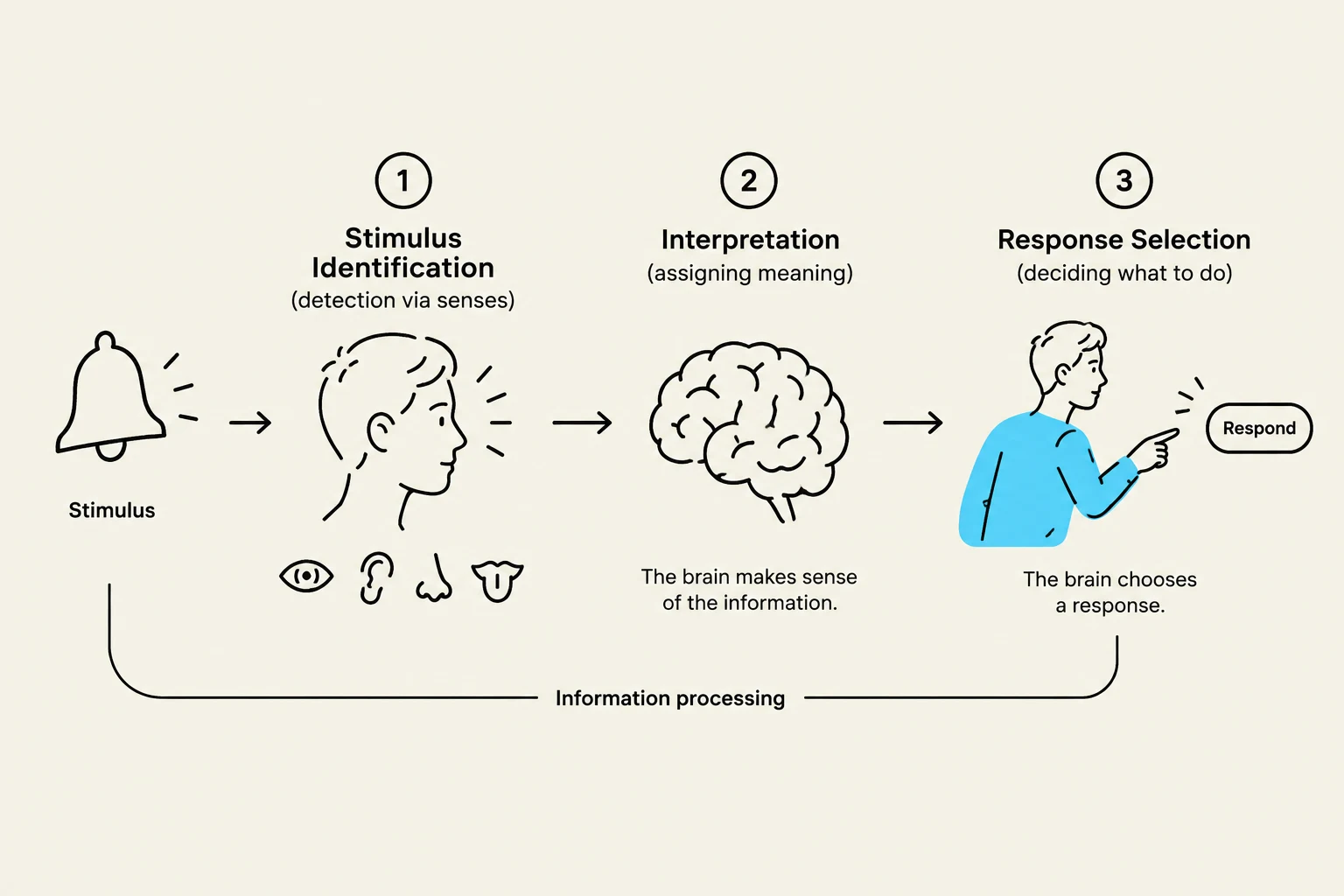
The cognitive journey from perceiving a stimulus to initiating a movement follows a structured three-stage model:
1. Stimulus Identification
This is the detection and recognition phase. The individual uses sensory inputs—visual, auditory, tactile, or proprioception (the sense of joint position in space)—to identify what is happening. For example, a goalkeeper uses a visual search task to scan a striker's hip angle and foot placement to identify cues about where the ball might be kicked. Experts often excel here because they can identify meaningful patterns in "noise" much earlier than novices.
2. Response Selection
Once the stimulus is identified, the brain must decide what to do. This is the decision-making phase where the individual chooses a specific action from a set of available options. In a basketball game, this might mean deciding whether to pass, shoot, or dribble based on the position of a defender.
3. Response/Movement Programming
The final cognitive stage involves the organization and retrieval of motor commands. The brain must "program" the necessary muscle activations and joint movements. This stage is significantly longer for complex movements that involve more joints and muscles, as the brain must coordinate a larger assembly of commands.
This diagram illustrates the process of information processing, starting with stimulus identification, followed by interpretation, and concluding with response selection.
Factors Influencing Reaction Time
Several variables can accelerate or hinder the speed of the information processing stages described above.
Hick’s Law and the Number of Alternatives
One of the most critical principles in reaction time is Hick’s Law, which states that reaction time increases in proportion to the number of stimulus-response alternatives. As the number of choices increases, the time required for response selection also increases. Interestingly, this relationship is not linear but logarithmic; doubling the number of choices does not necessarily double the reaction time, but it still results in a predictable delay.
Stimulus-Response Compatibility
Efficiency is heavily influenced by how logically a stimulus is linked to a response. This is known as stimulus-response compatibility. If a light appears on the left side of a panel and the required response is to press a button on the left, the reaction will be fast because the mapping is natural and spatial. However, if the mapping is arbitrary—such as having to turn a bicycle handle left to make the bike turn right—the decision-making process is slowed because the brain must override natural expectations.
Practice, Experience, and Anticipation
Repeated practice allows for the storage of motor programs in long-term memory, which reduces the time needed for the programming stage. Furthermore, experience enables anticipation—the ability to predict environmental changes before they occur.
An experienced goalkeeper does not just react to the ball; they anticipate its trajectory by reading the striker's body language. While successful anticipation reduces response time and provides a competitive advantage, it carries a high cost: if the anticipation is incorrect, the performer may commit to a movement that is entirely wrong, leading to significant errors.
Clinical Application: In rehabilitation settings, practitioners often use these principles to manage cognitive load. By starting with fewer choices (reducing alternatives) and ensuring high stimulus-response compatibility, they can help patients successfully learn new movements without overwhelming their processing capacity.
Keep reading for free.
Create an account to finish this reading and make it part of your study routine.