Understanding Rationality in Judgment and Decision Making
An exploration of instrumental and epistemic rationality, normative vs. descriptive models, the Great Rationality Debate (Meliorists vs. Pangossians), dual-process theory, and probabilistic reasoning with Bayes' Rule.
What does it mean to be "rational"? In common conversation, we often use the term to describe someone who is logical or calm. However, in the field of psychology, rationality is a precise scientific construct used to study how humans process information to make decisions and form beliefs. The study of judgment and decision making investigates the cognitive processes that allow us to navigate the world, exploring whether our mental shortcuts help us or lead us astray.
The Two Pillars of Rationality
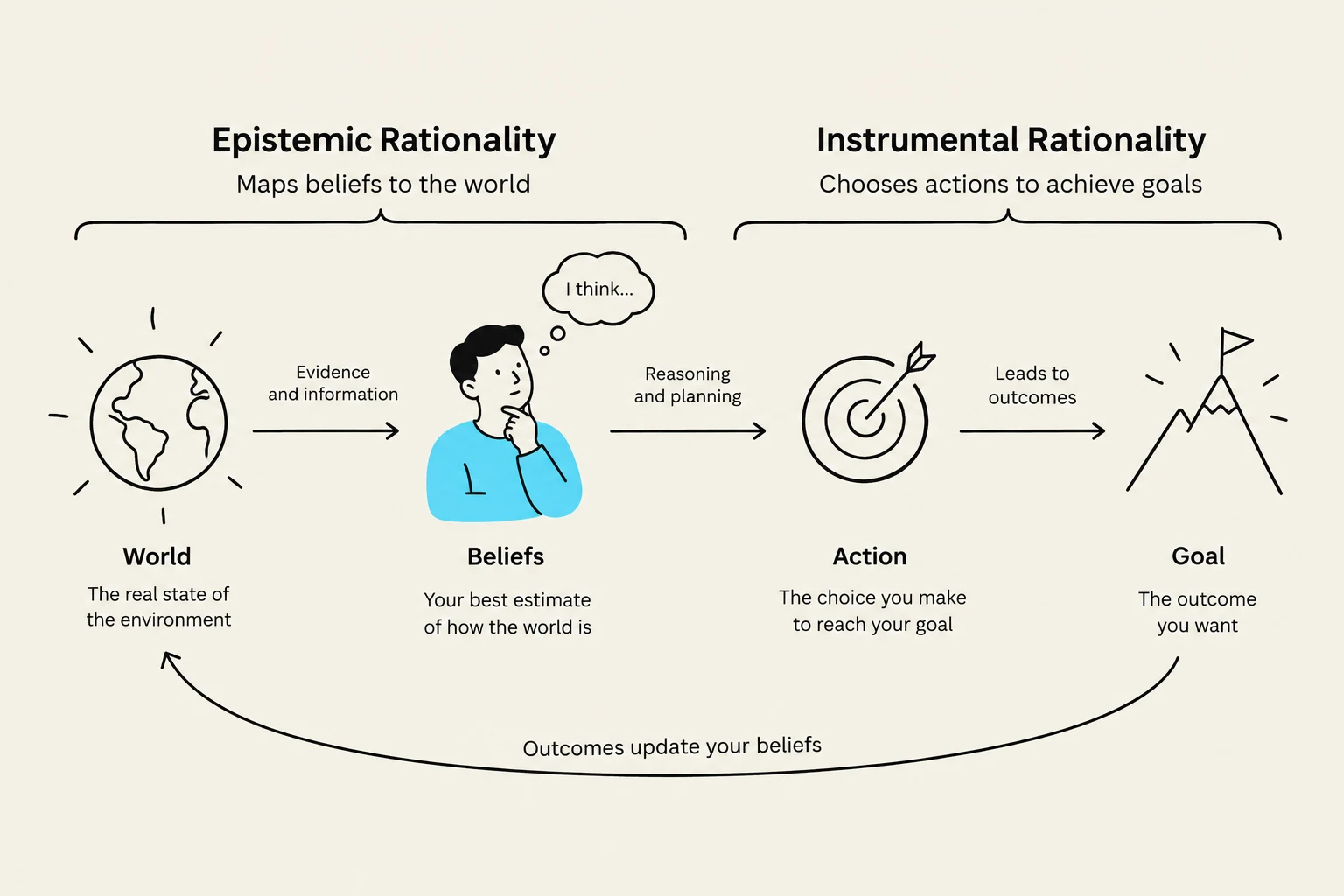
Cognitive scientists generally divide rationality into two distinct but deeply interconnected categories: instrumental rationality and the rationality of belief (often called epistemic rationality).
Instrumental Rationality: The Rationality of Action
Instrumental rationality is concerned with "what to do". It focuses on the rationality of action, which involves behaving in a way that achieves one's goals given the available physical and mental resources. At its core, this is about the optimization of goal fulfillment.
A common way to model this is through the maximization of Subjective Expected Utility (SEU). In this model, a rational agent evaluates possible actions by considering the probability of various outcomes and the "utility" (or desirability) of those outcomes.
Epistemic Rationality: The Rationality of Belief
While instrumental rationality asks "What should I do?", epistemic rationality asks "What is true?". This involves the rationality of belief, or how well our internal mental models map onto the actual structure of the physical world. To be epistemically rational, one must hold beliefs that are commensurate with available evidence and be willing to update those beliefs when new, more accurate information arises.
These two are linked: if your beliefs about the world are wrong (low epistemic rationality), your actions will likely fail to achieve your goals (low instrumental rationality).
This diagram illustrates the concepts of Epistemic Rationality, which involves mapping beliefs to the world based on evidence and information, and Instrumental Rationality, which involves choosing actions to achieve goals. The process shows how the world influences beliefs, which then guide actions leading to outcomes that ultimately update beliefs.
Normative vs. Descriptive Models
To study these rationalities, researchers use two different types of frameworks:
Normative Models: These define how a perfectly rational agent should behave. They provide the mathematical and logical standards for optimal decision-making, such as the axioms of choice or the rules of probability calculus.
Descriptive Accounts: These describe how humans actually behave in real-world scenarios.
The tension between these two—the gap between the "ideal" and the "actual"—is the engine that drives much of modern cognitive psychology.
The Great Rationality Debate
The divergence between normative ideals and descriptive reality has sparked The Great Rationality Debate, a high-stakes controversy regarding the extent of human irrationality. This debate is not just academic; it shapes the fundamental models of human nature used in economics, moral philosophy, and the "folk theories" we use to judge others.
The debate is split into two primary camps:
The Meliorists
Associated with the heuristics and biases research program, meliorists argue that human reasoning is fundamentally flawed and falls short of optimal performance. They identify systematic "biases"—errors that are not random but predictable—and suggest that human rationality could be enhanced through better education and improved information provision. To a meliorist, the gap between what people do and what they should do is a problem to be solved.
The Pangossians
Named after the character in Voltaire's Candide, Pangossians argue that human performance is inherently normative. They contend that the assumption of perfect rationality should be the default position and that perceived "irrationality" is often just a misunderstanding by the researcher. They offer two main rebuttals to the claims of the meliorists:
Inappropriate Normative Models: The researcher may be applying a mathematical model that doesn't match how the subject actually interprets the task.
Evolutionary Adaptation: The behavior might look "irrational" under a strict logical lens but is actually highly rational from an evolutionary perspective, as it helped our ancestors survive or adapt to specific environments.
Exam Tip: If a question asks about the difference between Meliorists and Pangossians, remember: Meliorists see a "gap" to be closed (improvement), while Pangossians see "rationality" that is simply misunderstood (adaptation).
Cognitive Mechanisms: Dual-Process Theory
To understand why these deviations occur, many researchers turn to Dual-Process Theory, which suggests the brain operates using two different types of cognitive processing:
Type 1 Processing: Fast, automatic, and intuitive. It uses heuristics (mental shortcuts) to solve problems quickly without heavy conscious effort. While efficient, it is prone to systematic errors.
Type 2 Processing: Slow, analytic, and computationally expensive. This is the "reflective mind" that requires conscious attention and can be used to override Type 1 impulses.
This illustration contrasts Type 1 and Type 2 decision-making processes. Type 1 is fast, automatic, and heuristic-driven, while Type 2 is slow, deliberate, and analytical.
A common error occurs through attribute substitution, where Type 1 processing replaces a difficult question (e.g., "How likely is this complex event?") with an easier one (e.g., "How vivid does this event feel?").
Probabilistic Reasoning and Bayes' Rule
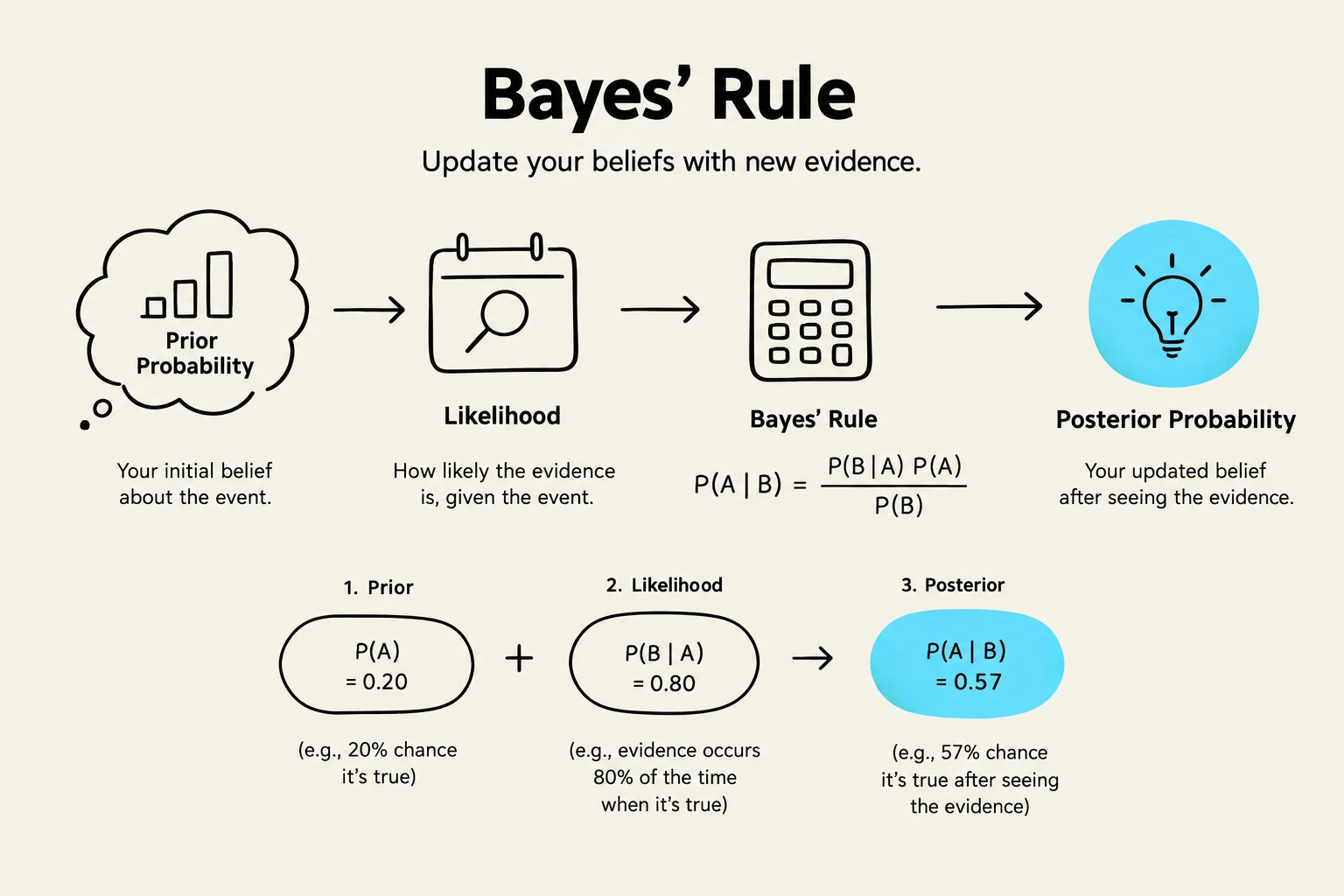
A critical component of epistemic rationality is how we update our beliefs based on new evidence. The gold standard for this is Bayes' Rule, which provides a formal method for "belief updating".
The formula for updating the probability of a hypothesis (H) given new data (D) is:
P(H∣D)=P(H)⋅P(D∣H)+P(¬H)⋅P(D∣¬H)P(H)⋅P(D∣H)
A major source of human error is the failure to "think of the opposite"—specifically, ignoring the term P(D∣¬H), which represents the probability of the evidence occurring if the alternative hypothesis were true. This failure to attend to the alternative hypothesis is a widespread epistemic irrationality.
Bayes' Rule illustrates how to update beliefs with new evidence, showing the process from prior probability to posterior probability using likelihood and the Bayes' Rule formula.
Summary Table: Key Perspectives
Feature
Meliorists
Pangossians
Core View
Human reasoning is flawed/suboptimal.
Human reasoning is inherently normative.
View of Errors
Systematic biases to be corrected.
Misunderstood adaptations or task misinterpretations.
Goal
Improve rationality via education.
Re-evaluate the normative models used.
Research Focus
Heuristics and Biases.
Evolutionary Psychology/Contextualism.
Keep reading for free.
Create an account to finish this reading and make it part of your study routine.