Understanding Psychological Research Methods and Designs
An overview of psychological research methods, including experimental, correlational, and non-experimental designs. It covers establishing causation, threats to validity, and real-world research techniques.
How do we know what we know about human behavior? Psychological science relies on systematic, empirical, and testable methods to move beyond intuition or anecdote toward evidence-based conclusions. Because human behavior is complex, researchers must choose specific "blueprints"—known as research designs—to investigate different questions, ranging from whether two things are related to whether one thing actually causes another.
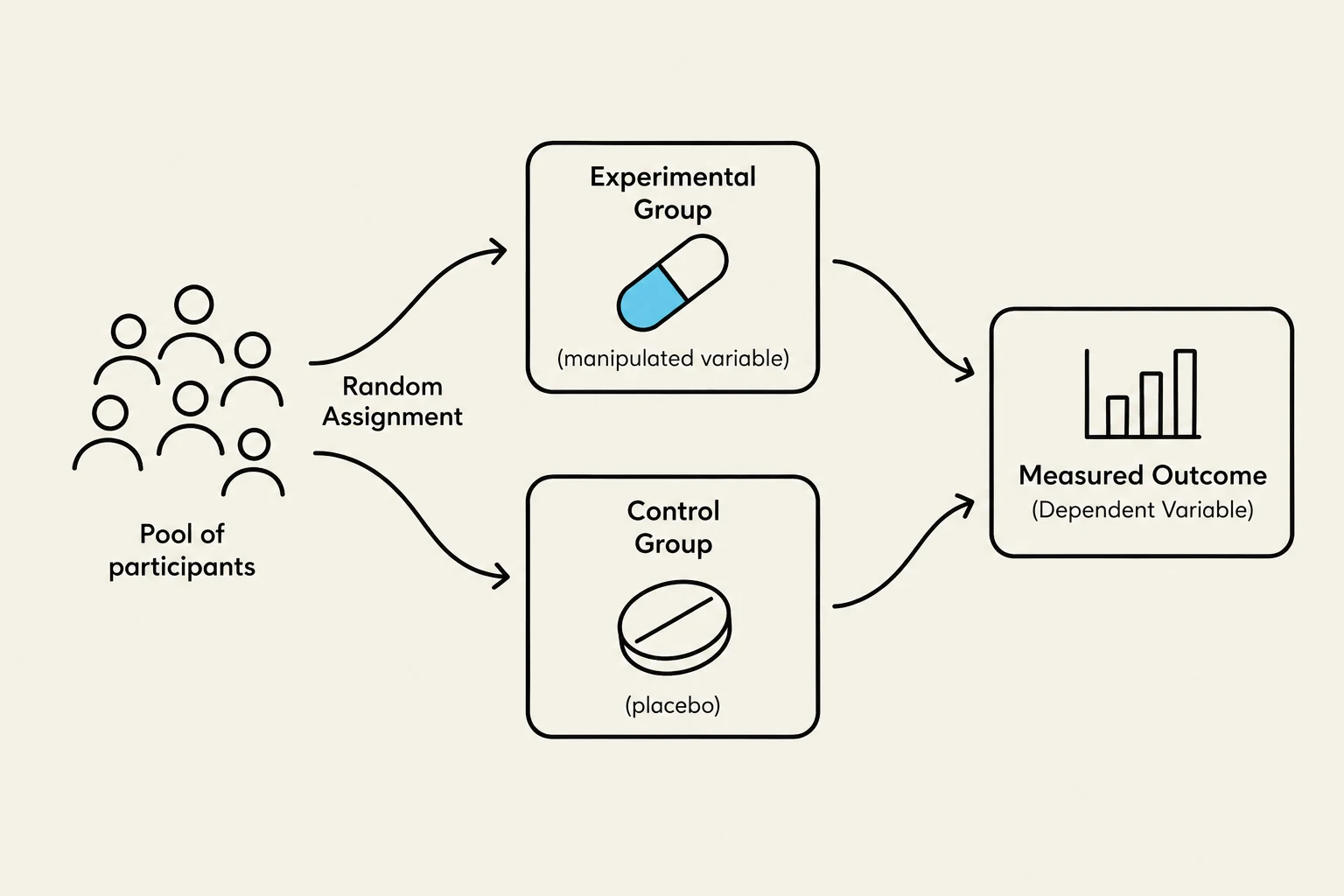
This diagram illustrates a basic experimental design, showing how a pool of participants is randomly assigned to either an experimental group (receiving a manipulated variable, such as a drug) or a control group (receiving a placebo). The outcome of the experiment is then measured for both groups.
Experimental Research: Establishing Causation
The gold standard for determining cause-and-effect is the experimental research design. In a true experiment, a researcher actively manipulates one variable to see how it affects another.
Independent Variable (IV): The factor that the researcher changes or manipulates.
Dependent Variable (DV): The measured outcome that is expected to change as a result of the IV.
To ensure that the results are actually caused by the IV and not by some other factor, researchers use random assignment. This process involves placing participants into different groups (such as an experimental group and a control group) by chance, which helps balance out individual differences across the groups.
Exam Tip: Random Sampling vs. Random Assignment
This is a high-yield distinction!
Random Sampling determines who gets into the study (helps with generalization to the population).
Random Assignment determines which condition a participant enters (helps with causal inference).
Threats to Experimental Validity
Even well-planned experiments face challenges:
Confounds: Unintended variables that change systematically along with the IV, providing an alternative explanation for the results.
Placebo Effects: When a participant's expectations about a treatment influence the outcome, even if the treatment has no active ingredient.
Participant Demand Characteristics: When participants guess the purpose of the study and change their behavior to "help" or "hinder" the researcher.
Experimenter Expectancy Effects: When researchers unintentionally influence participants or their own measurements due to their expectations.
To combat these, scientists often use double-blind procedures, where neither the participant nor the researcher interacting with them knows which condition is being administered.
Correlational and Non-Experimental Designs
Not all research can—or should—be experimental. Sometimes, it is unethical or impossible to manipulate variables (e.g., you cannot randomly assign people to smoke cigarettes to see if it causes cancer).
Correlational Research
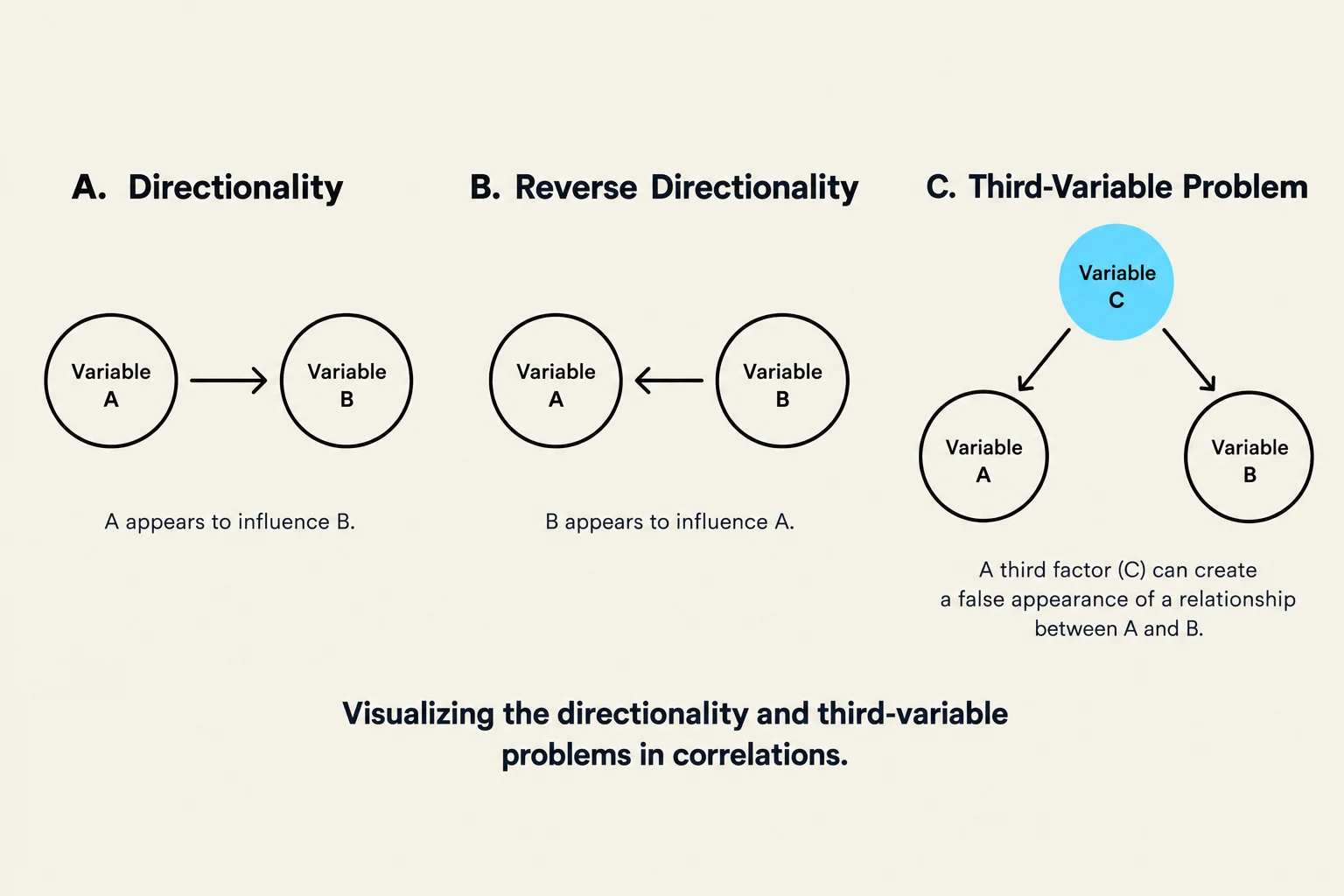
This diagram illustrates three common problems in understanding correlations: directionality, reverse directionality, and the third-variable problem, showing how a third factor can create a false appearance of a relationship between two variables.Correlational research examines the relationship between variables as they naturally occur. These relationships are quantified using the correlation coefficient (r):
A value near +1 indicates a strong positive relationship (both variables increase together).
A value near −1 indicates a strong negative relationship (as one increases, the other decreases).
A value near 0 indicates no linear relationship.
Crucial Limitation: Correlation does not equal causation. Because of the directionality problem (we don't know if A caused B or B caused A) and the third-variable problem (an unmeasured variable C might be causing both), we cannot make causal claims from correlations alone.
Other Key Designs
Quasi-experiments: These compare existing groups (e.g., smokers vs. non-smokers) without full random assignment. They are useful for real-world studies but provide weaker causal conclusions than true experiments.
Longitudinal Research: This involves following the same participants over a long period to observe developmental changes. While powerful for seeing how people change over time, these studies are expensive and suffer from attrition (participants dropping out over time).
Qualitative and Naturalistic Methods: These focus on rich, descriptive data. Examples include case studies (intensive analysis of one person or event), naturalistic observation (observing behavior in real-world settings without interference), and participant observation (where the researcher joins the group being studied). Narrative methods also allow researchers to study how people describe and interpret their own experiences.
Validity: Measuring Quality
This diagram illustrates the layers of validity in psychological research, including internal validity, external validity, and ecological validity.
To judge if a study is "good," psychologists look at three types of validity:
Internal Validity: The confidence we have that the IV actually caused the change in the DV.
External Validity: The extent to which findings can be generalized to other people, places, and situations.
Ecological Validity: A specific type of external validity that asks how closely the study settings and tasks resemble real-world behavior.
Research in the Real World
While laboratories offer high control (high internal validity), they can be artificial. To bridge the gap between the lab and real life, researchers use "real-world" methods:
Experience Sampling & Daily Diaries: Participants report their thoughts or behaviors multiple times a day or at the end of each day.
Day Reconstruction Method (DRM): Participants reconstruct and rate their experiences from the previous day.
Electronically Activated Recorders (EAR): Devices that capture brief snippets of ambient sound to study natural behavior.
Modern psychological science often utilizes full-cycle psychology. This approach moves back and forth between the real world and the lab: observing real-world patterns to generate questions, using laboratory experiments to test the underlying mechanisms, and then returning to the field to see if those mechanisms actually work in daily life.
Keep reading for free.
Create an account to finish this reading and make it part of your study routine.