


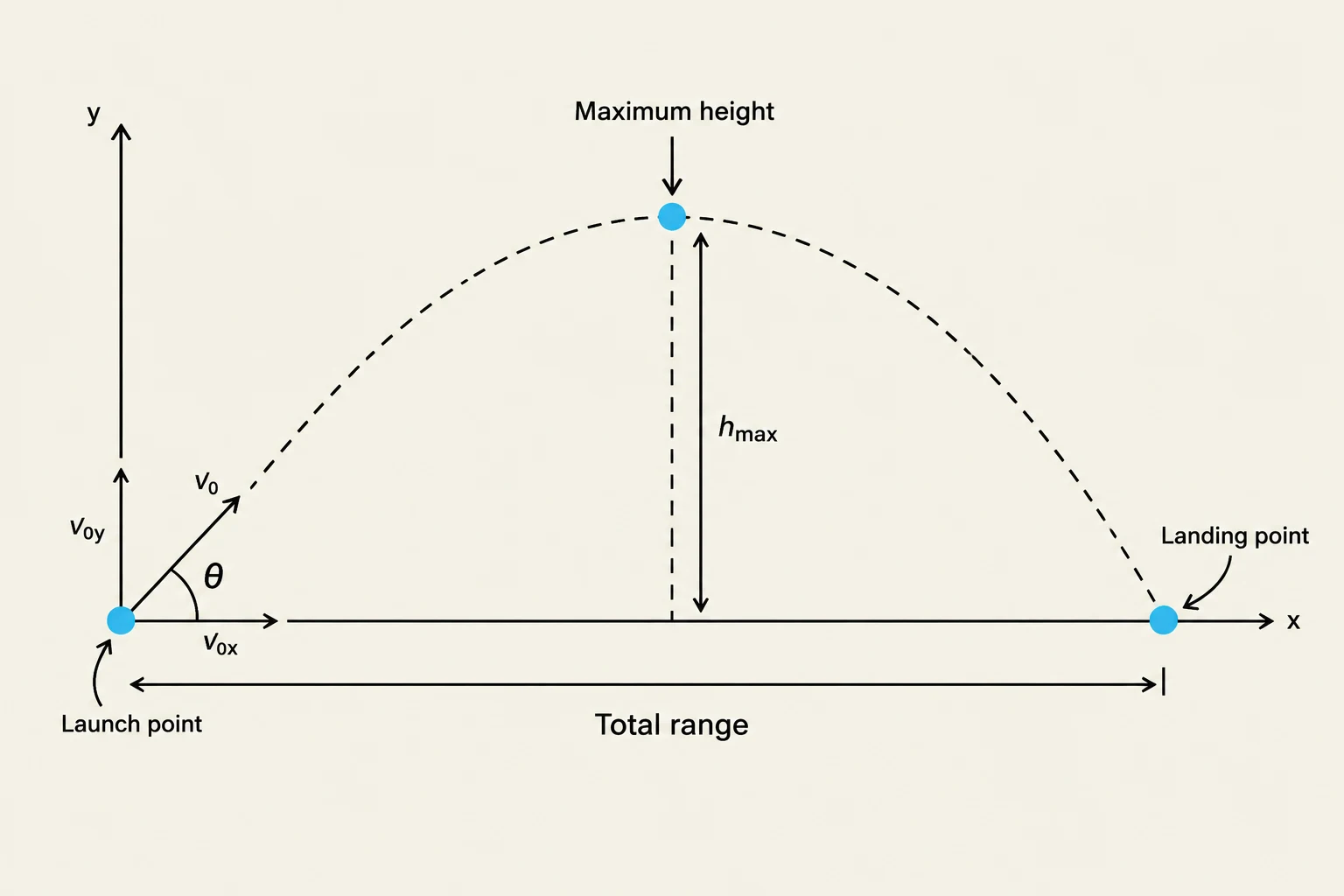
When an object is launched into the air and moves under the sole influence of gravity, it follows a predictable, curved path known as a trajectory. This phenomenon is called projectile motion. To understand how a projectile moves, we cannot simply look at its speed; we must decompose its motion into two independent parts: what is happening horizontally and what is happening vertically. By treating these two dimensions separately, we can use standard kinematic equations to predict exactly where an object will be at any given moment.
The Velocity Vector and Its Components
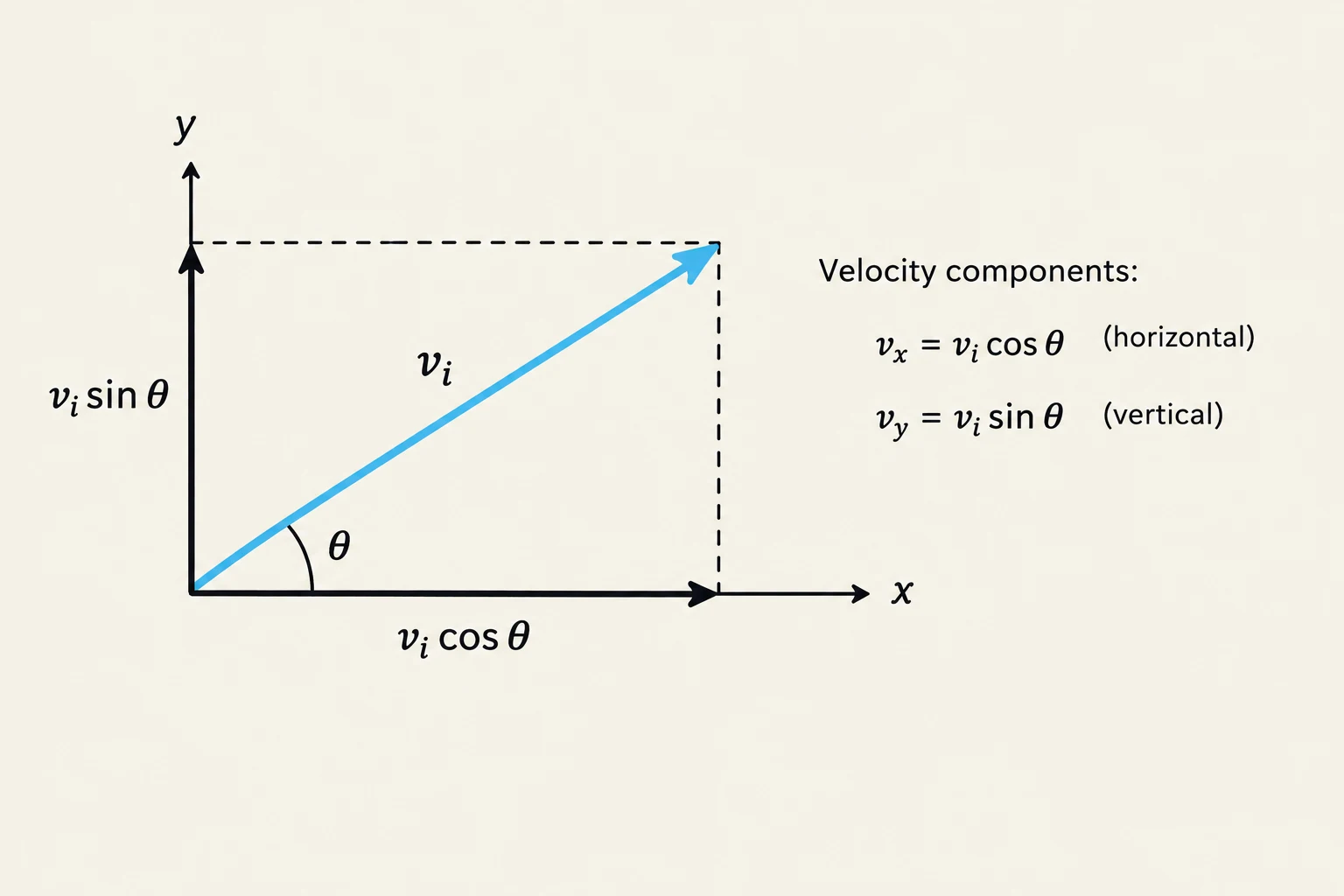
At the moment of launch, a projectile possesses an initial velocity vector directed at a specific launch angle relative to the horizontal. This vector represents both the speed and the direction of the object. To analyze the motion, we use trigonometry to break this vector into two perpendicular components:
-
Horizontal Component of Velocity (): This is the part of the velocity moving along the ground. Using right-triangle trigonometry, we find: In the absence of air resistance, there is no acceleration in the horizontal direction. Consequently, the horizontal component of velocity remains constant throughout the entire flight.
-
Vertical Component of Velocity (): This is the part of the velocity moving up or down. It is calculated as: Unlike the horizontal component, the vertical component changes constantly because of the force of gravity.
Exam Tip: Always remember that the horizontal velocity () does not change if air resistance is ignored. If a problem asks for the velocity at the peak of the flight, the vertical component is zero, but the horizontal component is still equal to its initial value!
Keep reading for free.
Create an account to finish this reading and make it part of your study routine.
Continue reading freeAlready have an account? Log in
Updated