Understanding Procedural Justice: Voice, Authority, and Representation
This content explains procedural justice, a critical dimension of fairness in decision-making processes. It details the core pillars: political representation, decision-making authority, and the right to a voice, differentiating it from distributive justice. The text also covers challenges to implementing procedural ju
When we discuss justice in a social or environmental context, we often focus on the outcome: Who gets the resources? Who bears the burden of pollution? While these questions are vital, they represent "distributive justice." There is another, equally critical dimension that focuses on the process itself. This is known as Procedural Justice.
Procedural justice examines the fairness of the decision-making processes that lead to societal outcomes. It asks not just "what" was decided, but "how" it was decided, who was allowed in the room, and whether those most affected by a decision had a meaningful way to influence it.
The Core Pillars of Procedural Justice
Procedural justice is not a single metric but a framework composed of several interconnected pillars. To determine if a process is "just," scholars and policymakers look at how power is distributed and how information flows between authorities and the public.
1. Political Representation
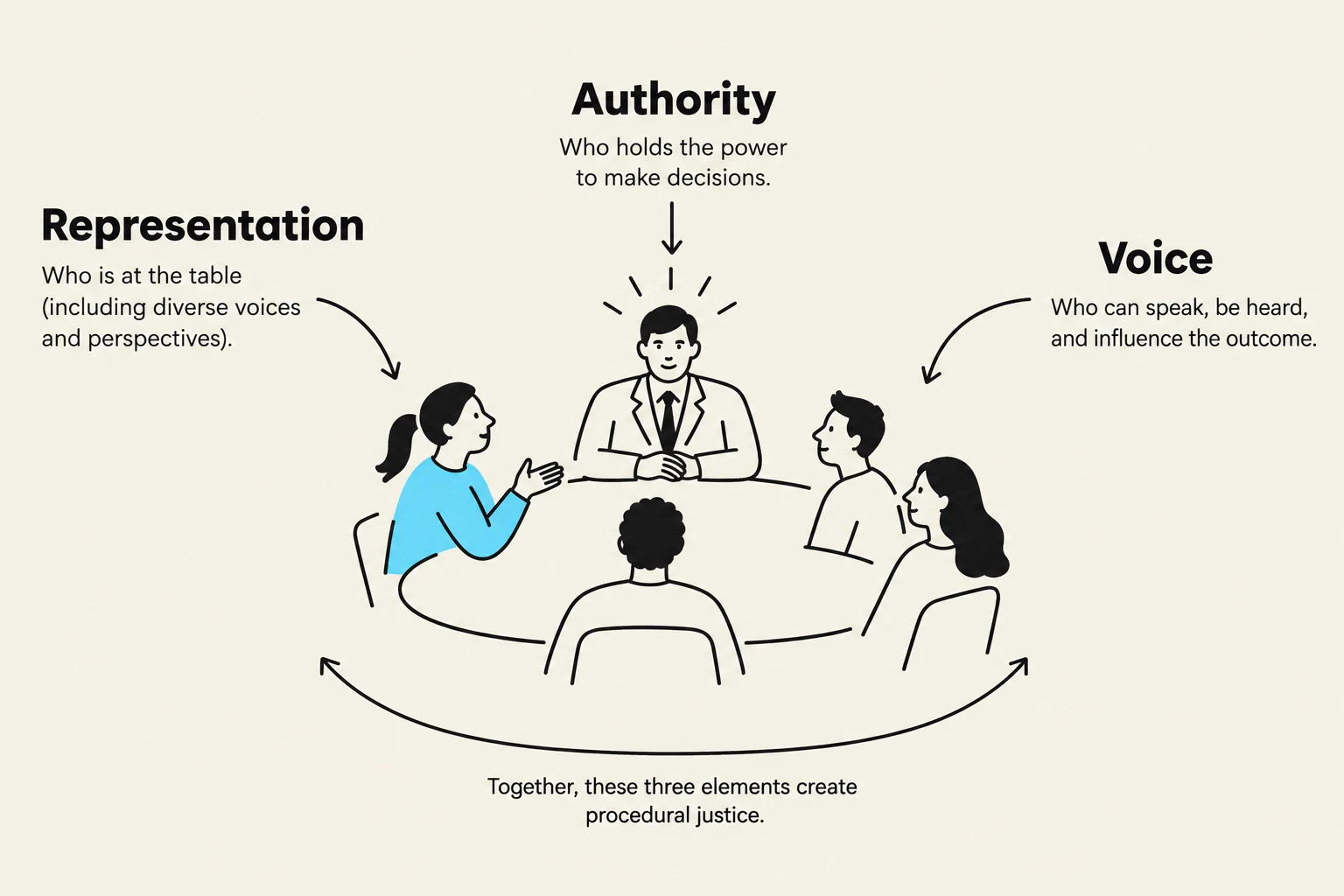
Representation is the foundation of procedural justice. It asks whether the groups involved in a decision-making body accurately reflect the diversity of the population that will be impacted by the decision. If a government agency makes a decision about water rights in a rural community, but the board consists entirely of urban developers, there is a failure of representation.
2. Decision-Making Authority
Even if people are present at the table, procedural justice requires examining where the actual authority lies. Is the decision-making power centralized in a distant bureaucracy, or is it decentralized to allow for local autonomy? True procedural justice seeks to ensure that authority is not just held by those with the most economic or political capital, but is shared in a way that respects the agency of affected stakeholders.
3. The Right to a Voice
Perhaps the most recognizable element of procedural justice is the concept of "voice." This goes beyond mere "consultation." In many flawed processes, authorities engage in "tokenism"—asking for public opinion only to ignore it entirely. Genuine procedural justice requires that affected communities have a substantive mechanism to voice their concerns, and that these voices are integrated into the final decision-making calculus.
This diagram illustrates the three key elements of procedural justice: Representation, Authority, and Voice. Representation ensures diverse perspectives are included, Authority signifies decision-making power, and Voice allows individuals to be heard and influence outcomes. Together, these components foster procedural justice.
Exam Tip: When analyzing a case study, distinguish between distributive and procedural justice. If a question asks about the "fairness of the rules" or "the inclusivity of the meeting," it is asking about procedural justice. If it asks about "the fairness of the final split of resources," it is asking about distributive justice.
The Mechanics of Inclusion: Voice vs. Consultation
A common pitfall in management and governance is confusing consultation with meaningful participation. To understand the depth of procedural justice, we can look at the spectrum of engagement.
Informative: The authority tells the community what is going to happen. There is no opportunity for feedback.
Consultative: The authority asks for opinions, but the authority retains absolute control over whether those opinions are used.
Collaborative/Participatory: The community and the authority work together to co-create solutions. Here, the "voice" of the community has a direct impact on the "authority" of the decision-maker.
The mathematical tension in resource management often involves balancing these interests. For example, if we represent the "utility" of a decision (U) as a function of both the outcome (O) and the perceived fairness of the process (P), we might see:
U=f(O,P)
If P (procedural fairness) is zero, even a high O (a positive outcome) may result in low social stability or compliance.
This diagram illustrates a spectrum of engagement, from receiving information to co-management, with increasing levels of influence and shared responsibility.
Challenges to Procedural Justice
Implementing procedural justice is difficult because power is rarely distributed equally. Several barriers often prevent affected communities from exercising their rights:
Information Asymmetry: Authorities often possess technical or legal data that is inaccessible to the general public, making it difficult for communities to participate on equal footing.
Resource Constraints: Meaningful participation takes time, money, and expertise. Marginalized communities may lack the resources to attend lengthy hearings or hire legal counsel.
Institutional Barriers: Existing laws or management structures may be designed to favor centralized authority, making it legally difficult to transfer decision-making power to local groups.
Worked Example: Urban Redevelopment
Imagine a city planning to build a new highway through a low-income neighborhood.
Scenario A (Low Procedural Justice):
The city council holds a single meeting at 2:00 PM on a Tuesday in a building across town. They present a finished plan and ask for "comments" to be submitted via mail. The decision-making authority remains entirely with the council.
Result: High information asymmetry, low representation, and no meaningful voice.
Scenario B (High Procedural Justice):
The city establishes a community oversight board composed of local residents (Representation). This board has the power to veto certain aspects of the design (Authority). Public workshops are held in the evenings within the neighborhood, and technical experts are provided to help residents understand the environmental impact reports (Voice and Information).
Result: High procedural justice, as the process addresses representation, authority, and voice.
This diagram illustrates a centralized top-down management structure, comparing representation, authority, and voice among employees and the top manager.
Summary Table for Study
Concept
Key Question
Goal
Representation
Who is in the room?
To ensure diversity and reflect the affected population.
Authority
Who makes the final call?
To distribute power and allow for local autonomy.
Voice
Can they influence the result?
To move from tokenism to meaningful participation.
By focusing on these elements, organizations and governments can move beyond simply "doing good" and toward "doing things fairly."
Keep reading for free.
Create an account to finish this reading and make it part of your study routine.