Understanding Privacy and Confidentiality in Healthcare
This content explains the critical concepts of privacy and confidentiality in the healthcare profession, detailing the ethical, legal, and professional obligations nurses have in safeguarding sensitive client information. It covers the distinction between privacy and confidentiality, the definition of Personal Health I
In the healthcare profession, the relationship between a nurse and a client is built on a foundation of trust. This trust is not merely a social courtesy; it is a rigorous professional requirement governed by ethical standards, legal frameworks, and professional regulatory bodies. As nurses gather data to support health and well-being, they become custodians of highly sensitive information. Understanding the distinction between privacy and confidentiality, as well as the legal obligations surrounding them, is essential for maintaining professional integrity and ensuring client safety.
Understanding the Core Concepts: Privacy vs. Confidentiality
While often used interchangeably in casual conversation, "privacy" and "confidentiality" represent two distinct concepts in a clinical setting.
Privacy is centered on the person. It involves protecting the client's physical body and their personal space. For example, providing privacy during a physical assessment means closing curtains, ensuring the door is shut, or asking visitors to step out while a client is bathing or dressing.
Confidentiality is centered on information. It is the moral, ethical, legal, and professional obligation to protect any information entrusted to the healthcare team, regardless of whether it is spoken, written, or stored electronically.
Personal Health Information (PHI)
Personal Health Information is a broad term encompassing any identifying information about a client. This includes:
Physical or mental health history and current care plans.
Financial information, such as health card numbers or eligibility for care.
Details regarding the donation of body parts or substances.
The names of a client's substitute decision-makers.
Exam Tip: Remember that while the information belongs to the client, it is the healthcare facility and the individual practitioner tasked with safeguarding it.
Legal Frameworks and Professional Standards
Healthcare workers must navigate a complex landscape of legislation to ensure they are meeting their obligations.
Canadian Legislation
PIPEDA (Personal Information Protection and Electronic Documents Act): This federal law governs how personal information is collected, used, and disclosed during commercial activities.
PHIPA (Personal Health Information Protection Act): Because PIPEDA was not specific enough for the nuances of medicine, PHIPA was enacted to specifically address the protection of health information within the healthcare sector.
The College of Nurses (CNO) Principles
The College of Nurses provides specific principles that guide professional practice. Key takeaways include:
Confidentiality applies to all information learned through the nurse-client relationship, and this responsibility continues even after the professional relationship has ended.
Information should be shared with the health team to facilitate care, but all team members are also obligated to maintain confidentiality.
Clients have a right to access their own records, though they must follow a formal process to do so.
Warning: Professional Misconduct
According to the CNO, "giving information about a client to a person other than the client or his or her authorized representative, except with the consent of the client or his or her representative, or as required by law" is considered Professional Misconduct. This includes accessing the charts of patients to whom you are not assigned.
Data Collection: From Emergent to Comprehensive Histories
This diagram illustrates the different types of patient history collection based on clinical urgency: Comprehensive History for routine care, Focused History for specific concerns, and Emergent History for critical data.
The way a nurse collects information dictates how that information must be protected. Depending on the clinical situation, a nurse may perform different types of health histories:
Emergent History: An abbreviated, rapid collection of data performed during an emergency. The focus is strictly on what is needed immediately to save life or limb.
Focused History: The most common type used in daily practice. It concentrates on a specific problem, such as a single body system or a new symptom reported by the client.
Comprehensive History: An expanded assessment that gathers information about all body systems and the client's broad health status, such as during an annual physical exam.
Regardless of the type of history, the data collected—whether it is subjective (what the client feels/says) or objective (what the nurse observes/measures)—is considered "intimate/private knowledge" and must be protected.
Navigating Complex Situations
When to Breach Confidentiality
There are rare but critical instances where a nurse is legally and ethically required to breach confidentiality. This occurs when there is a serious threat to the safety of the client or others, such as expressed intentions of suicide or homicide.
Decision-Making: SDMs and POA
When a client is unable to make their own decisions due to cognitive decline, intoxication, or injury, the healthcare team must look to authorized representatives:
Substitute Decision-Maker (SDM): An individual who makes decisions on behalf of a client when they lack capacity.
Power of Attorney (POA): The legal documentation that grants an individual the authority to act as an SDM.
Social Media Principles
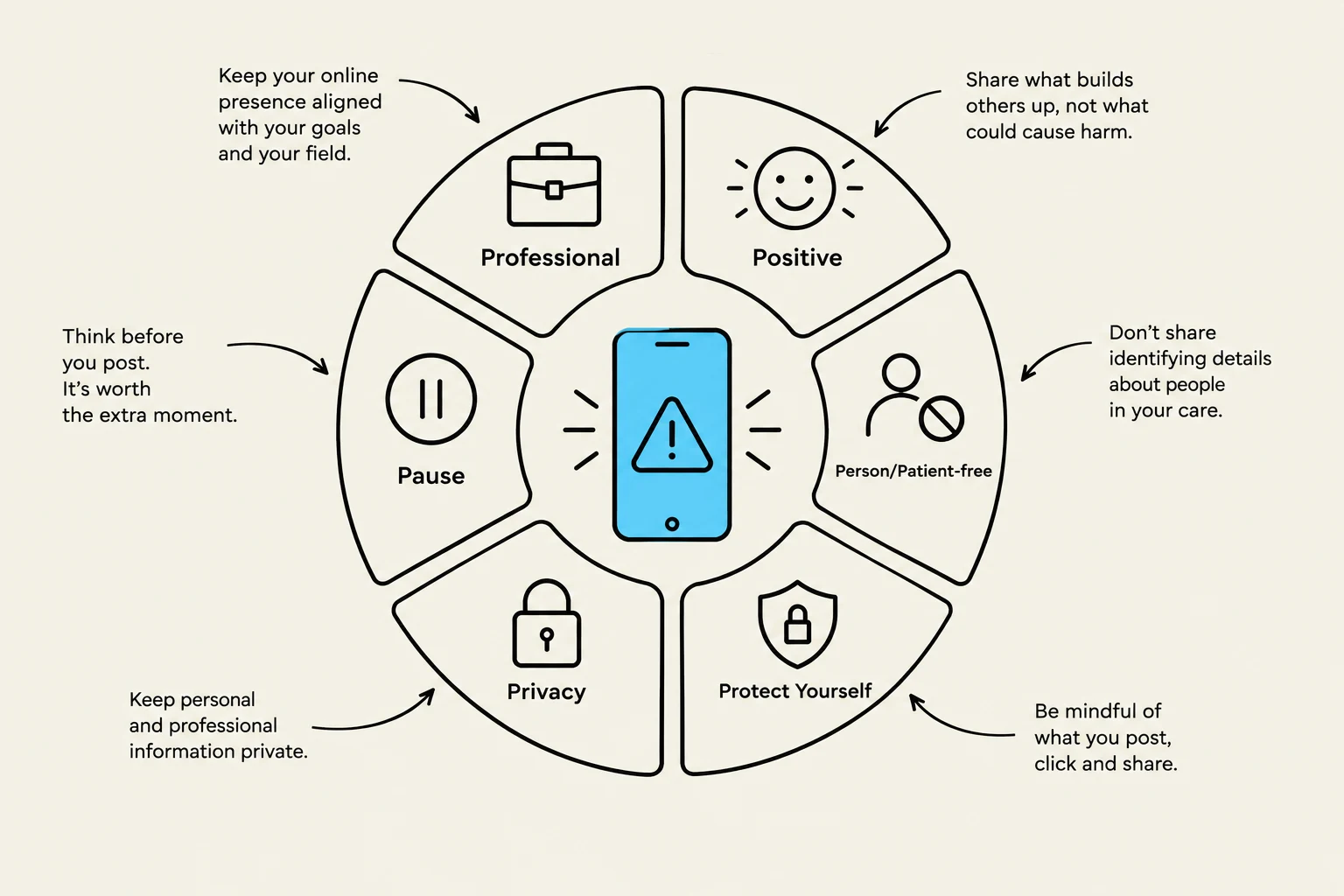
This diagram illustrates key principles for responsible online behavior, emphasizing professionalism, positivity, privacy, and self-protection, with a reminder to pause and consider before posting.
In the digital age, the "6 Ps" serve as a guide for healthcare workers (including students) to prevent accidental breaches of privacy on social media:
Professional: Avoid rants or unprofessional venting.
Positive: Maintain a positive public persona.
Person/Patient-free: Never reference patients, their procedures, or even your colleagues.
Protect Yourself: Do not post content that could damage your reputation.
Privacy: Respect your own personal and professional boundaries.
Pause: Always stop and think before hitting "post".
Clinical Practice Note: When communicating via telephone, assume that no personal health information should be shared unless explicit consent is obtained. If a client is incapacitated, provide as little information as possible and ideally direct the caller to the client directly.
Keep reading for free.
Create an account to finish this reading and make it part of your study routine.