Understanding Priming and Context-Dependent Memory
Explore the psychological phenomena of priming and context-dependent memory, which influence how we access and retrieve information. Learn about associative networks, cultural priming, and the impact of environment and mood on memory recall.
Memory is far more than a static filing cabinet of facts; it is a dynamic, interconnected, and reconstructive process. Our ability to recall information is not just a matter of how much we "know," but is deeply influenced by the associations we have formed, the cultural frameworks we inhabit, and the physical and emotional environments in which we learn. This article explores two powerful psychological phenomena that dictate how we access our past: priming and context-dependent memory.
The Architecture of Memory: Associative Networks
This is a mind map illustrating associations related to the concept of 'Fire'. It shows connections to 'Heat', 'Smoke', and 'Red', with further related concepts branching out from these nodes, such as 'Warmth', 'Cooking', 'Air', 'Indoor', 'Campfire', 'Color', 'Stop', and 'Flame'. The diagram also indicates that 'Activation spreads through associations' and that some connections are stronger than others.
To understand priming, one must first understand how memory is organized. Rather than being a collection of isolated data points, memory functions as a large, interconnected network of information. Concepts are linked through various types of associations, which act as "retrieval cues" that help us navigate this network:
Meaning (Semantic Association): Concepts related by definition (e.g., thinking of "fire" might trigger "heat" or "smoke").
Time: Events that occurred around the same time.
Location: Things encountered in the same place.
Experience: Ideas connected through personal history.
When one node in this network is activated, it can trigger a cascade of related concepts, making them easier to access.
Priming: Preparing the Mind
Priming is a process where exposure to a stimulus influences the processing of a subsequent stimulus, often without the individual being consciously aware of the influence. An instructor might compare priming to applying a primer to a wall before painting; it prepares the "surface" of the mind to process specific categories of information more effectively.
Cultural Priming and Social Orientation
Priming can extend beyond simple word associations to influence complex social and cultural behaviors. Research has shown that exposing individuals to cultural icons can temporarily activate specific cultural mindsets:
Western Priming: Using symbols like Superman or the bald eagle can activate associations with Western culture, leading to responses oriented toward independence.
Chinese Priming: Using symbols like the panda or Sun Wukong (the Monkey King) can activate associations with Chinese culture, leading to responses oriented toward interdependence.
Interestingly, even individuals not raised in these cultures may respond to these primes if they possess the relevant cultural knowledge.
Priming and Aggression
Priming can also influence behavioral tendencies. For example, exposure to objects associated with aggression, such as weapons, may activate aggressive concepts in the mind. It is important to note that priming does not "force" a person to act; rather, it makes certain concepts more accessible, which may influence judgments or behavior under specific conditions.
Exam Tip: Remember the priming sequence: Prime → Activation of associated concepts → Influence on later thinking/behavior. This often happens without conscious recognition.
Context-Dependent Memory
While priming focuses on the internal associations of the mind, context-dependent memory focuses on the external environment. This phenomenon describes how the physical environment in which information is learned can act as a cue for its retrieval.
The Role of the Physical Environment
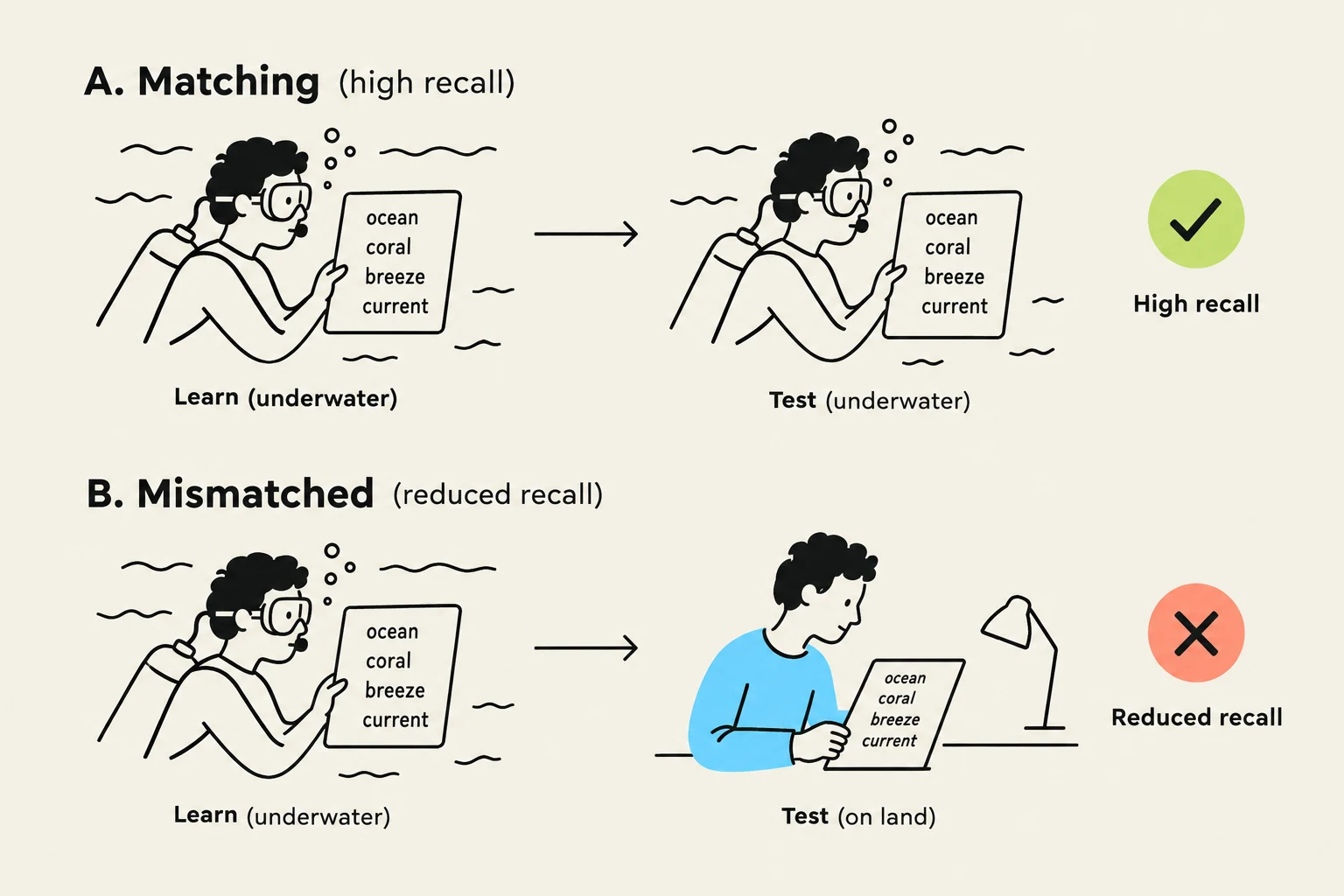
This illustration demonstrates how learning context affects recall. When learning and testing occur in the same environment (underwater), recall is high. When the learning environment (underwater) differs from the testing environment (on land), recall is reduced.
A classic study involving learning words either on land or underwater demonstrated that recall is significantly higher when the testing environment matches the learning environment:
Matching Contexts: Learning on land and testing on land (or underwater and testing underwater) resulted in high recall.
Mismatched Contexts: Switching from land to underwater (or vice versa) generally reduced the ability to recall the information.
This occurs because the learning environment becomes associated with the information itself. Returning to a similar setting reactivates the contextual cues necessary to "unlock" the memory.
Mood-Dependent Memory
A closely related concept is mood-dependent memory, which focuses on the internal emotional state rather than the physical surroundings. Research suggests that retrieval is more successful when a person's mood during testing matches their mood during the initial learning phase.
Feature
Context-Dependent Memory
Mood-Dependent Memory
Focus
Physical environment
Emotional state
Mechanism
Environmental cues support retrieval
Mood-related cues support retrieval
Example
Studying and testing in the same room
Learning while happy and testing while happy
Practical Application: When preparing for an exam, studying in a setting similar to your testing environment (like a quiet classroom) may provide helpful contextual cues.
Summary of Key Distinctions
To master these concepts for academic purposes, it is vital to distinguish between similar-sounding terms:
Priming vs. Context-Dependent Memory: Priming is about the activation of internal mental associations; context-dependent memory is about the influence of the external environment.
Encoding Failure vs. Retrieval Failure: Encoding failure means the information was never properly stored (e.g., not paying attention). Retrieval failure means the information is in your memory, but you cannot access it at the moment (e.g., the "tip-of-the-tongue" phenomenon).
Misinformation Effect vs. False Memory: The misinformation effect is the process where post-event information alters your recollection. A false memory is the resulting inaccurate recollection itself.
Keep reading for free.
Create an account to finish this reading and make it part of your study routine.