


In economics, understanding how markets react to change is crucial for producers, policymakers, and consumers alike. While we often focus on how consumers react to price changes (demand), it is equally important to understand how producers respond. This responsiveness is captured by a concept known as the Price Elasticity of Supply (PES). By measuring how much the quantity supplied of a good changes in response to a change in that good's price, we can predict how supply shocks—such as technological breakthroughs or resource shortages—will impact the market.
What is Price Elasticity of Supply?
Price elasticity of supply measures the responsiveness of the quantity supplied to a change in price. Specifically, it is defined as the percentage change in quantity supplied resulting from a 1 percent change in price.
To calculate this, economists use the following mathematical formula:
This ratio tells us whether a producer can easily ramp up production when prices rise or if they are stuck with a fixed amount of output regardless of the price.
Elastic vs. Inelastic Supply
Supply can be categorized into two primary states based on the relationship between the magnitude of the price change and the resulting change in quantity.
Inelastic Supply
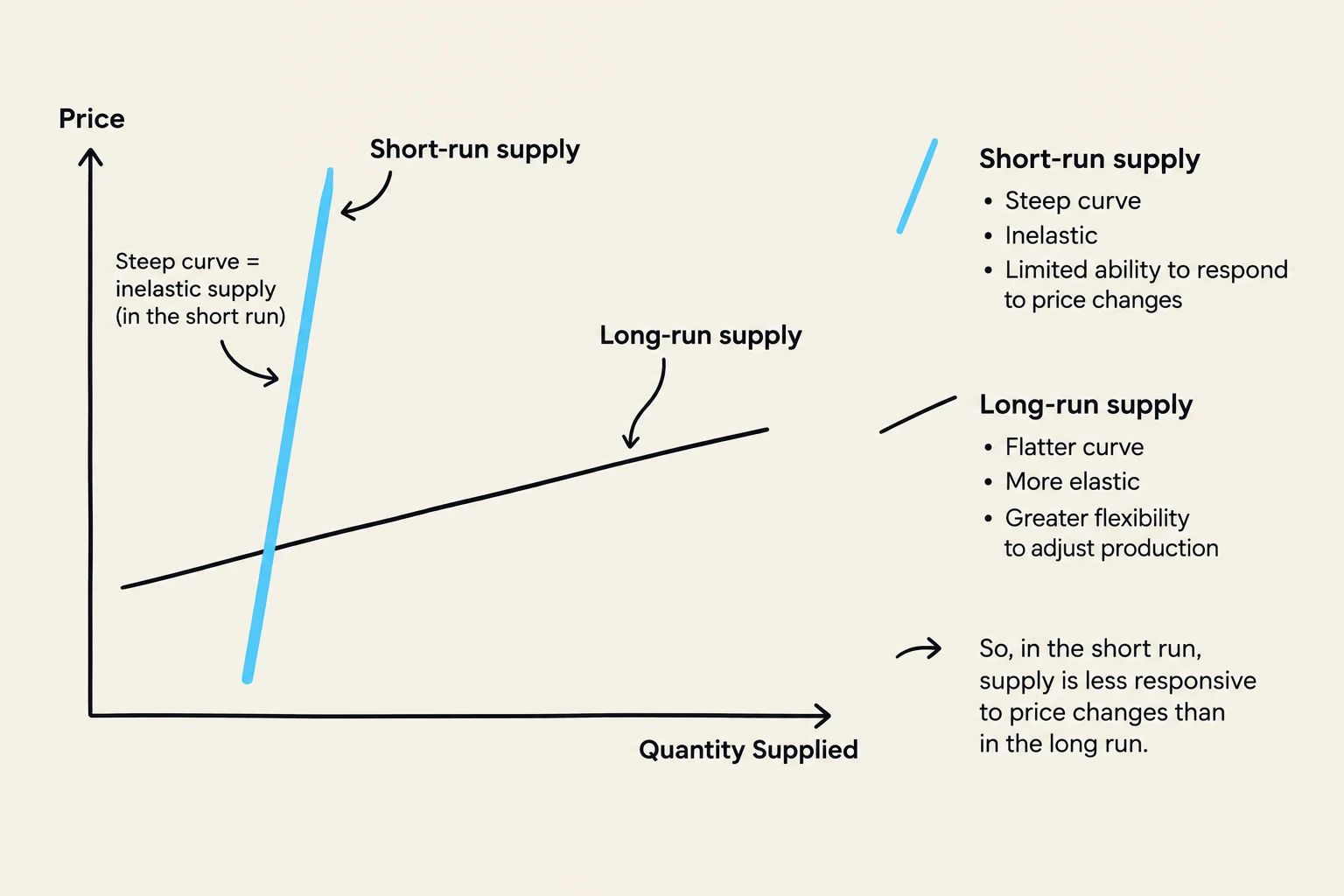
Supply is considered inelastic if the percentage change in quantity supplied is less than the percentage change in price. In this scenario, even if the price jumps significantly, producers find it difficult to increase their output substantially. This often happens in industries where production takes a long time or requires rare resources.

Keep reading for free.
Create an account to finish this reading and make it part of your study routine.
Continue reading freeAlready have an account? Log in
Updated