


In economics, understanding the relationship between price and quantity is only the first step. While the law of demand tells us that price and quantity demanded generally move in opposite directions, it doesn't tell us how much the quantity will change when the price moves. To answer this, economists use a concept called elasticity.
What is Price Elasticity of Demand?
Price elasticity of demand measures the responsiveness of the quantity demanded of a good to a change in its price. Essentially, it quantifies how sensitive consumers are to price fluctuations.
To calculate this, we use the following formula:
Because price and quantity demanded move in opposite directions, the result is typically negative. However, economists usually drop the minus sign and look at the absolute value () to classify the type of demand.
Exam Tip: The Midpoint Method When calculating elasticity between two specific points, using simple percentage changes can lead to different results depending on whether the price is rising or falling. To avoid this, economists use the Midpoint Formula, which uses the average of the starting and ending values as the base for both the numerator and denominator.
The Five Types of Demand Elasticity
Demand can be categorized into five distinct levels based on how much the quantity demanded reacts to a price change.
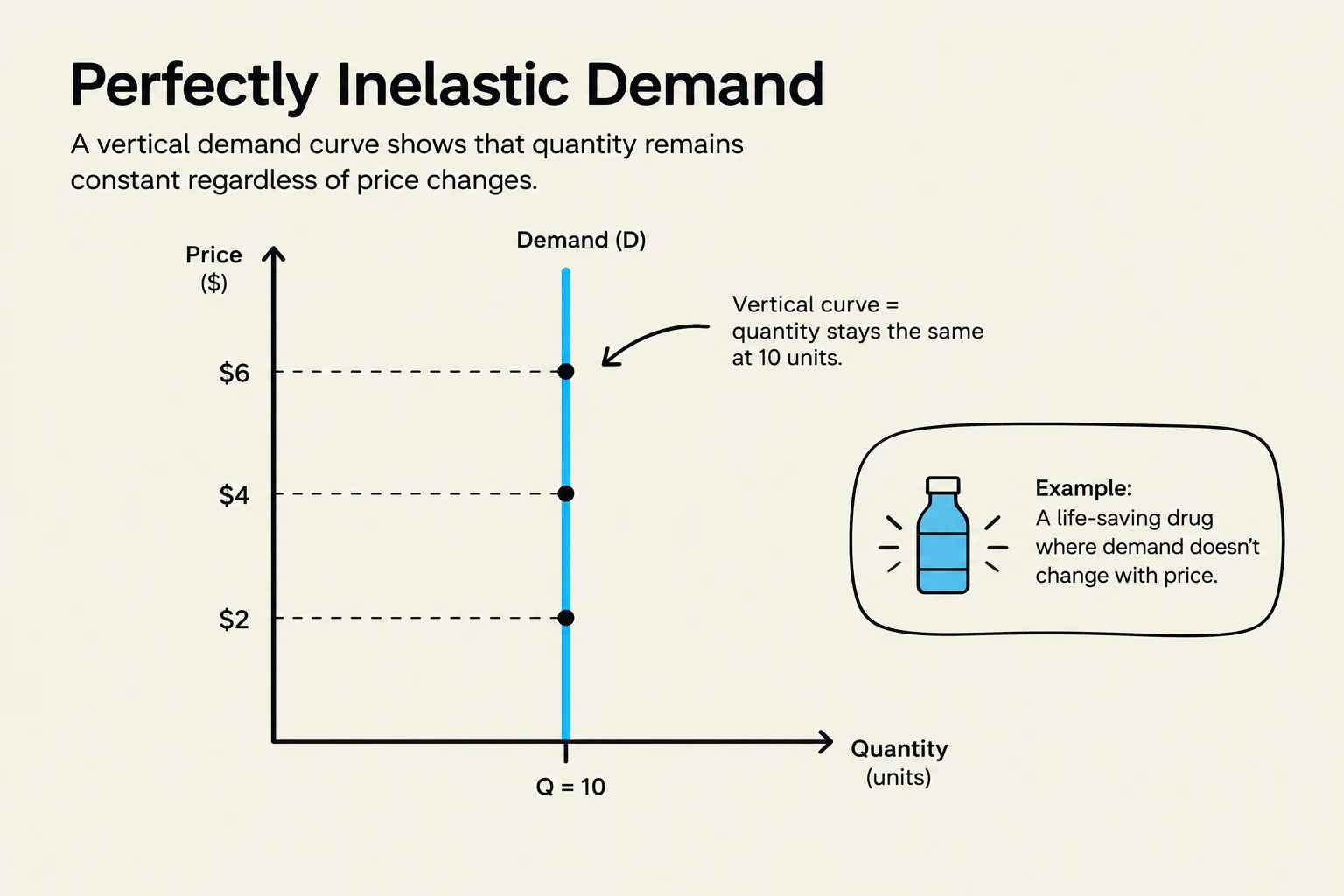
1. Perfectly Inelastic Demand
In this extreme case, the quantity demanded does not change at all, regardless of how much the price increases or decreases. The price elasticity of demand is exactly zero (). An example might be a life-saving medication where a patient must have a specific dose regardless of cost.

Keep reading for free.
Create an account to finish this reading and make it part of your study routine.
Continue reading freeAlready have an account? Log in
Updated