Explains the Time Value of Money (TVM) and how to calculate Present Value (PV) using discounting. Covers formulas, examples, and adjustments for compounding frequency.
In the world of finance, money does not have a static value. A pound in your hand today is fundamentally different from a pound promised to you a year from now. This core principle is known as the Time Value of Money (TVM). To make sound investment decisions, managers and investors must be able to translate future sums of money into their equivalent value in today's terms. This process is known as finding the Present Value (PV).
The Time Value of Money (TVM)
The Time Value of Money dictates that the timing of a cash flow is just as important as the amount itself. There are four primary reasons why money today is worth more than the same amount in the future:
Inflation: Over time, inflation reduces the purchasing power of money. What $£1,000$ can buy today will likely cost much more in the future.
Time Preference: Most individuals prefer immediate consumption over delayed consumption because it provides more immediate satisfaction.
Risk and Uncertainty: A promised future cash flow carries the risk that the payer might not be able to fulfill the promise.
Opportunity Cost: Money held today can be invested to earn a return. By waiting for money, you forfeit the interest you could have earned in the meantime.
Future Value vs. Present Value
To understand Present Value, it is helpful to first look at its counterpart: Future Value (FV).
Future Value (FV) refers to the amount an investment will grow to after a specific number of periods through the process of compounding. Compounding occurs when you earn interest not only on your original principal but also on the interest accumulated from previous periods—essentially "earning interest on interest".
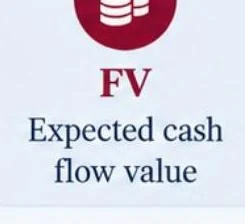
Expected cash flow value
Present Value (PV) is the inverse of this process. It represents the current worth of a future cash flow when discounted at an appropriate rate. While compounding moves money forward in time, discounting moves money backward from the future to the present.
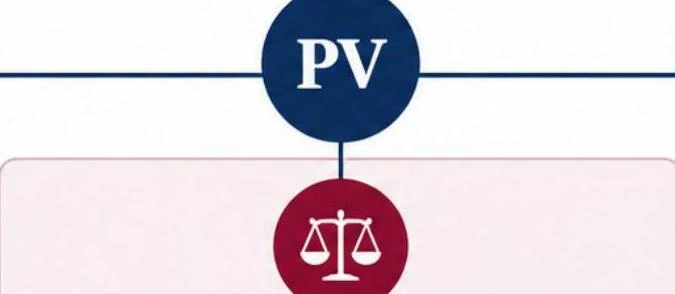
A diagram showing the letters PV above a scale symbol.
The Discounting Process and Formula
The process of calculating the present value is called discounting. The interest rate used in this calculation is known as the discount rate (r).
The mathematical relationship to find the Present Value of a single future cash flow is:
PV=(1+r)nFVn
Where:
PV = Present Value
$FV_n$ = Future Value at period n
r = Periodic discount rate
n = Number of periods
The Discount Factor (PVIF)
To simplify calculations, mathematicians often use the Discount Factor, also known as the Present Value Interest Factor (PVIF). This represents the value of $£1$ received n periods in the future.
The formula can be rewritten as:
PV=FVn×PVIF(r,n)
where
PVIF(r,n)=(1+r)n1
A timeline illustrating the passage of time in yearly increments from Year 0 to Year 3.
Worked Example: Single Cash Flow
Problem: Suppose you need to have $£1,000$ in 2 years to fund a project. If you can earn a $7%$ annual rate of return, how much must you invest today?
Solution:
Using the PV formula:
PV &= \frac{1,000}{(1+0.07)^2} \\
PV &= \frac{1,000}{1.1449} \\
PV &= £873.44
\end{aligned}$$
Alternatively, using a PVIF table for $n=2$ and $r=7\%$:
$$\begin{aligned}
PV &= 1,000 \times 0.8734 \\
PV &= £873.40
\end{aligned}$$
*(Note: Small differences are due to rounding in tables)*.
## Multiple Cash Flows
In real-world scenarios, investments rarely involve a single payment. They often consist of a series of different cash flows occurring at different times. Because money at different points in time has different values, you **cannot** simply sum the nominal amounts.
To find the total present value ($PV_{total}$), you must discount each individual cash flow back to Year 0 and then sum them:
$$PV_{total} = \sum_{t=1}^{n} \frac{CF_t}{(1+r)^t}$$
, you must adjust both the rate and the number of periods:
1. **Periodic Interest Rate ($r$):** Divide the annual interest rate by the number of compounding periods per year.
$$\text{Periodic Rate} = \frac{\text{Annual Rate}}{\text{Compounding Frequency}}$$
2. **Number of Periods ($n$):** Multiply the number of years by the compounding frequency.
$$n = \text{Years} \times \text{Compounding Frequency}$$
 and your $n$ is the total number of quarters, not years.
## Solving for Other Variables
If you know three of the four variables ($PV, FV, r, n$), you can derive the fourth:
* **To find the Rate of Return ($r$):**
$$r = \left(\frac{FV_n}{PV}\right)^{\frac{1}{n}} - 1$$
* **To find the Number of Periods ($n$):**
$$n = \frac{\ln(FV_n / PV)}{\ln(1+r)}$$