Understanding Political and Regulatory Risk in International Investment
This guide explains political and regulatory risks in international investment, differentiating between macro and micro-level risks, and detailing their impact on investment value through cash flows and discount rates. It also covers mitigation strategies like insurance, joint ventures, and diversification.
When an investor moves capital across borders, they are not just betting on a company's profitability or a country's economic growth; they are also betting on the stability of the host government. Unlike market risk, which is driven by supply and demand, political and regulatory risk stems from the decisions, actions, or even the inaction of sovereign authorities. These risks can fundamentally alter the value of an international investment, sometimes overnight.
Understanding the Nature of Political Risk
Political risk refers to the possibility that political decisions, events, or conditions in a country will significantly affect the profitability or even the existence of an investment. This risk is inherently more difficult to quantify than traditional financial risks because it is often driven by human behavior, social movements, and shifting ideologies rather than mathematical trends.
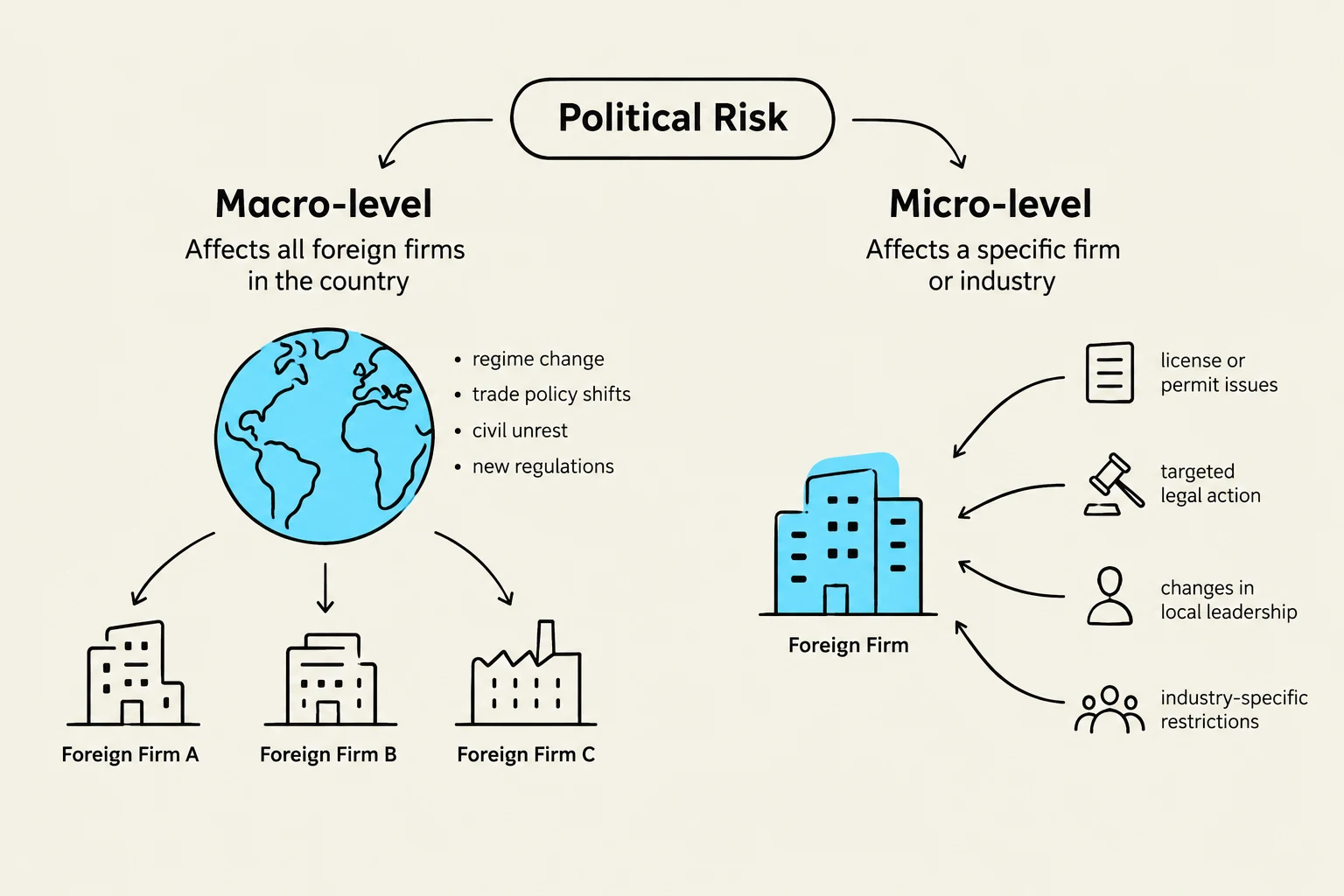
Political risk can be categorized into two broad types: macro-level risk and micro-level risk.
Macro-level risk: These are events that affect all foreign enterprises within a country. Examples include civil unrest, coups, revolutions, or sudden changes in national leadership that shift the country's entire economic stance.
Micro-level risk: These are targeted risks that affect specific industries or individual companies. A government might decide to increase taxes on mining companies or impose stricter environmental regulations on the automotive sector without affecting other sectors.
This diagram illustrates political risk, differentiating between macro-level factors affecting all foreign firms and micro-level factors impacting specific firms or industries.
Exam Tip: When analyzing a case study, always distinguish whether a policy change is "broad-based" (Macro) or "sector-specific" (Micro). This distinction is crucial for determining the scope of the risk to a diversified portfolio.
Regulatory Risk and the "Rules of the Game"
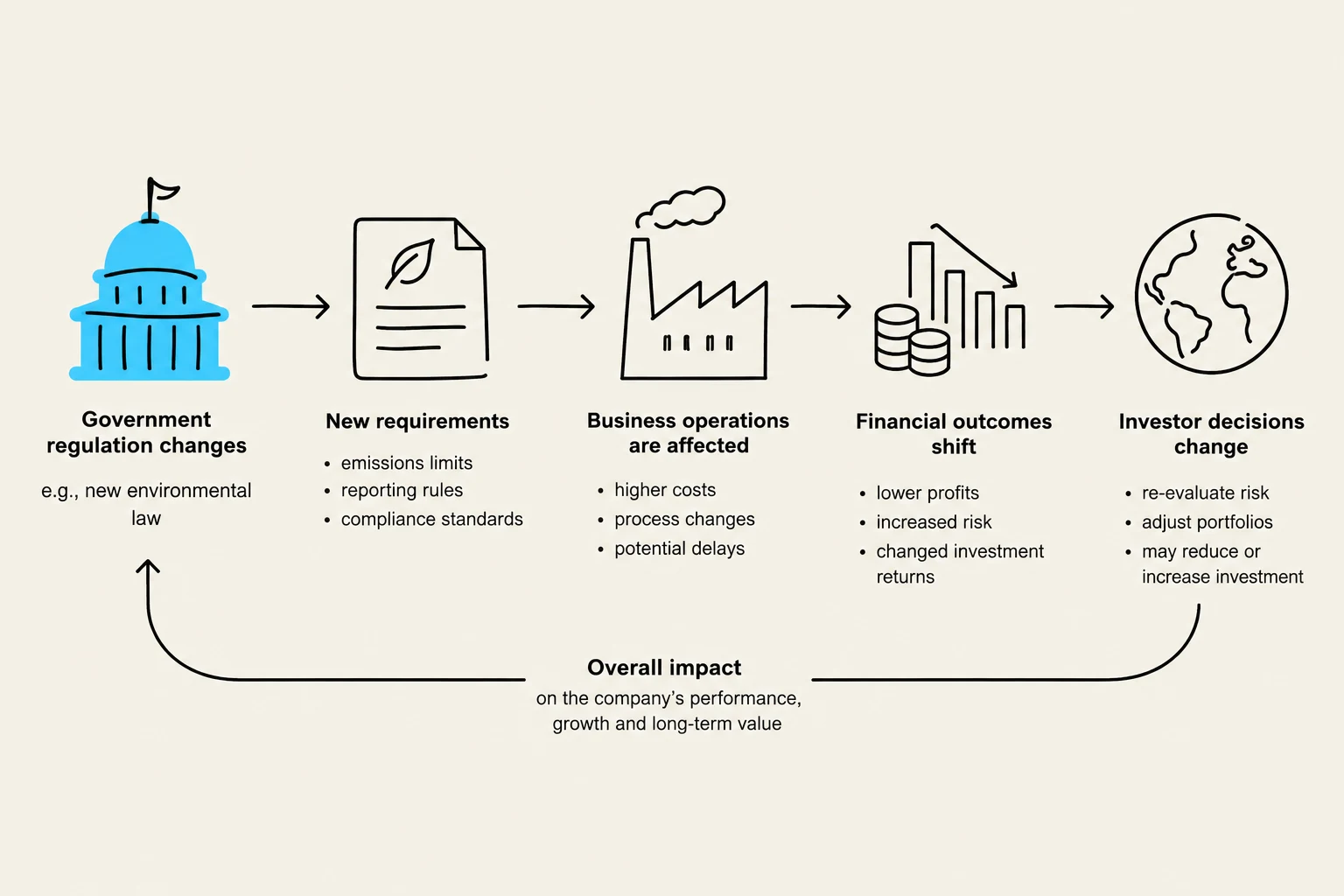
While political risk often captures the "explosive" events like regime changes, regulatory risk represents the more subtle, day-to-day shifts in the legal and administrative environment. Regulatory risk is the danger that a change in laws or government agency rules will impact a business's ability to operate profitably.
Common forms of regulatory risk include:
Changes in Tax Laws: Sudden increases in corporate tax rates or the introduction of new withholding taxes on repatriated profits.
Environmental and Labor Standards: New mandates that require expensive upgrades to manufacturing processes or changes in minimum wage laws.
Trade Barriers: The imposition of tariffs, quotas, or import/export restrictions that disrupt supply chains.
Compliance and Licensing: The sudden revocation of operating licenses or the introduction of complex new bureaucratic requirements.
This diagram illustrates the impact of government regulation changes on business operations, financial outcomes, and investor decisions.
Assessing the Impact on Investment Value
To understand how these risks affect an investor, we can look at how they impact the Net Present Value (NPV) of a project. Political and regulatory changes typically impact one of three variables: cash inflows, cash outflows, or the discount rate.
1. Impact on Cash Flows
A new regulation might increase operating expenses (outflows), or a change in trade policy might reduce the number of customers available in a region (inflows).
2. Impact on the Discount Rate
Political instability increases the "risk premium" that investors demand to hold assets in that country. If the perceived risk of a country increases, the discount rate (r) used in valuation models must also increase.
Consider the standard formula for the Present Value (PV) of a future cash flow:
PV=(1+r)tCFt
Where:
$CF_t$ is the cash flow at time t.
r is the discount rate (incorporating the risk premium).
t is the time period.
If political instability rises, r increases. Because r is in the denominator, an increase in the discount rate leads to a mathematical decrease in the present value of the investment, even if the expected cash flows remain the same.
3. Expropriation and Asset Seizure
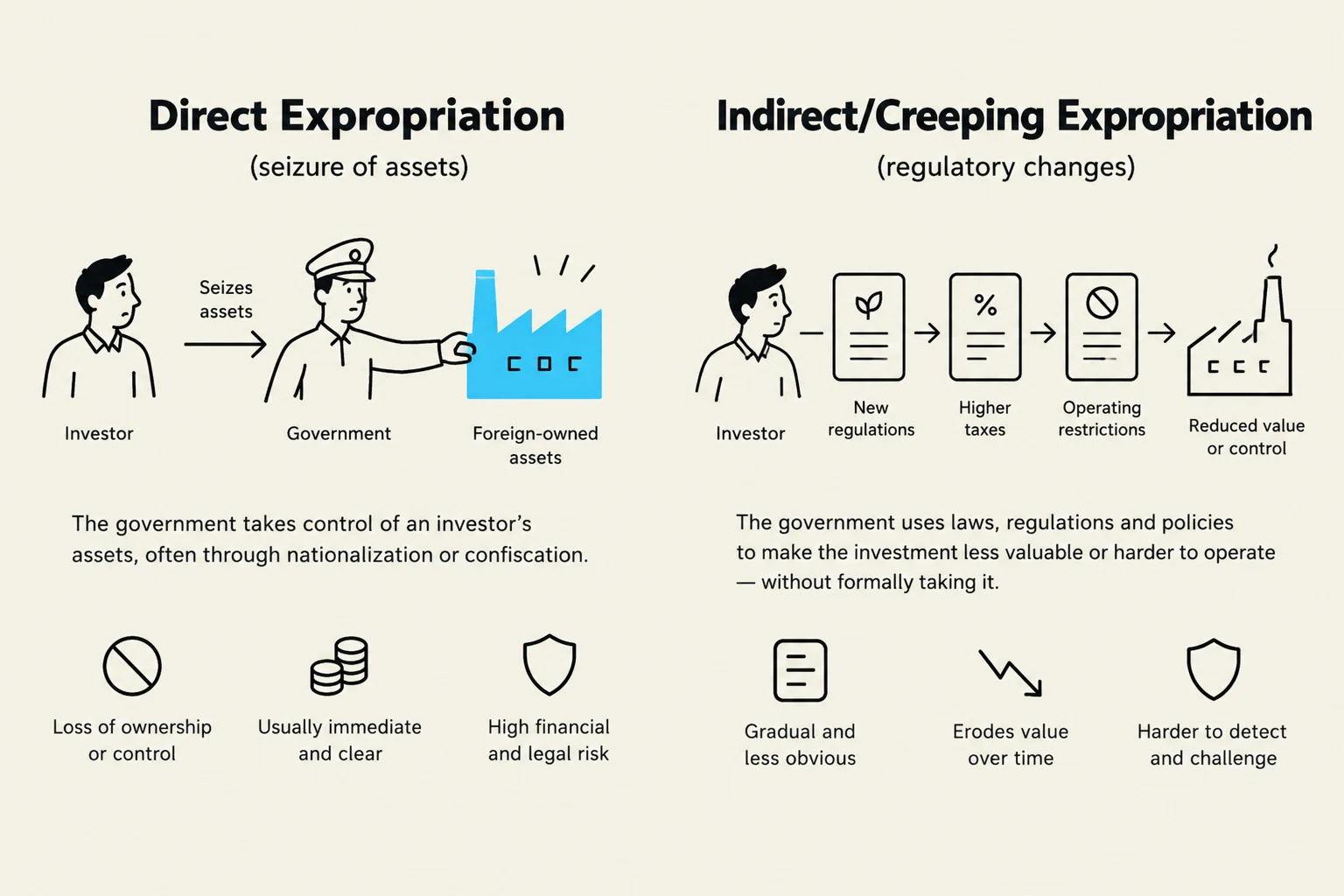
The most extreme form of political risk is expropriation, where a government seizes private assets. This can be direct (physical seizure of property) or indirect (creeping expropriation, where the government uses taxes and regulations to slowly strip the value of the asset until it is no longer profitable for the owner).
This diagram illustrates two forms of expropriation: direct (seizure of assets) and indirect/creeping (regulatory changes), detailing their characteristics and impacts on investors.
Worked Example: The Sudden Tariff
Imagine an electronics firm, GlobalTech, that manufactures components in Country A and sells them in Country B. Currently, the project has an expected annual cash flow of $$1,000,000$ and a discount rate of $10%$.
Suddenly, Country B imposes a $25%$ import tariff on all electronics to protect its domestic industry. This tariff acts as a regulatory risk that increases the cost of goods sold, reducing GlobalTech's annual cash flow from $$1,000,000to$750,000$.
Before the tariff:
PV=(1+0.10)11,000,000=909,091
After the tariff:
PV=(1+0.10)1750,000=681,818
The regulatory change caused a significant drop in the investment's value, even though the physical factory and the company's technology remained untouched.
Mitigating Political and Regulatory Risk
Investors rarely accept these risks blindly. They use several strategies to manage exposure:
Political Risk Insurance (PRI): Specialized insurance policies (often provided by organizations like MIGA, part of the World Bank) that cover losses from expropriation, war, or breach of contract.
Joint Ventures: Partnering with local companies can align the interests of the foreign investor with the host country's citizens, making it politically "costly" for the government to target the firm.
Diversification: Spreading investments across multiple countries and different regulatory environments ensures that a single policy change in one nation does not collapse the entire portfolio.
Scenario Analysis: Instead of relying on a single forecast, analysts create "best-case," "base-case," and "worst-case" scenarios to model how different political outcomes might affect returns.
By integrating these assessments into the early stages of capital budgeting, international investors can make more informed decisions about where to deploy their resources in an increasingly complex global landscape.
Keep reading for free.
Create an account to finish this reading and make it part of your study routine.