Understanding Phylogenetic Inference and Biological Group Classification
This article explains phylogenetic inference, the process of reconstructing evolutionary relationships among organisms. It details the distinctions between monophyletic, paraphyletic, and polyphyletic groups, providing a method to identify them correctly based on evolutionary lineages and common ancestors.
In the study of biology, understanding how life is organized requires more than just looking at what organisms look like. It requires understanding their history. Phylogenetic inference is the scientific process of reconstructing the evolutionary relationships among organisms based on shared characteristics, such as molecular DNA sequences or morphological traits. By analyzing these traits, biologists aim to build "trees of life" that accurately reflect the branching patterns of evolution.
The ultimate goal of this process is to identify valid biological groups. However, not all groups are created equal in the eyes of modern taxonomy. To be considered a scientifically accurate unit, a group must reflect a complete evolutionary lineage. This article will explore the distinctions between monophyletic, paraphyletic, and polyphyletic groups, providing you with a "recipe" to identify them correctly.
The Foundation: Phylogenetic Inference
Phylogenetic inference relies on the principle that organisms sharing more recent common ancestors are more closely related than those that do not. To build these trees, researchers look for specific types of evolutionary markers:
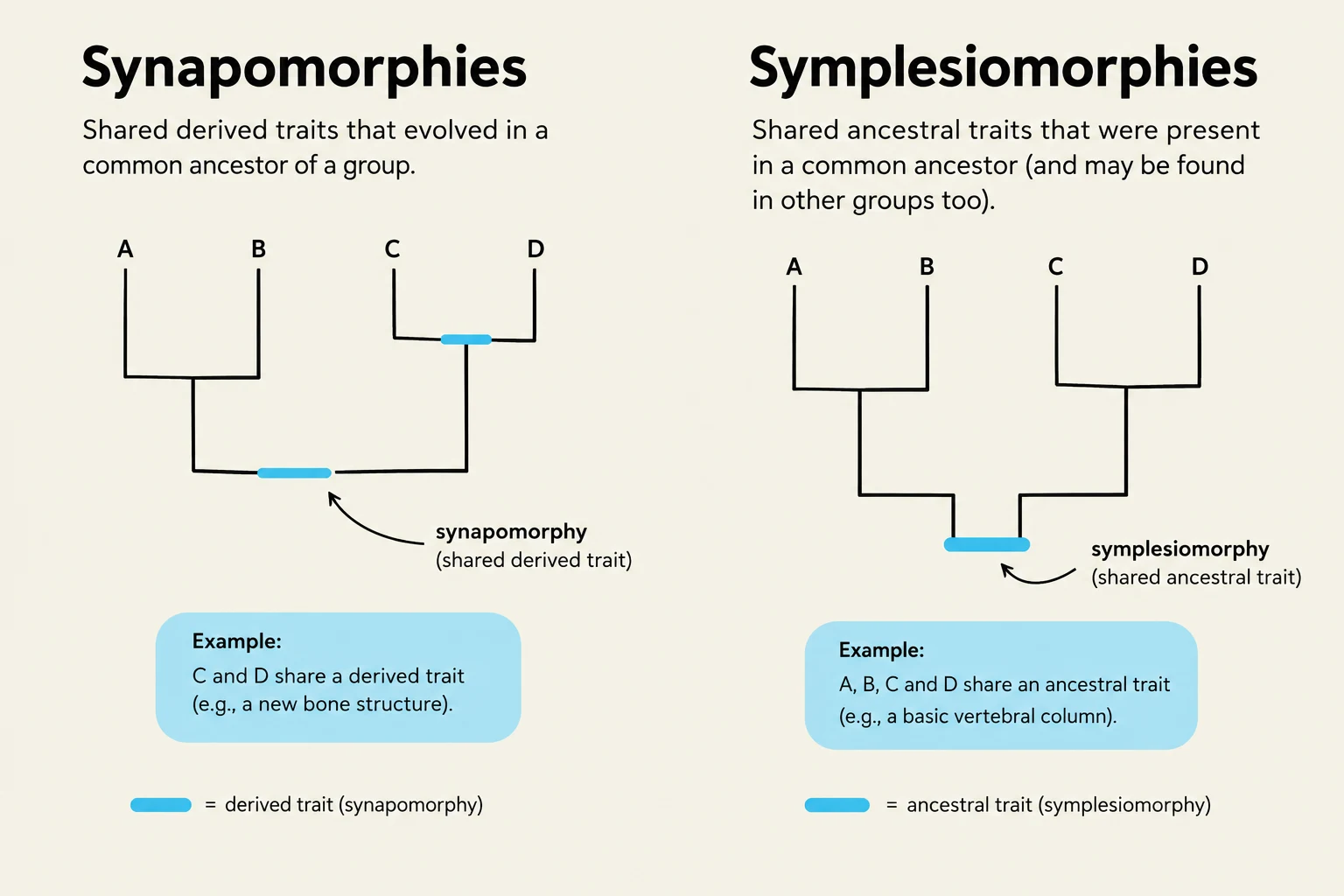
Synapomorphies: These are shared, derived characters. A synapomorphy is a trait that evolved in the most recent common ancestor of a group and was passed down to its descendants. These are the "gold standard" for defining groups because they signal a shared evolutionary innovation.
Symplesiomorphies: These are shared, ancestral characters. These are traits that were present in a distant ancestor but are not unique to the specific group being studied. Because they are "old" traits found in many different lineages, they cannot be used to define a specific new group.
Exam Tip: When asked to identify a clade, do not look for "old" traits (symplesiomorphies) that many animals share, such as having a backbone. Instead, look for "new" traits (synapomorphies) that are unique to that specific branch.
This diagram illustrates the concepts of synapomorphies (shared derived traits) and symplesiomorphies (shared ancestral traits) using phylogenetic trees as examples.
Monophyletic Groups: The True Clades
In modern biological classification, the only valid unit for formal taxonomy is the monophyletic group, also commonly referred to as a clade.
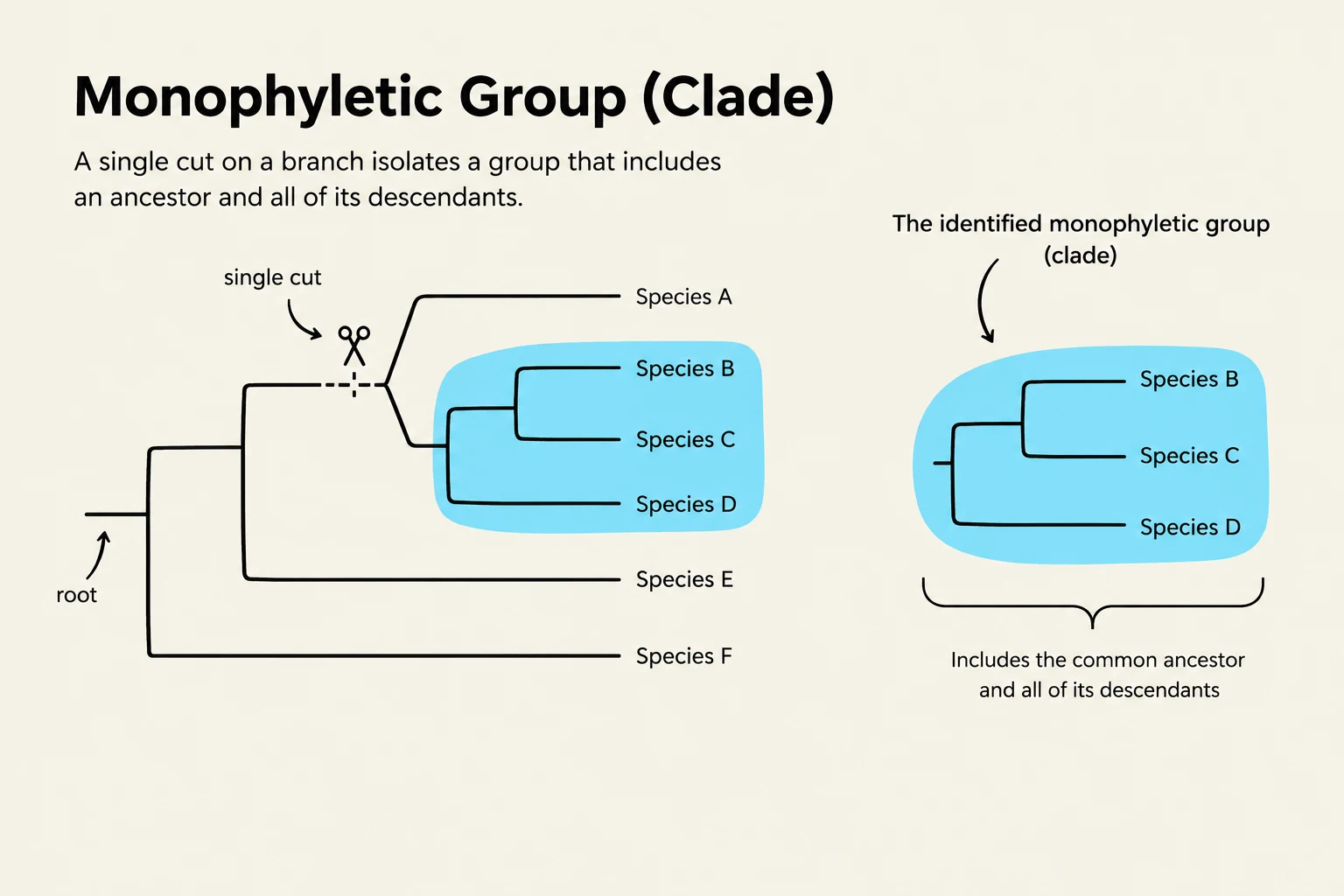
A monophyletic group consists of an ancestral species and all of its descendants. If you were to look at a phylogenetic tree and imagine taking a pair of scissors and making a single, clean cut on one of the branches, every organism that falls off that branch together forms a monophyletic group.
Because monophyletic groups represent complete, unbroken evolutionary lineages, they provide a stable and accurate way to categorize life. For example, "Mammalia" is a monophyletic group because it includes the common ancestor of all mammals and every single descendant species currently in existence.
A diagram illustrating a monophyletic group (clade) in evolutionary biology, showing how a single cut on a phylogenetic tree isolates an ancestor and all of its descendants.
Paraphyletic and Polyphyletic Groups: The Pitfalls of Classification
Not all groups identified by traditional methods are monophyletic. Often, researchers or early taxonomists grouped organisms based on shared appearances rather than shared ancestry, leading to two types of "imperfect" groups.
Paraphyletic Groups
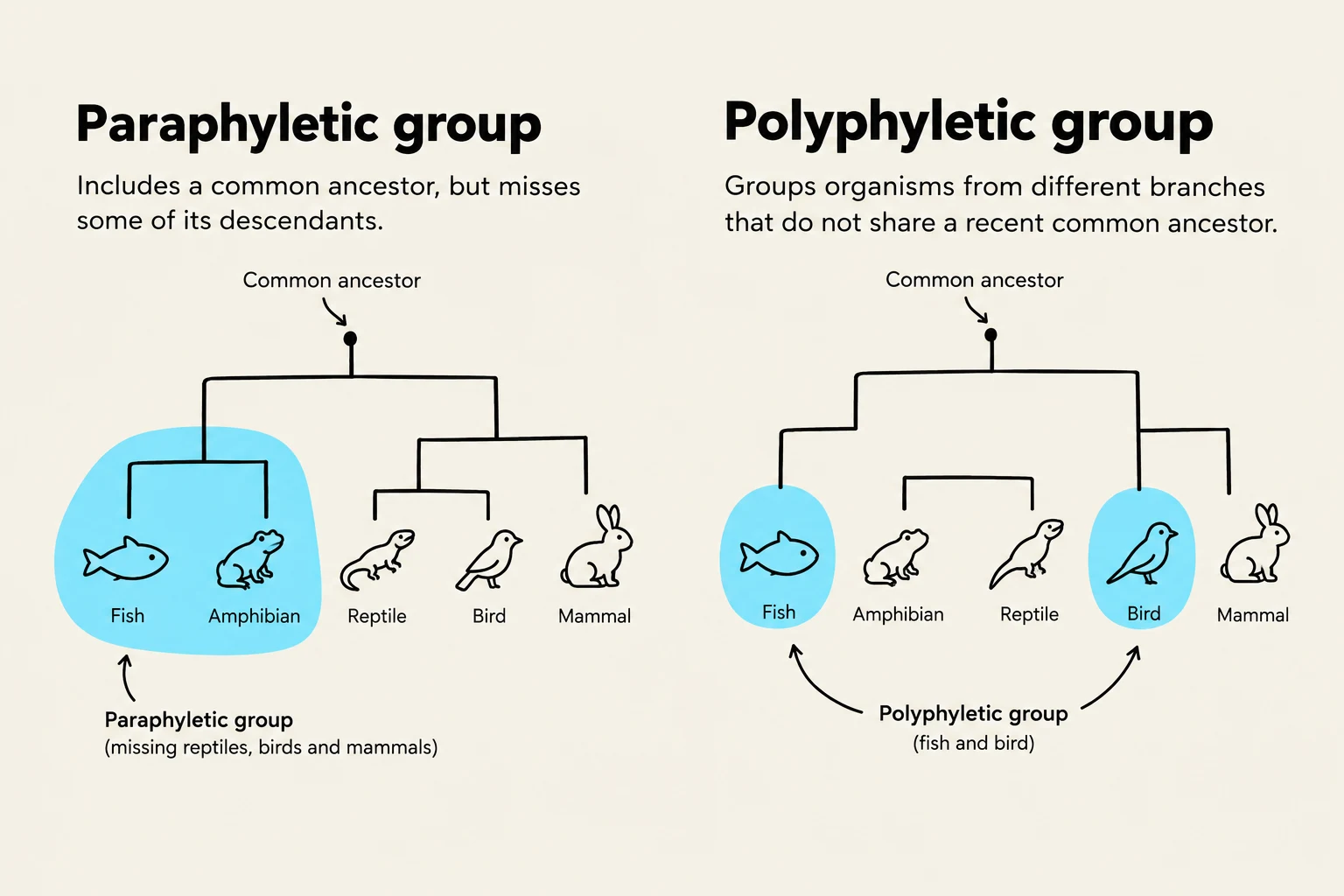
A paraphyletic group consists of an ancestral species and some, but not all, of its descendants. These groups are usually defined by what they lack rather than what they have.
A classic example is the traditional classification of "Reptiles." In many older textbooks, reptiles were defined as a group that included lizards, snakes, and crocodiles, but excluded birds. However, because birds evolved from a specific lineage of reptiles, excluding them makes the "reptile" group paraphyletic. To make it monophyletic, you would have to include birds.
Polyphyletic Groups
A polyphyletic group is a collection of organisms that does not include their most recent common ancestor. These groups are usually formed due to convergent evolution.
Convergent evolution occurs when unrelated species evolve similar traits (analogous structures) because they live in similar environments or face similar selective pressures. For instance, if you grouped "flying animals" together by including bats, birds, and insects, you would be creating a polyphyletic group. They all fly, but they do not share a recent common ancestor that was also a flyer.
This diagram illustrates the difference between paraphyletic and polyphyletic groups in biological classification. A paraphyletic group includes a common ancestor and some, but not all, of its descendants, as shown by the fish and amphibians. A polyphyletic group includes organisms from different branches that do not share a recent common ancestor, exemplified by the fish and birds.
The Recipe for Identification
To distinguish between these groups during an exam or research, follow this mental "recipe":
Identify the Most Recent Common Ancestor (MRCA) of the organisms in your target group.
Check for completeness:
Does the group include the MRCA and all descendants? →Monophyletic (Clade).
Does the group include the MRCA but leaves some descendants out? →Paraphyletic.
Does the group exclude the MRCA entirely, grouping organisms from distant branches? →Polyphyletic.
By applying this logic, you move beyond superficial similarities and begin to see the true history of life written in the branches of the phylogenetic tree.
Keep reading for free.
Create an account to finish this reading and make it part of your study routine.