Understanding Philosophical Worldviews in Research Design
Explore the fundamental philosophical worldviews that underpin research design, including ontology, epistemology, postpositivism, constructivism, pragmatism, and transformative approaches. Learn how these perspectives guide research questions, methodologies, and data interpretation.
When embarking on a research journey, many students believe the first step is simply picking a topic and collecting data. However, professional research is built upon a foundation of deeply held assumptions about the nature of reality and knowledge. These assumptions, known as philosophical worldviews, act as the "compass" for a study, guiding every decision from the initial research question to the final analysis. Understanding how these worldviews connect to ontology and epistemology is essential for designing a study that is coherent, rigorous, and meaningful.
The Foundation: Ontology and Epistemology
Before a researcher can decide how to measure something, they must implicitly or explicitly decide what they are measuring and how they can know it. This involves two core philosophical concepts: ontology and epistemology.
Ontology is the study of being or existence. It asks: "What is the nature of reality?" Is there one single, objective truth that exists independently of us, or are there multiple, subjective realities shaped by human experience?
Epistemology is the study of knowledge. It asks: "How do we come to know and understand what there is?" It explores the relationship between the researcher and the reality being studied.
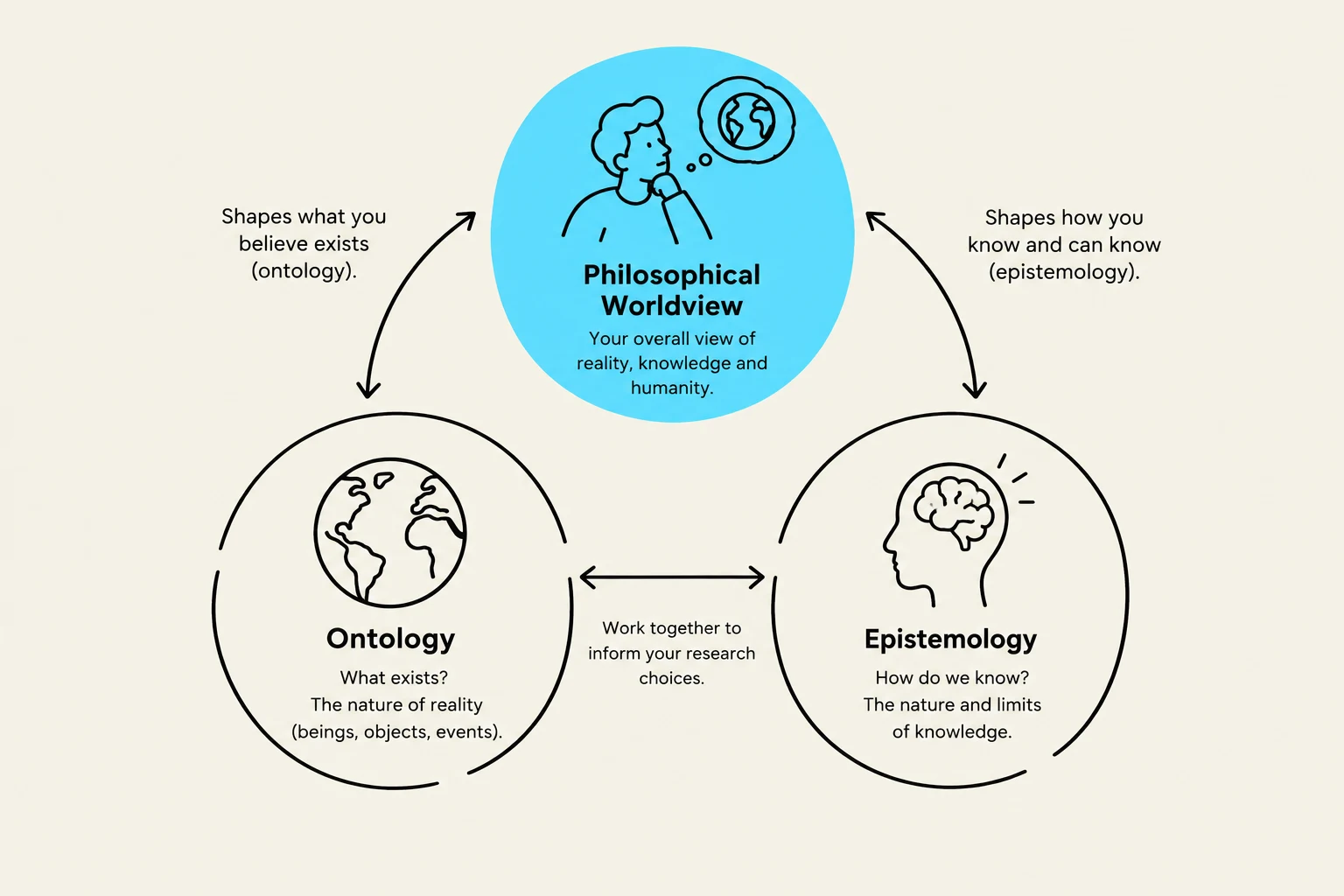
The relationship between these two is cyclical: your view of what is "real" (ontology) dictates what you believe can be "known" (epistemology), which in turn dictates the methods you use to conduct your research.
This diagram illustrates the interconnectedness of philosophical worldview, ontology, and epistemology, explaining how they shape our understanding of reality and knowledge and inform research choices.
Philosophical Worldviews in Research
Researchers generally operate within specific philosophical frameworks. These worldviews provide the logic for the research approach and the specific methods employed.
Postpositivism and the Quantitative Approach
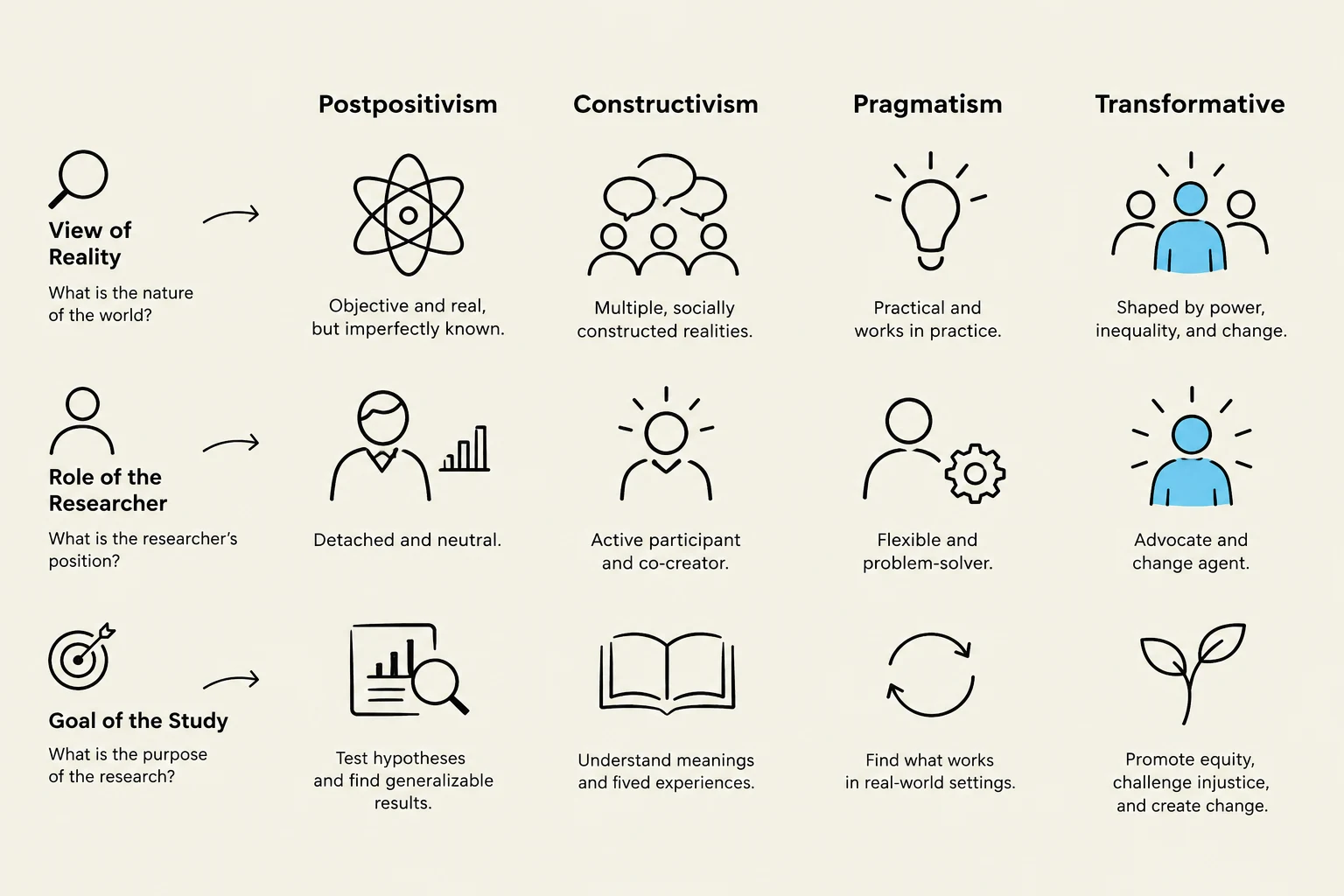
Postpositivism is rooted in the idea that there is a single, objective reality that can be discovered through scientific observation. It relies on the scientific method and assumes that causes determine effects (determinism) and that complex ideas can be broken down into testable questions (reductionism). Because of this focus on objective truth and measurement, postpositivism is the philosophical foundation for the quantitative approach.
Constructivism and the Qualitative Approach
In contrast, constructivism posits that multiple realities exist simultaneously. From this perspective, meaning is not "out there" to be found, but is instead subjective and socially constructed by individuals through their experiences. Researchers using this worldview seek to understand the complexity of these varied views and recognize that their own perspectives shape the research process. This aligns with the qualitative approach.
Pragmatism and Mixed Methods
Pragmatists are less concerned with the debate between a single reality or multiple realities and are instead focused on "what works" to solve a specific problem. They are driven by application and are willing to use whatever tools are necessary to understand a research problem. This flexibility makes pragmatism the natural home for mixed methods approaches, which combine both quantitative and qualitative data.
This diagram illustrates four major research paradigms: Postpositivism, Constructivism, Pragmatism, and Transformative, outlining their views on reality, the role of the researcher, and the goal of the study.
Transformative Worldview
The transformative worldview is driven by an agenda of social change and politics. Rather than just observing the world, researchers in this paradigm aim to reform and better the lives of participants, often through collaborative efforts. While often guided by qualitative approaches (such as feminist theory), quantitative elements can also be integrated to support the goal of social justice.
Expanding the Horizon: Two-Eyed Seeing
In recent years, particularly within Indigenous health research, the concept of "Two-Eyed Seeing" has become increasingly vital. This worldview rejects the idea that one way of knowing is superior to another. Instead, it advocates for "bringing together" the strengths of Indigenous knowledge systems and Western ways of knowing (European-derived sciences). By treating all knowledge systems as equitable, Two-Eyed Seeing allows for a much richer diversity of perspectives and a more holistic understanding of complex issues.
Exam Tip: If a question asks which worldview is most appropriate for a study aimed at social reform or political change, look for "Transformative." If the study focuses on "what works" to solve a practical problem using both surveys and interviews, the answer is "Pragmatism."
Connecting Theory to Design
The worldview you choose directly influences your research design components. For example, in a quantitative study, you will focus on defining variables (independent, dependent, mediator, etc.) and testing hypotheses derived from theory. In a qualitative study, your focus shifts toward exploring a "central phenomenon" to advance understanding rather than measuring associations between variables.
Component
Quantitative (Postpositivist)
Qualitative (Constructivist)
Goal
Test theories and predict outcomes
Explore and understand meanings
Focus
Variables and measurable relationships
Central phenomena and experiences
Logic
Deductive (Theory → Observation)
Inductive (Observation → Theory)
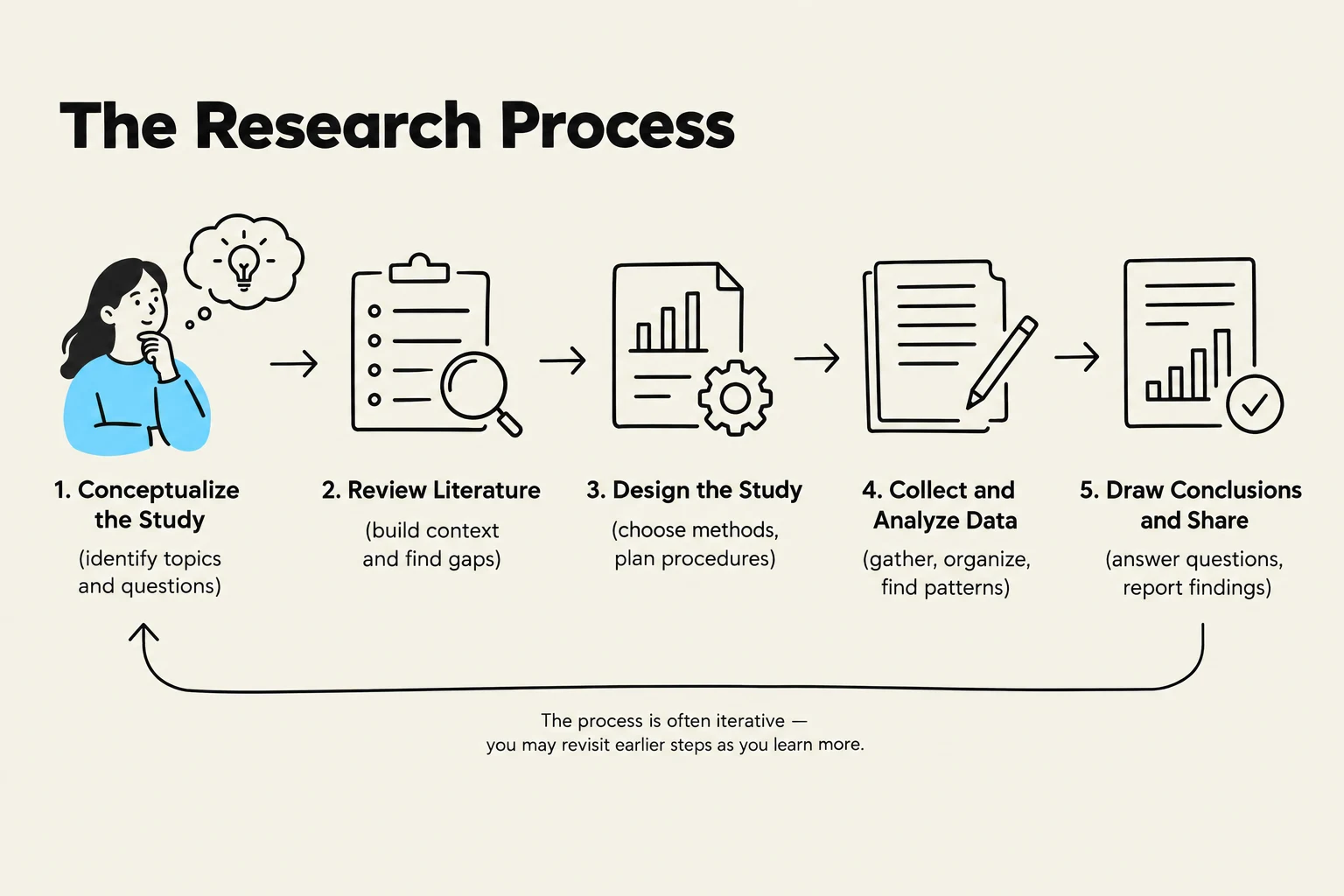
A flowchart illustrating the five steps of the research process: Conceptualize the Study, Review Literature, Design the Study, Collect and Analyze Data, and Draw Conclusions and Share. It also notes that the process is iterative.
Ultimately, what a researcher counts as "knowledge" will influence their entire program of research, including their strategy of inquiry and the specific methods they use to collect and analyze data.
Keep reading for free.
Create an account to finish this reading and make it part of your study routine.