


Effective pest management begins not with the application of a chemical, but with an understanding of the organism itself. To predict when a pest will strike, we must look beyond its appearance and investigate its biological requirements. Every pest species operates within a specific set of environmental boundaries; if these requirements are not met, the pest cannot grow, reproduce, or survive. In the unique climate of Washington State, these requirements—specifically temperature, moisture, and nutrition—dictate the timing of seasonal outbreaks and the success of control measures.
The Engine of Life: Temperature and Degree Days
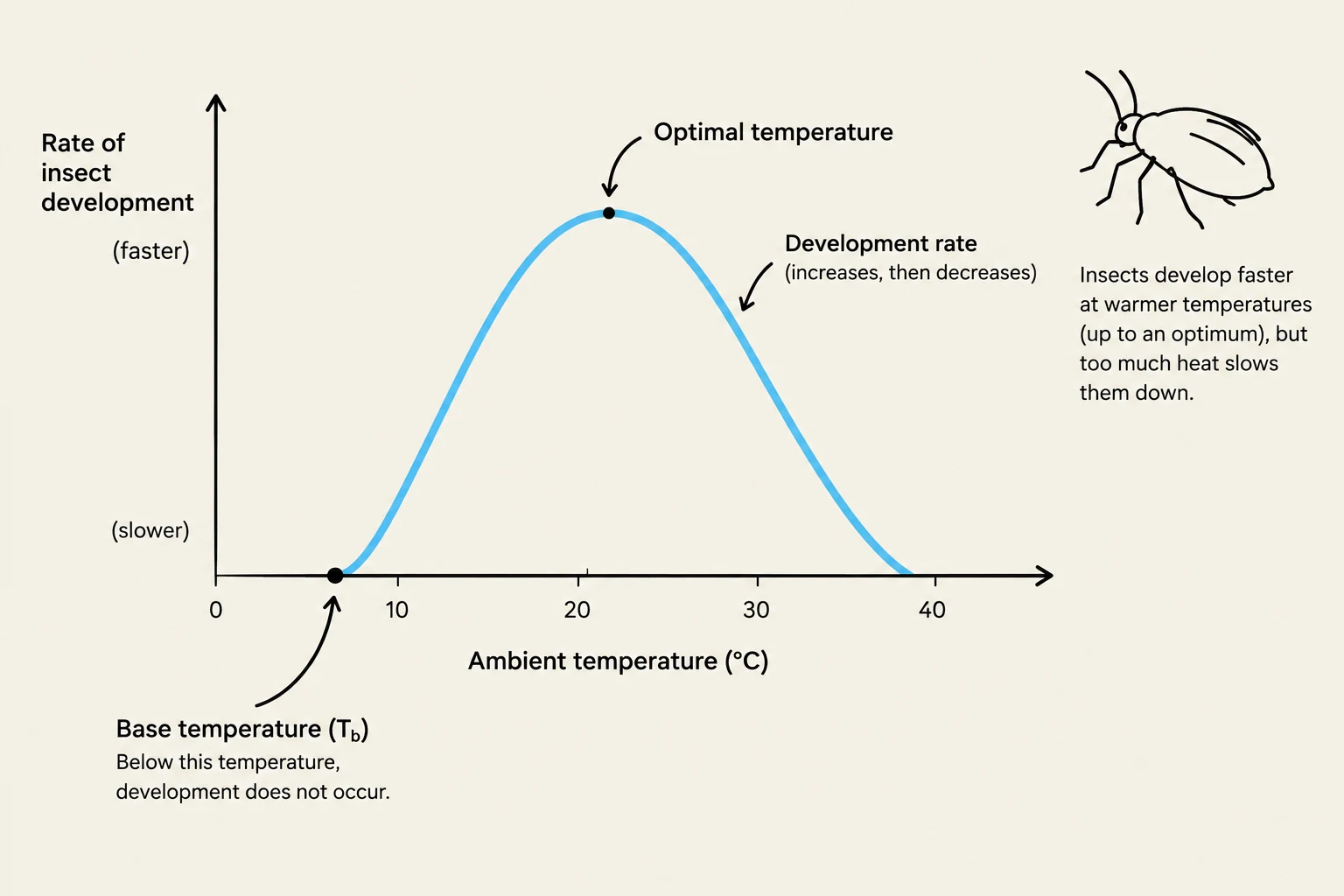
Temperature is perhaps the most critical driver of pest development. Insects are ectothermic, meaning their internal body temperature is regulated by the environment. As the ambient temperature rises, metabolic processes accelerate, leading to faster growth and more frequent generations within a single growing season.
However, temperature does not act linearly across all ranges. Every pest has a "base temperature" (the threshold below which development stops) and an "upper threshold" (the point at which heat becomes lethal). Between these two points, we calculate the rate of development using the concept of Growing Degree Days (GDD).
The mathematical representation of accumulated heat is:
Where:
- is the average temperature on day .
- is the biological threshold for the specific pest.
By tracking these accumulated units, growers in Washington can predict exactly when a pest will transition from a larva to an adult, allowing for "preventative" rather than "reactive" spraying.
Keep reading for free.
Create an account to finish this reading and make it part of your study routine.
Continue reading freeAlready have an account? Log in
Updated