Understanding Personality in Sport and Exercise Psychology
An exploration of personality traits, their development, and their influence on behavior within sport and exercise contexts, including models like the Big Five and concepts such as self-efficacy and mental toughness.
In the realm of sport and exercise psychology, one of the most fundamental questions researchers ask is: "Who are you?" This isn't just a casual inquiry about your name or hobbies; it is a scientific investigation into the psychological characteristics that make people similar to one another and, more importantly, different from one another. By studying personality, we aim to understand how an individual's unique makeup influences their thoughts, feelings, and behaviors within athletic and physical activity contexts.
Defining Personality and Disposition
Personality is defined as a systematic variation in the way people think, feel, and behave. It emphasizes individual differences, acknowledging that every person is unique. Within this study, we often discuss "disposition," which refers to broad, pervasive, and stable ways of relating to particular types of people or situations—such as having an optimistic motivational orientation.
To understand personality, we must distinguish between two critical concepts: Trait and State.
Trait: A relatively stable characteristic or quality that represents a portion of one's personality (e.g., being a "proud person").
State: Momentary feelings and thoughts that change depending on the situation and time (e.g., "feeling proud" in a specific moment).
Exam Tip: Remember the distinction using this mnemonic: A Trait is your "default setting," while a State is your "current mood".
The Big Five Model
One of the most widely recognized frameworks for measuring personality is the Big Five Model (Digman, 1990). This model categorizes personality into five broad dimensions:
Openness to experience: Curiosity and willingness to try new things.
Conscientiousness: Organization, dependability, and discipline.
Extraversion: Sociability and energy levels.
Agreeableness: Cooperativeness and kindness.
Neuroticism: Emotional instability or tendency toward negative emotions.
While these traits are useful, research in sport and exercise has found that there is little to no evidence of a distinct "sport personality," and personality alone is often a poor predictor of elite performance or specific sport choice.
Approaches to Personality Development
How do these personality traits form? Psychologists generally look through three different lenses:
1. Cognitive-Behavioural Approaches
This perspective suggests that people learn behaviors for specific situations through reinforcement and punishment.
Reinforcement: Behavior followed by a reward increases the likelihood of it happening again.
Punishment: Behavior followed by an aversive event decreases the likelihood of it happening again.
Furthermore, Social Learning Theory (Bandura) emphasizes that we are active agents who learn through observational learning (modelling)—watching others to shape our own behaviors. This includes the concept of self-efficacy, which is an individual's belief in their capacity to achieve a specific goal.
2. Biological/Evolutionary Approach
This approach suggests that personality may be moderately heritable, implying an evolutionary basis. For example, differences in extraversion might reflect differences in cortical arousal, while neuroticism may be linked to individual differences in limbic activity.
3. Interactionist Approach
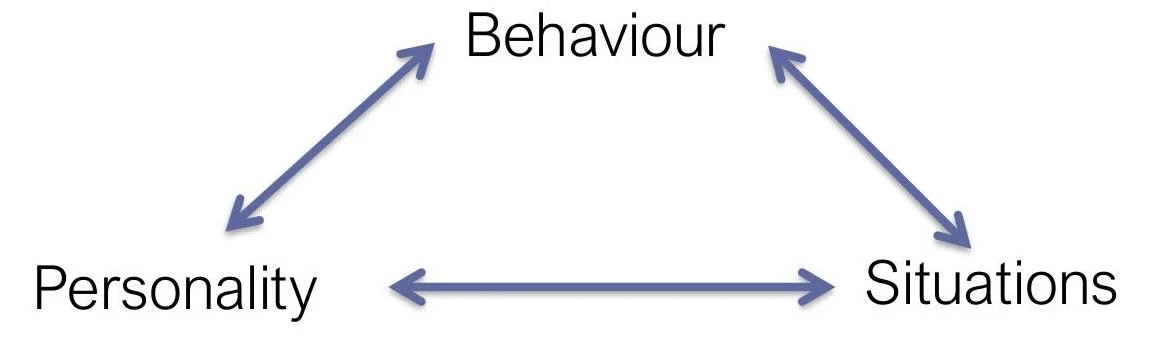
The interactionist approach argues that behavior is not just about the person or just about the environment, but the interplay between the two. An athlete brings their unique dispositions to a situation, and the specific environment determines how those traits manifest.
A diagram illustrating the interaction between personality, behaviour, and situations.
Personality Traits in Sport and Exercise
Beyond the Big Five, several specific constructs are vital to understanding athletes and exercisers.
Risk Taking and Sensation Seeking
Sensation seeking is the desire for varied, novel, complex, and intense sensations, accompanied by a willingness to take risks to achieve them. While some believe sensation seekers have specific personality profiles, evidence is limited; however, we do know that sensation seeking tends to decline with age and is more common in males.
Competitiveness
Competitiveness is the desire to engage in and strive for success. It is often viewed through three dimensions: competitiveness, win orientation, and goal orientation.
Perfectionism: The Paradox
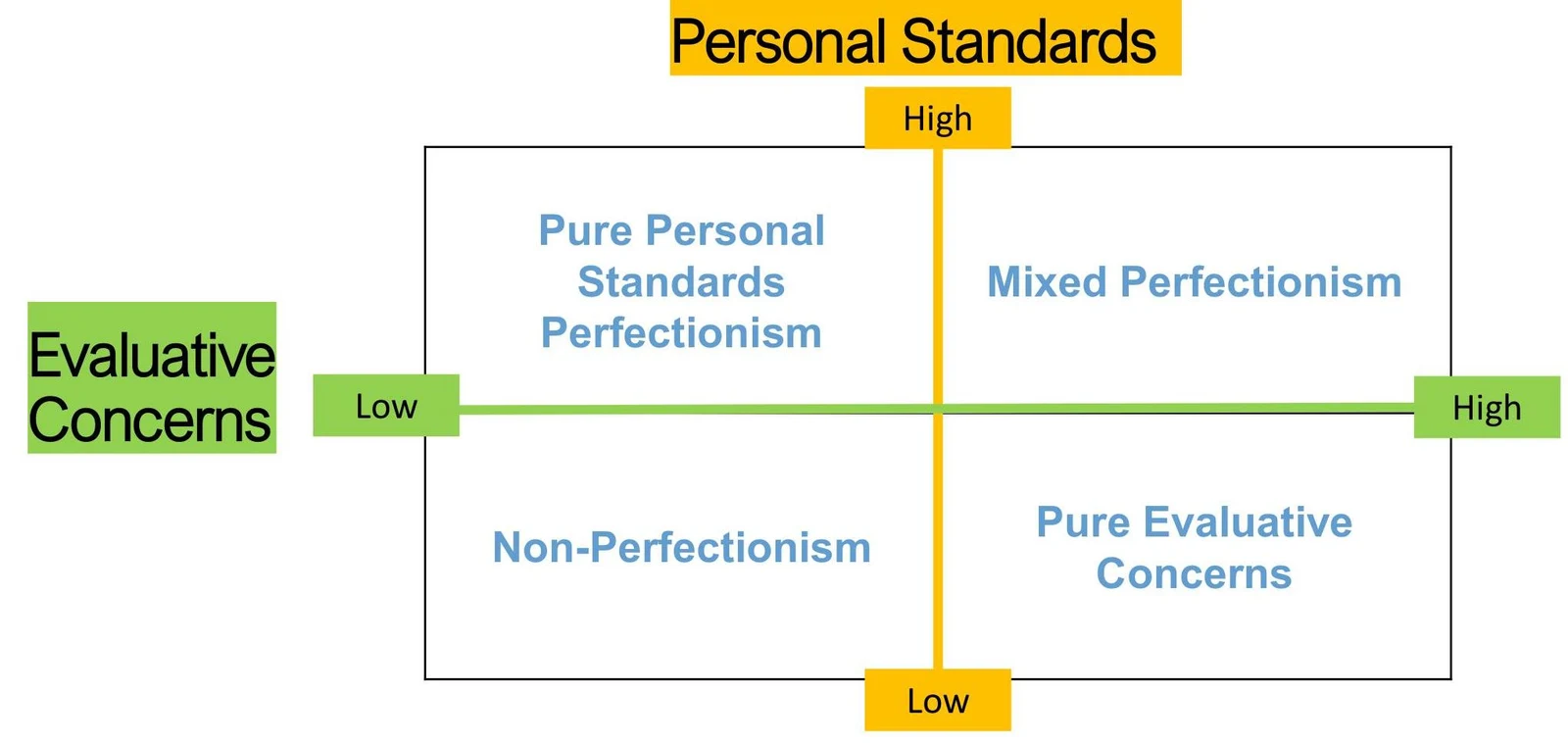
Perfectionism involves striving for exceedingly high standards in a way that is relentless and self-critical. This creates a "Perfectionism Paradox": while high standards can drive success, perfectionists are also vulnerable to unhealthy, maladaptive outcomes.
Researchers distinguish between two types of perfectionism:
Personal Standards Perfectionism (PSP): A self-driven pursuit of flawlessness and continuous improvement. This is often associated with adaptive, healthy functioning.
Evaluative Concerns Perfectionism (ECP): An intense fear of making mistakes and a feeling that others demand perfection. This is linked to negative, dysfunctional outcomes.
A diagram illustrating the four types of perfectionism based on personal standards and evaluative concerns: Pure Personal Standards Perfectionism, Mixed Perfectionism, Non-Perfectionism, and Pure Evaluative Concerns.
Passion
Passion is categorized into two distinct styles:
Harmonious Passion (HP): Engaging in an activity because it is part of your identity and brings pleasure. This is linked to well-being and effective decision-making.
Obsessive Passion (OP): An uncontrolled urge to engage in an activity due to external pressure or guilt. This is linked to stress, rumination, and even cheating.
Mental Toughness and Grit
Mental toughness refers to a set of positive characteristics that allow a person to cope with challenges to reach goals. One common framework is the 4C Model: Challenge, Control, Confidence, and Commitment.
A related concept is Grit, defined as a tendency toward perseverance and passion for long-term goals. While grit is a strong predictor of performance, there is ongoing controversy in the field regarding whether "mental toughness" and "grit" are truly distinct concepts or just new names for the same psychological skills.
Summary of Personality and Exercise
When looking at the broader population through meta-analyses, personality has only a minor association with exercise participation. Specifically, Extraversion and Conscientiousness show small positive associations with physical activity, while Neuroticism shows a small negative relationship.
Critical Reflection: Much of our current personality research is based on "WEIRD" populations (Western, Educated, Industrialized, Rich, and Democratic). As a student, always consider whether a theory developed in one cultural context can be applied universally to all athletes and exercisers.
Keep reading for free.
Create an account to finish this reading and make it part of your study routine.