Understanding Pareto Superiority and Optimality in Economics
This reading explains the economic concepts of Pareto superiority and Pareto optimality. It defines Pareto superiority as a change that benefits at least one person without harming anyone, and Pareto optimality as a state where no further Pareto-superior moves are possible. The text uses examples like fruit trade to il
In the study of economics and law, we often seek to determine whether a change in rules, a new contract, or a shift in resource allocation is "better" than the status quo. However, "better" is a subjective term. What is good for one person might be detrimental to another. To navigate this complexity, economists use a rigorous framework known as Pareto efficiency. This framework allows us to evaluate changes based on their impact on all parties involved, distinguishing between moves that create value and moves that merely redistribute it.
Pareto Superiority: The "Win-Win" Move
The concept of Pareto superiority (often referred to as a Pareto improvement) is the most straightforward way to identify a beneficial change. A change is considered Pareto superior if it makes at least one person better off without making anyone else worse off.
In a world of limited resources, we often look for these "win-win" bargains. If a new law or a trade agreement can increase the utility (satisfaction or wealth) of Person A while leaving Person B's utility unchanged, that move is Pareto superior. Because no one is harmed, there is no logical basis for anyone to object to the change from a purely efficiency-oriented perspective.
Exam Tip: If a question asks whether a change is a Pareto improvement, check two conditions:
Is at least one person better off?
Is nobody worse off?
If even one person loses a single unit of utility, the move is not Pareto superior.
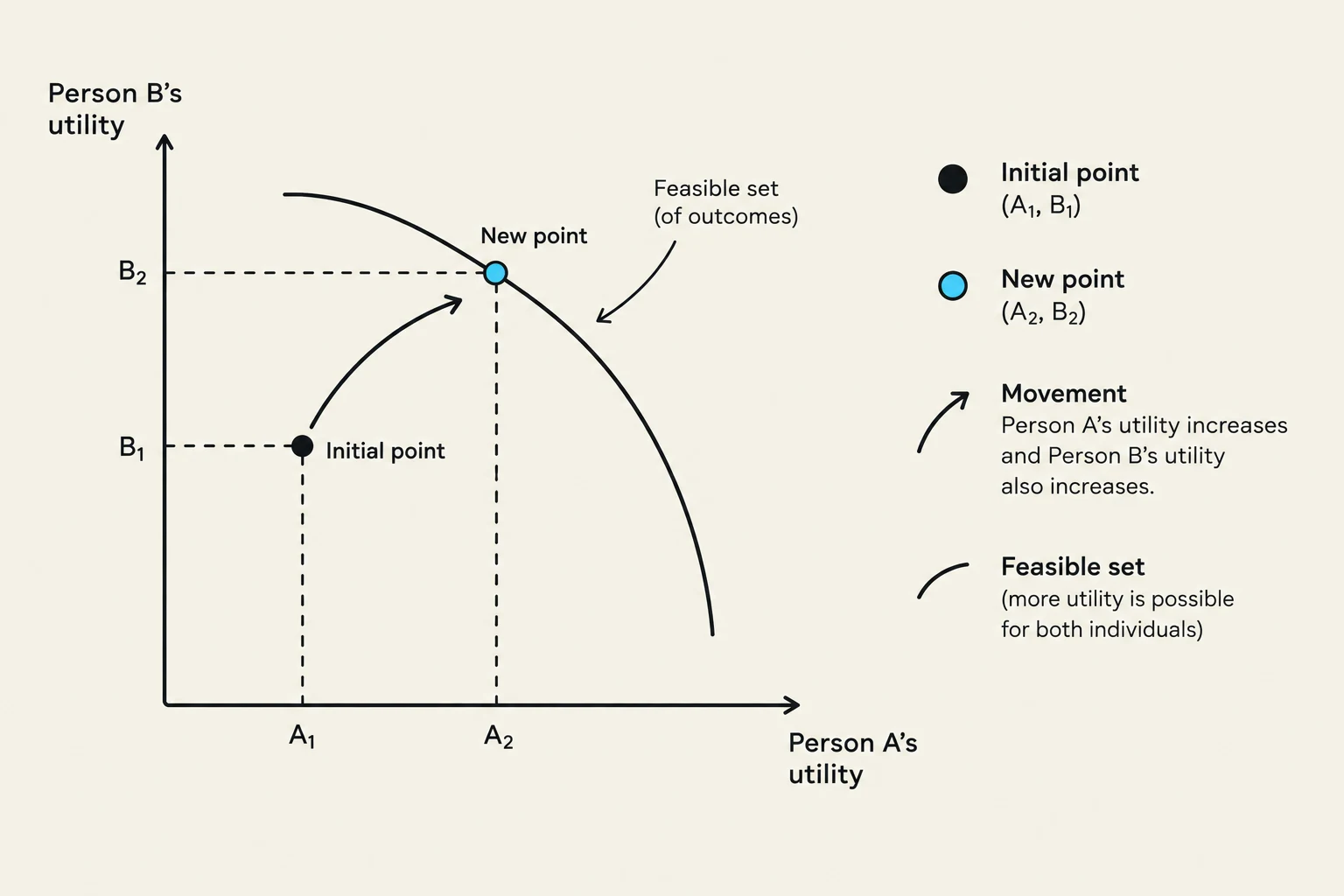
This graph illustrates the concept of a feasible set in economics, showing the possible utility combinations for two individuals, Person A and Person B. The movement from an initial point to a new point indicates an increase in utility for both individuals.
The Limits of Pareto Superiority
It is important to note that Pareto superiority is a very high bar to clear. In the real world, most changes involve trade-offs. If a policy helps the poor but requires a tax increase that slightly reduces the wealth of the rich, it is not a Pareto improvement, even if the net benefit to society is massive. This is because the "no one is made worse off" condition has been violated.
Pareto Optimality: The State of Maximum Efficiency
While Pareto superiority describes a move or a change, Pareto optimality (or Pareto efficiency) describes a state or an equilibrium.
A state is Pareto optimal if it is impossible to make any one person better off without making at least one other person worse off. In other words, you have reached a point where all possible Pareto-superior moves have already been exhausted. You have squeezed all the "free" value out of the system.
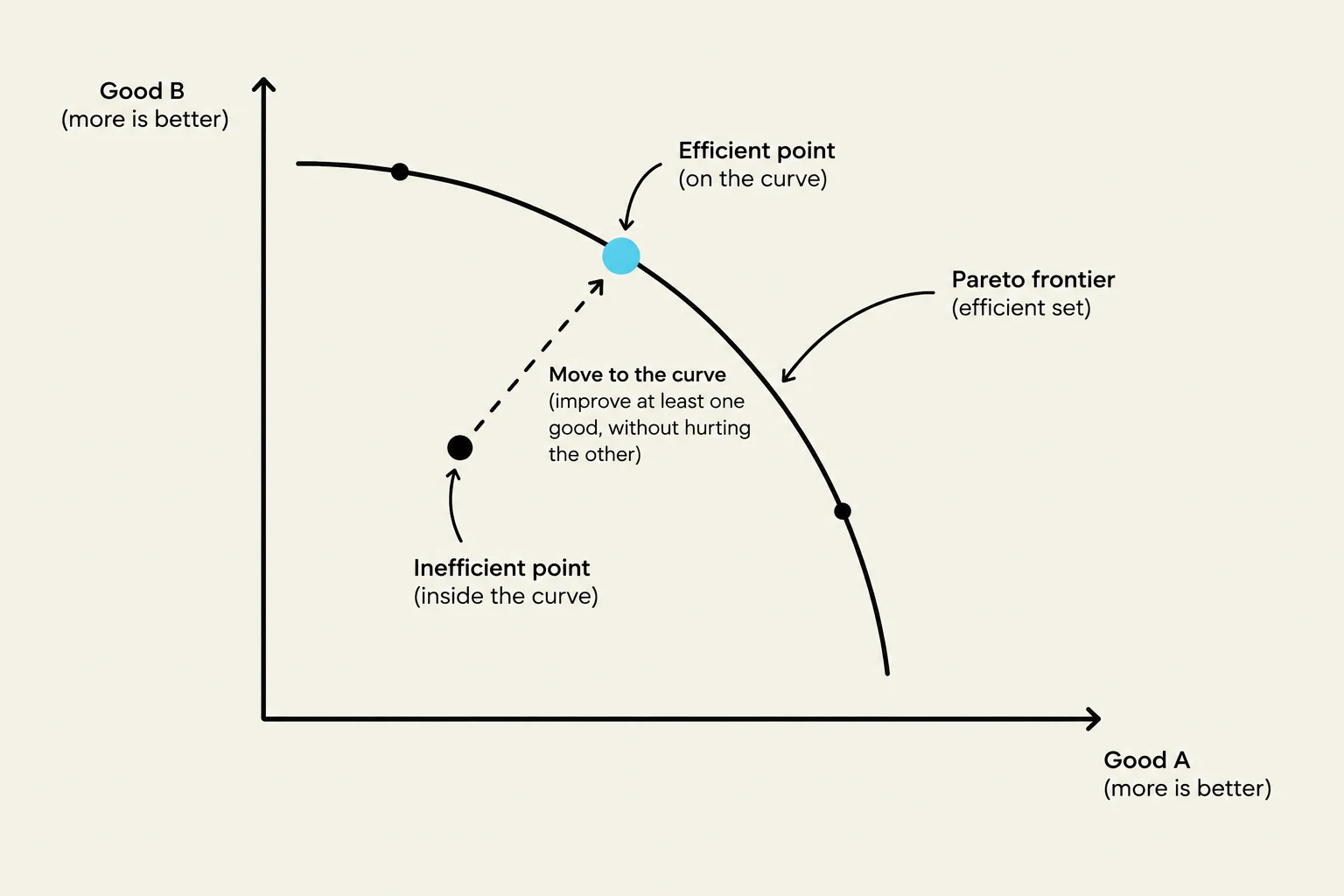
This graph illustrates the concept of Pareto optimality, showing the trade-offs between two goods. Points on the Pareto Frontier represent states where no individual can be made better off without making someone else worse off. Points inside the frontier are not Pareto optimal, as improvements can be made for one party without negatively impacting the other.
The Pareto Frontier
When we plot the utility of two different parties on a graph (with Person A on the x-axis and Person B on the y-axis), the collection of all Pareto optimal points forms a boundary known as the Pareto Frontier.
Inside the Frontier: Any point located below or to the left of the frontier is "inefficient." At these points, there is still room for Pareto-superior moves. You could move toward the frontier to make someone better off without hurting anyone else.
On the Frontier: Any point on the frontier is Pareto optimal. To move from one point on the frontier to another, you must trade off utility from one person to give to the other.
Worked Example: The Fruit Trade
To solidify these concepts, let's look at a simple exchange between two individuals, Alice and Bob.
Initial State (Status Quo):
Alice has 10 Apples and 0 Oranges.
Bob has 0 Apples and 10 Oranges.
Scenario 1: A Pareto Superior Move
Suppose there is a surplus of fruit in a nearby orchard. A new rule allows Alice to take 5 Oranges for free.
Alice now has 10 Apples and 5 Oranges.
Bob still has 0 Apples and 10 Oranges.
Since Alice is better off and Bob is unchanged, this is a Pareto improvement.
Scenario 2: A Pareto Optimal State
Now, suppose Alice and Bob decide to trade. Alice gives Bob 5 Apples in exchange for 5 Oranges.
Alice: 5 Apples, 5 Oranges.
Bob: 5 Apples, 5 Oranges.
If they have reached a point where any further trade (e.g., Alice giving Bob another apple) would result in Alice having less of something she values, they have reached a Pareto optimal state. They cannot improve one person's situation without hurting the other.
Scenario 3: An Inefficient State
If Alice has 10 Apples and Bob has 10 Oranges, but they both want the other fruit, the current state is inefficient. They are "inside the frontier." A trade would be a Pareto-superior move that leads them toward the frontier.
Summary Table: Comparison of Concepts
Concept
Definition
Focus
Pareto Superiority
A change that helps at least one person and harms no one.
The process of change.
Pareto Optimality
A state where no more Pareto-superior moves are possible.
The end result or state.
Inefficiency
A state where a Pareto-superior move is still possible.
The potential for improvement.
Final Thought for Students: Remember that Pareto optimality does not mean "fairness." A state where one person owns everything and everyone else has nothing can still be Pareto optimal, provided that you cannot give anything to the others without taking it away from the person who owns everything. Pareto analysis measures efficiency, not equity.
This graph illustrates the concept of Pareto efficiency, showing the trade-offs between two goods (Good A and Good B). Points on the Pareto frontier represent efficient allocations where no individual can be made better off without making someone else worse off. Points inside the curve are inefficient, meaning resources could be reallocated to improve at least one individual's well-being without harming another.
Keep reading for free.
Create an account to finish this reading and make it part of your study routine.