Parallelism is a fundamental principle of professional communication that uses similar patterns of words or grammatical forms to express similar or related ideas. This guide explains how to identify and correct faulty parallelism for clearer and more effective writing.
Have you ever read a sentence that felt "off," even if you couldn't quite explain why? Perhaps it felt clunky, awkward, or forced you to pause unexpectedly in the middle of a thought. Often, the culprit is a lack of parallelism. Parallelism is a fundamental principle of professional communication that uses similar patterns of words or grammatical forms to express similar or related ideas. When mastered, it transforms writing from a series of disjointed thoughts into a cohesive, persuasive, and rhythmic experience.
What are Parallel Structures?
At its core, parallelism is about consistency. When you are listing items, comparing ideas, or describing a series of actions, you should use the same grammatical "template" for each part of that series. This means if your first item is a noun, the subsequent items in that list should also be nouns. If you start with a verb phrase, you should continue with verb phrases.
Parallel structures are used to:
Express ideas of equal importance: It signals to the reader that each item in a list carries the same weight.
Create rhythm and balance: It makes the prose "pleasing to the ear".
Improve clarity and conciseness: It allows the reader to process information smoothly without being tripped up by sudden changes in sentence structure.
Emphasize points: Well-placed parallelism can make a powerful, persuasive impact.
This diagram illustrates the concept of parallelism in language, showing how balanced structures, like a scale, make elements easier to understand. It uses the example of three nouns (strength, courage, wisdom) on one side of the scale, balanced by a matching structure of three items on the other.
Identifying Faulty Parallelism
Faulty parallelism occurs when a writer breaks the established pattern within a sentence. It is important to note that faulty parallelism does not usually create a factual error or change the literal meaning of a sentence. Instead, it creates a stylistic error that disrupts the flow of reading.
Common examples of faulty parallelism include:
Mixing Nouns and Verb Phrases:
Faulty: "Golf requires hand-eye coordination, flexibility, and to be able to concentrate".
Why it fails: The first two items are nouns, but the third is a verb phrase.
Mixing Verb Phrases and Nouns:
Faulty: "Jack is responsible for loading the trunk, cleaning the seat cushions, and the engine check".
Why it fails: The first two items are verb phrases, while the third is a noun.
Inconsistent Verb Forms:
Faulty: "Working on tall bridges requires tremendous balance, amazing agility, and will create an eventual lack of fear".
Why it fails: The shift from noun phrases to a future-tense verb phrase creates an "uncomfortable pause" for the reader.
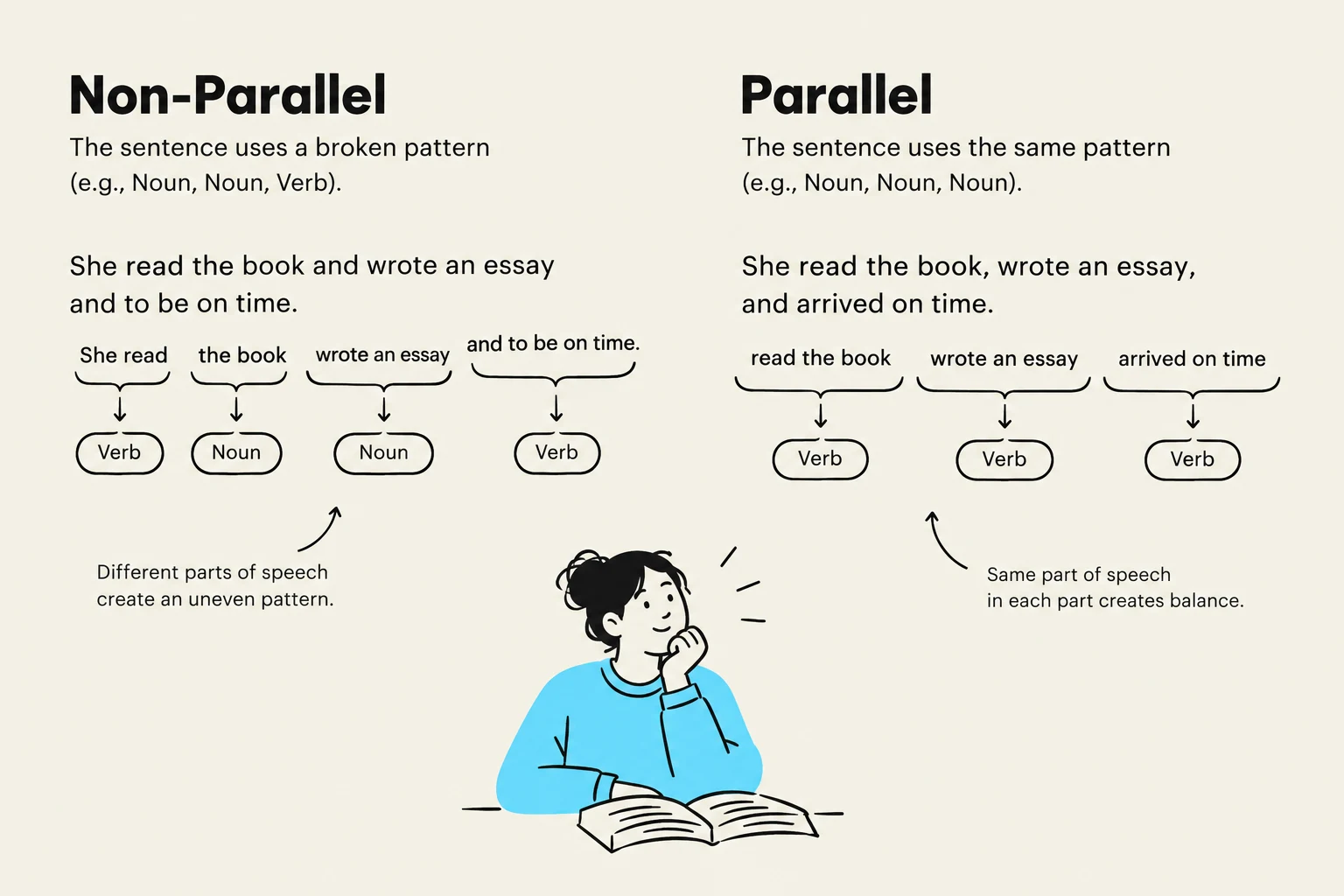
This illustration explains the grammatical concepts of parallel and non-parallel sentence structures, demonstrating how consistent parts of speech create balance in parallel structures.
Exam Tip: When you encounter a multiple-choice question asking you to identify a parallel sentence, look at the grammatical category of each item in the list. If one item is an "-ing" word (gerund) and the next is a "to..." word (infinitive), the sentence is likely not parallel.
Correcting Faulty Parallelism
Correcting these errors is a matter of "matching" the forms. You must decide on a single grammatical structure and apply it to every element in the series.
Worked Example 1: The Noun List
Incorrect: "Golf requires hand-eye coordination, flexibility, and to be able to concentrate".
Correct: "Golf requires hand-eye coordination, flexibility, and concentration".
Logic: We converted the verb phrase into a noun so that all three items are nouns.
Worked Example 2: The Verb Phrase List
Incorrect: "Jack is responsible for loading the trunk, cleaning the seat cushions, and the engine check".
Correct: "Jack is responsible for loading the trunk, cleaning the seat cushions, and checking the engine".
Logic: We converted the noun into a verb phrase so that all three items follow the "verb + object" pattern.
Worked Example 3: Comparisons
Parallelism is also vital when comparing two things. If you use a structure like "Just as..., so does..." you must ensure the two sides of the comparison mirror each other.
Parallel: "Just as she loves reading, so does she enjoy writing".
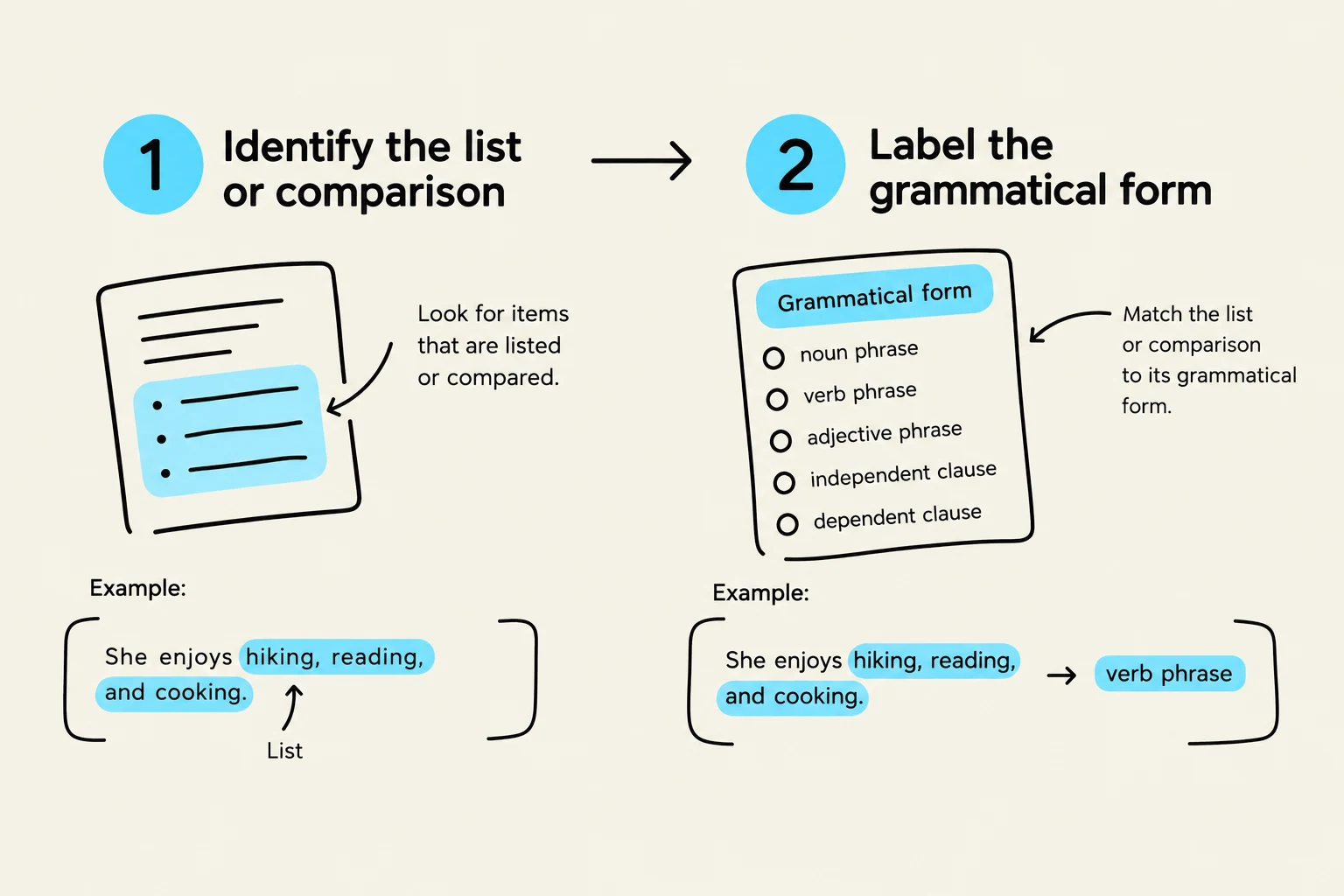
This illustration explains how to identify a list or comparison in a sentence and label its grammatical form, using an example of a verb phrase.
Summary Checklist for Editors
When you are reviewing your own work or preparing for an exam, use this checklist to ensure your writing remains smooth and professional:
Check Lists: Are all items in a series the same part of speech (all nouns, all adjectives, or all verbs)?
Check Verb Tenses: If you are describing a sequence of actions, are the tenses consistent?
Check Infinitive Phrases: If you use "to [verb]" for the first item, do you use it for the others, or do you omit the "to" for subsequent items? (Note: "To dance, to jog, and to bike" is parallel, as is "To dance, jog, and bike").
Check Comparisons: Do the two things being compared use the same grammatical construction?
By applying these rules, you move away from "clunky" and "confusing" prose and toward writing that is easy to understand, pleasing to the ear, and even persuasive.
Keep reading for free.
Create an account to finish this reading and make it part of your study routine.