Understanding Organizational Culture: Characteristics, Functions, and Dynamics
An exploration of organizational culture, defining its core characteristics, functions, and the different frameworks used to categorize it, such as the Clan, Adhocracy, Market, and Hierarchy models. It also delves into the depth of culture using the organizational iceberg concept and discusses its impact on organizatio
In the study of organizational behavior, few concepts are as pervasive or as influential as culture. Organizational culture refers to a system of shared meaning held by members that distinguishes one organization from another. It is the "social glue" that holds an organization together, providing a unique identity that tells employees and outsiders alike what the company stands for and how it operates.
Primary Characteristics of Culture
While every organization is unique, researchers have identified several primary characteristics that capture the essence of a company's culture. These characteristics act as dimensions along which different organizations can be measured.
Adaptability: The degree to which an organization responds to changes in the external environment and encourages innovation.
Detail Orientation: The extent to which employees are expected to pay attention to all little details.
Results/Outcome Orientation: The focus on outcomes and results rather than the techniques and processes used to achieve them.
People/Customer Orientation: The degree to which management decisions take into account the effect of outcomes on people within the organization and its customers.
Collaboration/Team Orientation: The extent to which work activities are organized around teams rather than individuals.
Integrity: The degree to which employees are expected to exhibit honesty and trustworthiness.
Student Tip: When analyzing a case study, do not just label a culture as "good" or "bad." Instead, use these dimensions to describe the extent to which a company exhibits these traits (e.g., "The company has a high degree of outcome orientation but low detail orientation").
Cultural Frameworks: The Four Types
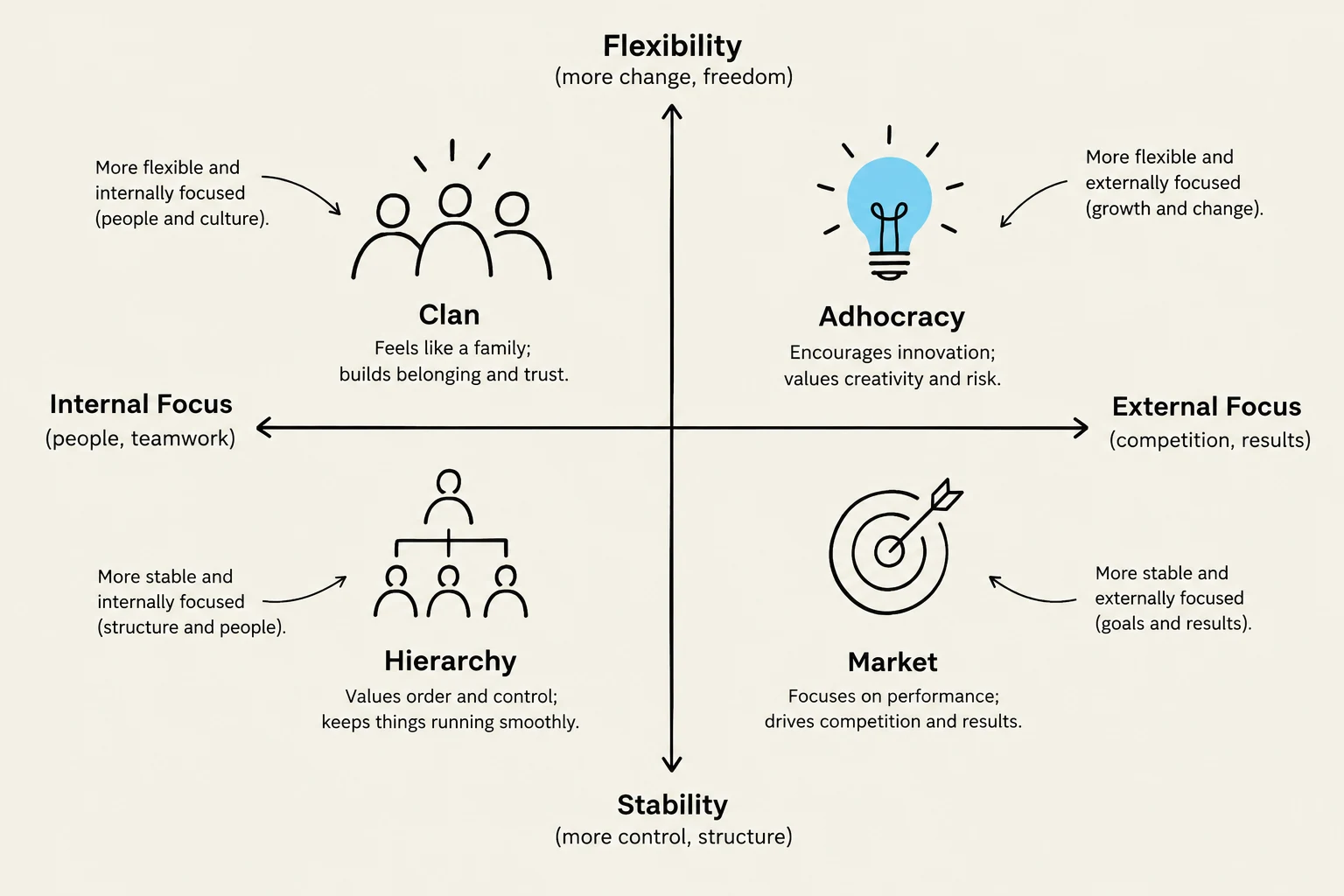
Beyond individual characteristics, many scholars use a framework to group organizations into four distinct cultural types based on their internal focus and external orientation:
Clan Culture: Focused on internal maintenance with flexibility; resembles a family-like environment where mentoring and teamwork are central.
Adhocracy Culture: Focused on external positioning with flexibility; characterized by innovation, risk-taking, and adaptability.
Market Culture: Focused on external positioning with stability and control; driven by competition, achievement, and results.
Hierarchy Culture: Focused on internal maintenance with stability and control; relies on formal rules, structure, and efficiency.
This diagram illustrates the Competing Values Framework, a model used to assess and categorize organizational culture based on two dimensions: flexibility vs. stability, and internal vs. external focus. It defines four types of organizational cultures: Clan, Adhocracy, Market, and Hierarchy.
The Depth of Culture: The Organizational Iceberg
To truly understand culture, one must recognize that it exists at different levels. A common way to visualize this is through the "Organizational Iceberg" concept.
Just like a physical iceberg, culture has visible and invisible components. The visible parts (the tip of the iceberg) might include formal structures, official goals, and observable behaviors. However, the vast majority of culture lies beneath the surface. This "submerged" culture includes shared values, underlying assumptions, and deep-seated beliefs that drive behavior but are much harder to change or observe directly.
This iceberg model illustrates the visible and hidden elements of an organization, distinguishing between explicit aspects like structure and strategy, and intangible elements such as values, beliefs, norms, and shared attitudes that influence behavior and decisions.
What Do Cultures Do? Functions and Climate
Culture is not just a passive background; it serves active functions within an organization:
Boundary-defining role: It creates distinctions between one organization and others.
Identity: It conveys a sense of identity for its members.
Commitment: It facilitates the generation of commitment to something larger than individual self-interest.
Stability: It enhances the stability of the social system.
Control mechanism: It serves as a sense-making and control mechanism that guides and shapes the attitudes and behavior of employees.
Organizational Climate and Ethics
Culture also creates organizational climate, which refers to the shared perceptions employees have about the organization and its work environment. While culture is the deep-seated system of meaning, climate is the "atmosphere" that influences daily habits and team spirit.
Furthermore, culture has a critical ethical dimension. Organizations are not ethically neutral. Over time, a shared concept of right and wrong behavior develops as part of the organizational climate. This "ethical climate" reflects the true values of the organization and shapes how members make decisions.
The Global Context and Intervening Variables
In a globalized economy, culture does not exist in a vacuum. National culture often reflects and influences organizational culture. For example, management practices that are considered standard in one country might be viewed as unethical or inappropriate in another due to differing national values regarding personal contacts or hierarchy.
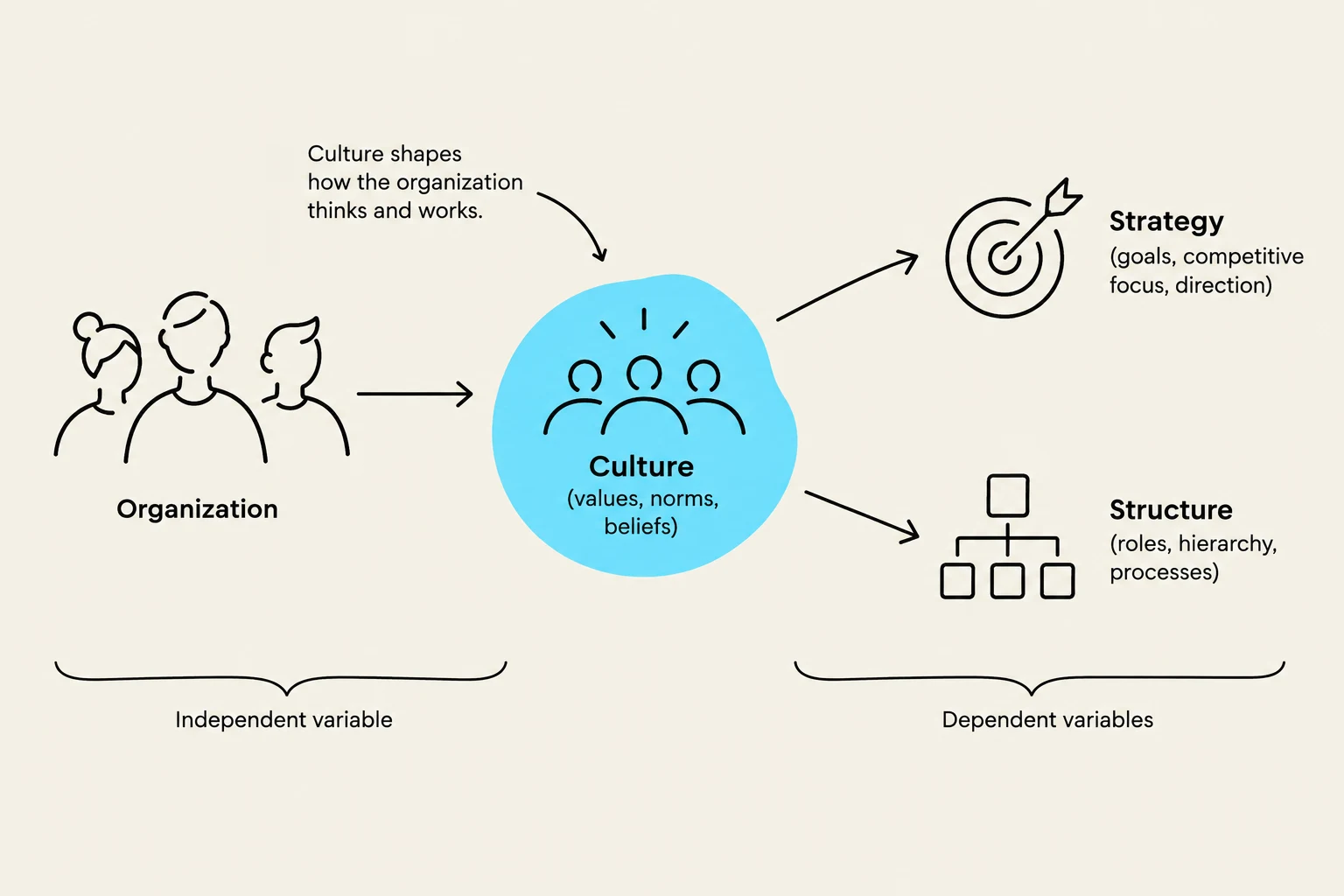
Finally, it is important to view culture as an intervening variable. This means that culture can sit between an organizational cause (like a new strategy or structure) and an effect (like employee performance or satisfaction). A new strategy might fail to produce the intended results if the existing organizational culture does not support it.
This diagram illustrates the relationship between an organization's culture, strategy, and structure, showing how culture influences the other two elements.
Exam Insight: If asked how to close the gap between the current state (IST) and the desired state (SOLL) of an organization, always consider whether the culture supports the proposed strategy. If the strategy requires innovation but the culture is a rigid "Hierarchy," the strategy will likely fail unless the culture is addressed.
Keep reading for free.
Create an account to finish this reading and make it part of your study routine.