Understanding Organizational Culture and Structure
Explore the fundamental concepts of organizational culture, including its levels, drivers, and diversity, alongside organizational structure, its common elements, and basic types. Learn how aligning culture, structure, and strategy leads to organizational effectiveness.
When you walk into a new company, you might notice more than just the desks and computers. You might sense a specific "vibe"—perhaps everyone is dressed formally and speaks in hushed tones, or perhaps the office is an open space filled with loud laughter and collaborative energy. This "vibe" is not accidental; it is the manifestation of the organization's culture and structure. Together, these elements form the building blocks of an organization, determining how work gets done, how people interact, and how the company responds to the world around it.
Understanding Organizational Culture
Organizational culture is often described as a company's "DNA". Formally, it is the set of shared, taken-for-granted implicit assumptions that a group holds, which determines how members perceive, think about, and react to their various environments. It provides a powerful, often invisible template for employee behavior, guiding individuals toward the "right way" of performing tasks.
Several key drivers shape this culture:
Founder's values: The original vision and personality of the creators.
Industry and business environment: The competitive landscape and market demands.
National culture: The broader societal values of the country where the business operates.
Organization’s vision and strategy: The long-term goals and the roadmap to achieve them.
Behavior of leaders: How management acts and communicates.
The Three Levels of Culture
The three levels of organizational culture: observable artifacts, espoused values, and basic assumptions.
To analyze culture effectively, researchers often look at it through three distinct levels of depth:
Level 1: Observable Artifacts: These are the physical manifestations of the culture that you can see, hear, or feel. This includes office design, dress codes, ceremonies, language, and even the stories employees tell about "the time the CEO stayed late to help with a shipment".
Level 2: Espoused Values: These are the explicitly stated values, norms, and goals of the organization—the things written on the website or the mission statement.
Level 3: Basic Assumptions: These are the core, underlying values that are so deeply embedded they are rarely questioned. They are the "taken-for-granted" truths of the organization.
Exam Tip: If a question asks about the difference between "espoused values" and "basic assumptions," remember that espoused values are what the company says they do, while basic assumptions are what they actually believe and do instinctively.
Cultural Diversity: Dominance, Subcultures, and Countercultures
While we often talk about "the" company culture, most organizations are not monolithic. Instead, they exhibit different layers of cultural alignment:
Dominant Culture: This consists of the values and assumptions shared most consistently and widely across the entire organization.
Subcultures: These are smaller groups of values located throughout different units or departments within the organization.
Countercultures: These are specific subcultures that actively oppose aspects of the dominant culture. While they can create friction, they also serve important functions, such as providing critical review or acting as a source for emerging new values.
It is important to note that culture can sometimes feel "fuzzy" due to fragmentation, where values exist within individuals rather than being unified within specific work units.
The Organizational Culture Profile (OCP)
To better understand specific cultural environments, we can use the Organizational Culture Profile, which identifies several key dimensions of how a company operates:
Dimension
Characteristics
Innovation
Experimenting, opportunity-seeking, risk-taking, and low cautiousness.
Stability
Predictability, security, and being rule-oriented.
Respect for people
Fairness and tolerance.
Outcome orientation
Action-oriented with high expectations for results.
Attention to detail
Being precise and analytic.
Team orientation
Collaboration and being people-oriented.
Aggressiveness
Competitive nature with low emphasis on social responsibility.
Organizational Structure: The Formal Framework
While culture is the "soul" of the company, organizational structure is the "skeleton." It is the formal system of task and reporting relationships that coordinates and motivates members to achieve organizational goals. It answers the fundamental questions: Who reports to whom? and Who specializes in what work?.
Common Elements of Structure
Most structures are built upon several core elements:
Common Purpose: The reason for the organization's existence.
Coordinated Effort: Turning individual tasks into group-wide action.
Division of Labor: Breaking tasks into discrete parts for different people.
Hierarchy of Authority: Ensuring the right people make decisions at the right time (unity of command).
Span of Control: The number of people reporting directly to a single manager.
Centralization vs. Decentralization: Whether decision-making power sits with upper management or is distributed among middle and lower levels.
Basic Types of Organizational Structures
Comparison of functional and matrix organizational structures.
Depending on the company's size and goals, they may adopt different structural models:
Simple Structure: Centralized authority in one person with few rules; common in small firms.
Functional Structure: Grouping people by occupational specialties (e.g., a Marketing Department).
Divisional Structure: Grouping people by similar products, customers, or geographic regions.
Matrix Structure: A grid-like system that combines functional and divisional chains of command, resulting in two reporting lines.
Hollow/Network Structure: A central core that outsources many functions to external vendors.
Virtual Structure: Members are geographically distant and work primarily via digital connections.
Aligning Culture, Structure, and Strategy
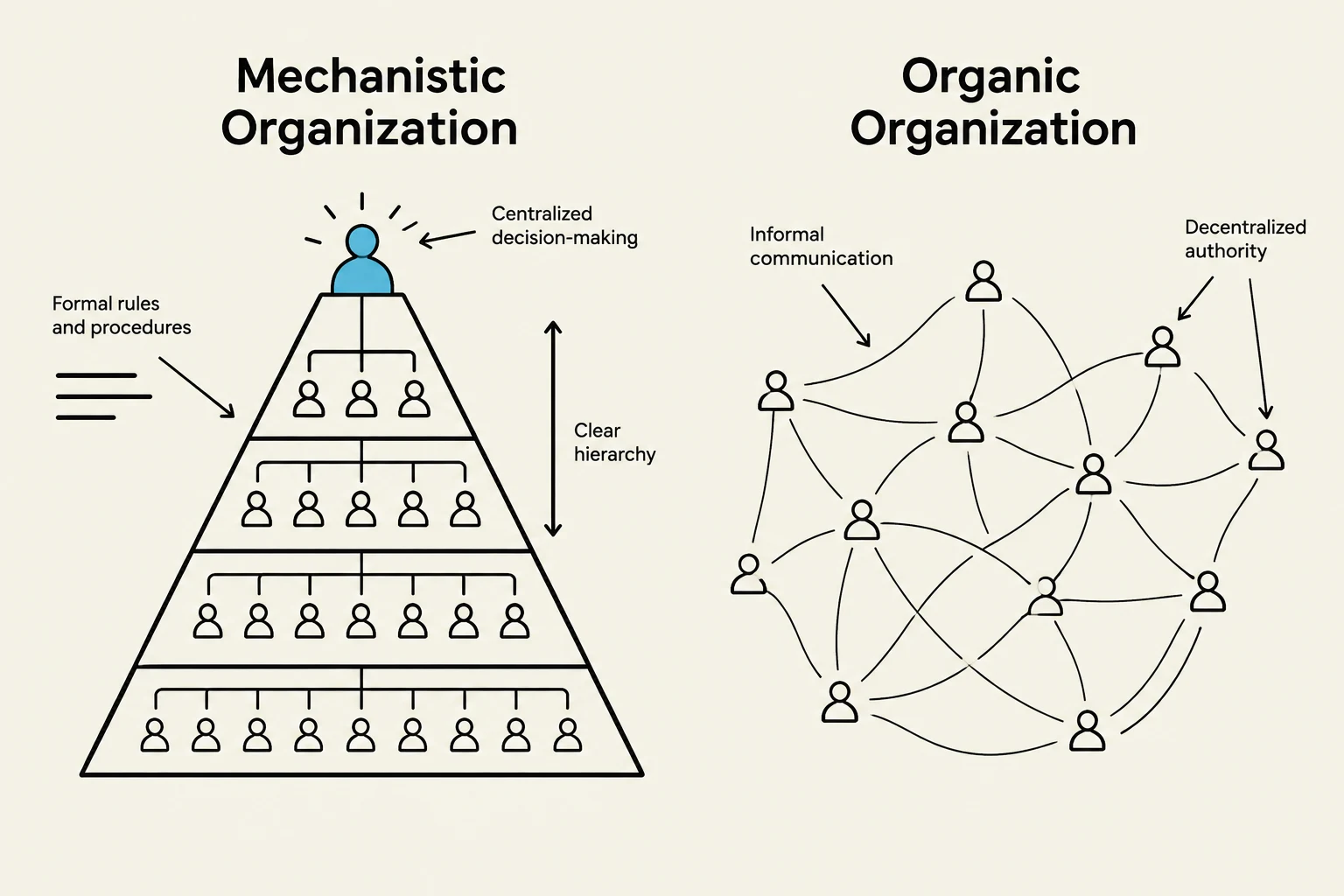
Diagrams illustrating mechanistic and organic organizational structures, highlighting differences in hierarchy, decision-making, and communication.
For an organization to be effective, its culture and structure must be aligned with its vision and strategy. This is known as contingency design—the process of fitting the organization to its specific environment.
For example, a company operating in a highly volatile, fast-changing market might benefit from an organic organization:
Organic Organizations: Decentralized authority, few rules, shared tasks, and informal communication.
Conversely, a company in a highly regulated industry (like a bank or a traditional hotel) might prefer a mechanistic organization:
Mechanistic Organizations: Centralized hierarchy, many rules and procedures, specialized tasks, and formal communication.
Key Concept: Differentiation vs. Integration
As organizations grow, they face two opposing forces: Differentiation (the tendency of parts to fragment into specialized units) and Integration (the tendency of those parts to draw together through rules and coordination to achieve a common purpose).
In summary, while structure provides the formal rules and reporting lines, culture provides the underlying values that drive behavior. When these two elements are aligned with the company's strategic goals, the organization can achieve higher performance, better employee well-being, and greater adaptability to change.
Keep reading for free.
Create an account to finish this reading and make it part of your study routine.