


Effective nursing care for patients with urinary issues requires more than just monitoring output; it demands a precise understanding of the patient's physiological state through the lens of nursing diagnoses. Whether a patient is currently experiencing pain or is simply at a higher risk for developing an infection due to a catheter, the nurse's ability to distinguish between different clinical states dictates the entire plan of care.
Understanding Nursing Diagnoses: Actual vs. Risk
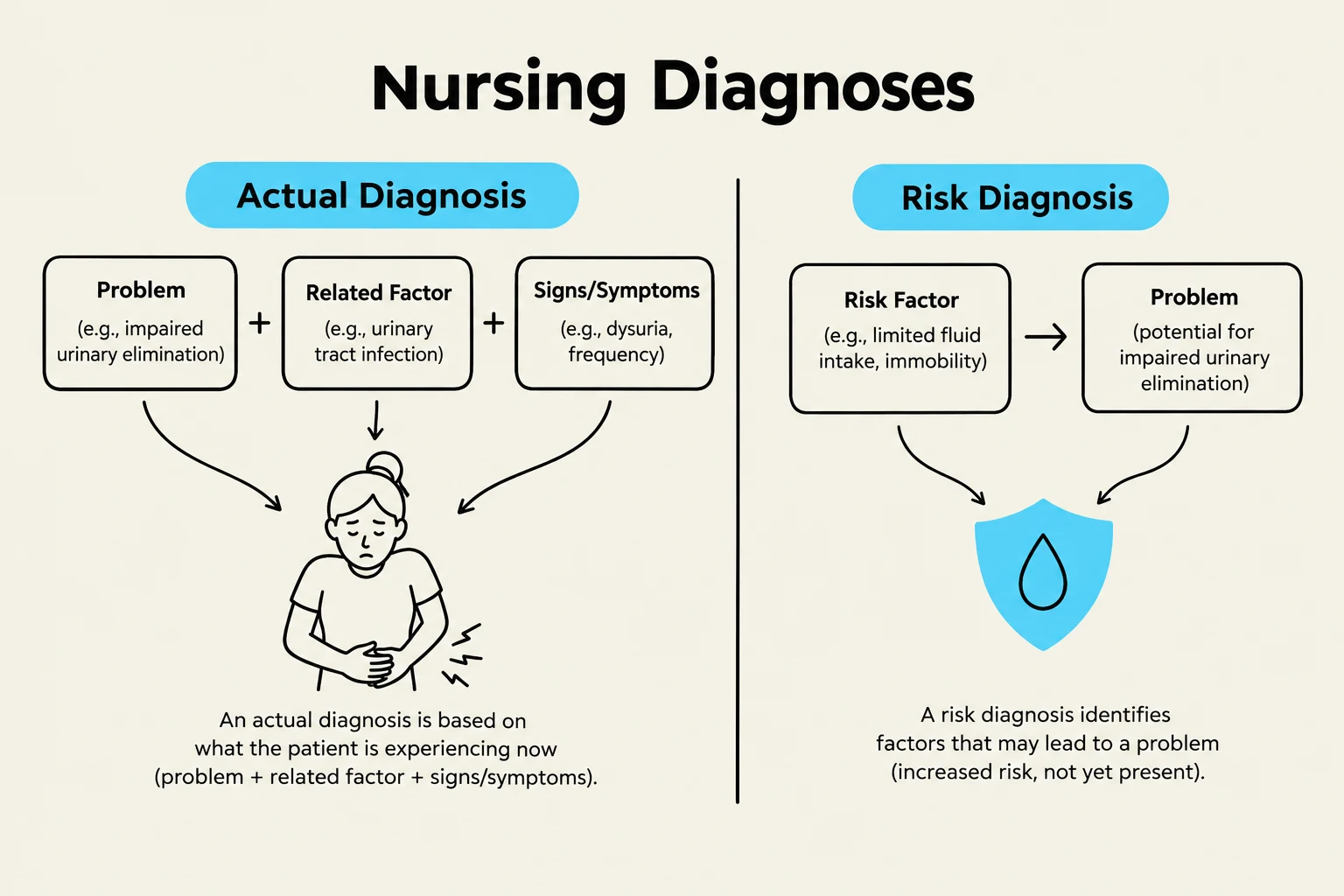
In the clinical setting, nursing diagnoses are categorized based on whether a problem is currently present or merely a potential threat. Mastering this distinction is essential for accurate documentation and effective intervention.
Actual Nursing Diagnoses
An actual nursing diagnosis describes a problem that is currently manifesting in the patient. To write a complete actual diagnosis, you must follow a specific three-part structure: Problem + Related Factor + Signs/Symptoms. The signs and symptoms are identified using the phrase "as evidenced by" to list the defining characteristics observed during assessment.
Risk Nursing Diagnoses
Conversely, a risk nursing diagnosis indicates a problem that has not yet occurred but is likely to develop due to specific risk factors. Because the problem is not yet present, risk diagnoses lack current defining symptoms or "as evidenced by" statements.
Exam Tip: If a question asks you to identify a diagnosis for a patient who is currently experiencing pain or leakage, look for an actual diagnosis. If the patient is stable but has a catheter, look for a risk diagnosis.

Keep reading for free.
Create an account to finish this reading and make it part of your study routine.
Continue reading freeAlready have an account? Log in
Updated