Explore Newton's Second Law of Motion (F=ma), its mathematical representation, and its application in real-world scenarios involving forces, mass, and acceleration. Learn to use free-body diagrams to solve dynamics problems.
Dynamics is the branch of physics that studies why objects move the way they do. While kinematics describes the motion itself, dynamics focuses on the underlying causes: forces. By understanding the relationship between mass, force, and acceleration, we can predict the behavior of everything from a heavy warehouse forklift to a gymnast landing a somersault.
The Foundation: Newton's Second Law
At the heart of all dynamics problems is Newton's Second Law. This law states that the acceleration of an object is directly proportional to the net force acting upon it and inversely proportional to its mass. Mathematically, we express this relationship as:
Fnet=m⋅a
In this equation, Fnet represents the vector sum of all forces acting on the object, m is the mass (measured in kilograms), and a is the acceleration (measured in m/s2).
To solve these problems effectively, you must distinguish between different types of forces:
Mass (m): The amount of matter in an object, which resists changes in motion.
Force (F): A push or pull exerted on an object.
Acceleration (a): The rate at which velocity changes. This can be an increase in speed, a decrease in speed (deceleration), or a change in direction.
Acceleration due to gravity (g): On Earth, this is approximately 9.8 m/s2. It is the constant acceleration experienced by any object in free fall.
Newton's Second Law of Motion illustrates the relationship between force, mass, and acceleration. For a constant net force, an object with greater mass experiences smaller acceleration.
The Essential Tool: The Free-Body Diagram
Before you touch a calculator, you must draw a free-body diagram (FBD). An FBD is a simplified sketch of an object that shows all the external forces acting upon it as arrows pointing away from a central point.
When drawing an FBD, consider these common forces:
Gravity (Fg or W): Always acts straight down toward the center of the Earth. It is calculated as Fg=m⋅g.
Normal Force (FN): The support force exerted by a surface, acting perpendicular to the surface.
Friction (f): A force that opposes motion, acting parallel to the surface of contact.
Tension (T): The pulling force transmitted through a string, rope, or cable.
Exam Tip: Always check your FBD for "hidden" forces. If an object is being pulled by a cable, don't forget the tension! If it's sliding on grass, don't forget friction!
Real-World Application 1: Lifting and Pushing
The Forklift Scenario
In a warehouse, a forklift might lift a box of mass m=250 kg.
If the box moves up at a constant speed, the acceleration is zero (a=0). This means the net force is zero, so the upward force from the forklift must exactly balance the downward force of gravity:
Fforklift=m⋅g=250 kg⋅9.8 m/s2=2450 N
However, if the forklift accelerates the box upward at 0.9 m/s2, the net force is no longer zero. We must account for both gravity and the extra force needed for acceleration:
Fnetm⋅aFforkliftFforklift=Fforklift−Fg=Fforklift−m⋅g=m⋅a+m⋅g=250(0.9)+250(9.8)=2675 N
The Lawnmower Scenario
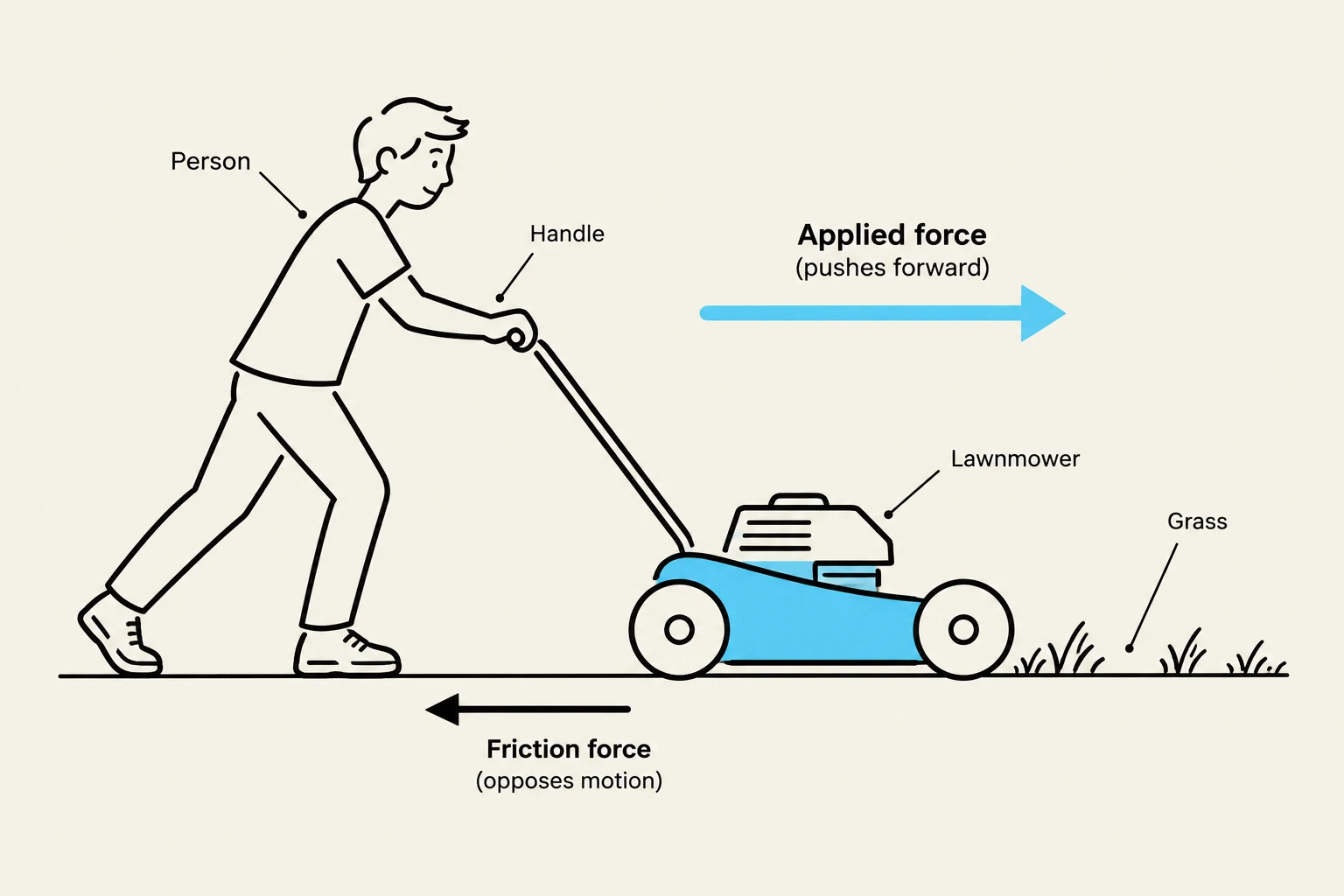
When pushing a mower, you often deal with opposing forces. If a person pushes a 24-kg mower with an applied force Fapp, and friction (24 N) opposes it, the net force is the difference between them:
Fnet=Fapp−ffriction
If the problem states the net force is 51 N, you can solve for the applied force:
51 N=Fapp−24 N⟹Fapp=75 N
Diagram illustrating applied force and friction force acting on a lawnmower being pushed by a person.
Real-World Application 2: Elevators and Apparent Weight
Elevator problems often involve tension in the cable and the concept of apparent weight.
Apparent weight is what a scale reads. A scale does not actually measure your mass; it measures the upward normal force it exerts on you. If you are in an elevator accelerating upwards, the scale must push up with enough force to both counteract gravity and accelerate your mass upward.
For example, a 79-kg man in an elevator accelerating rapidly will see a scale reading much higher than 79 kg. This is because the scale is exerting a larger force to create that acceleration. Conversely, if an elevator accelerates downward, you would feel "lighter" because the scale is pushing up with less force than your actual weight.
Real-World Application 3: Gymnasts and Deceleration
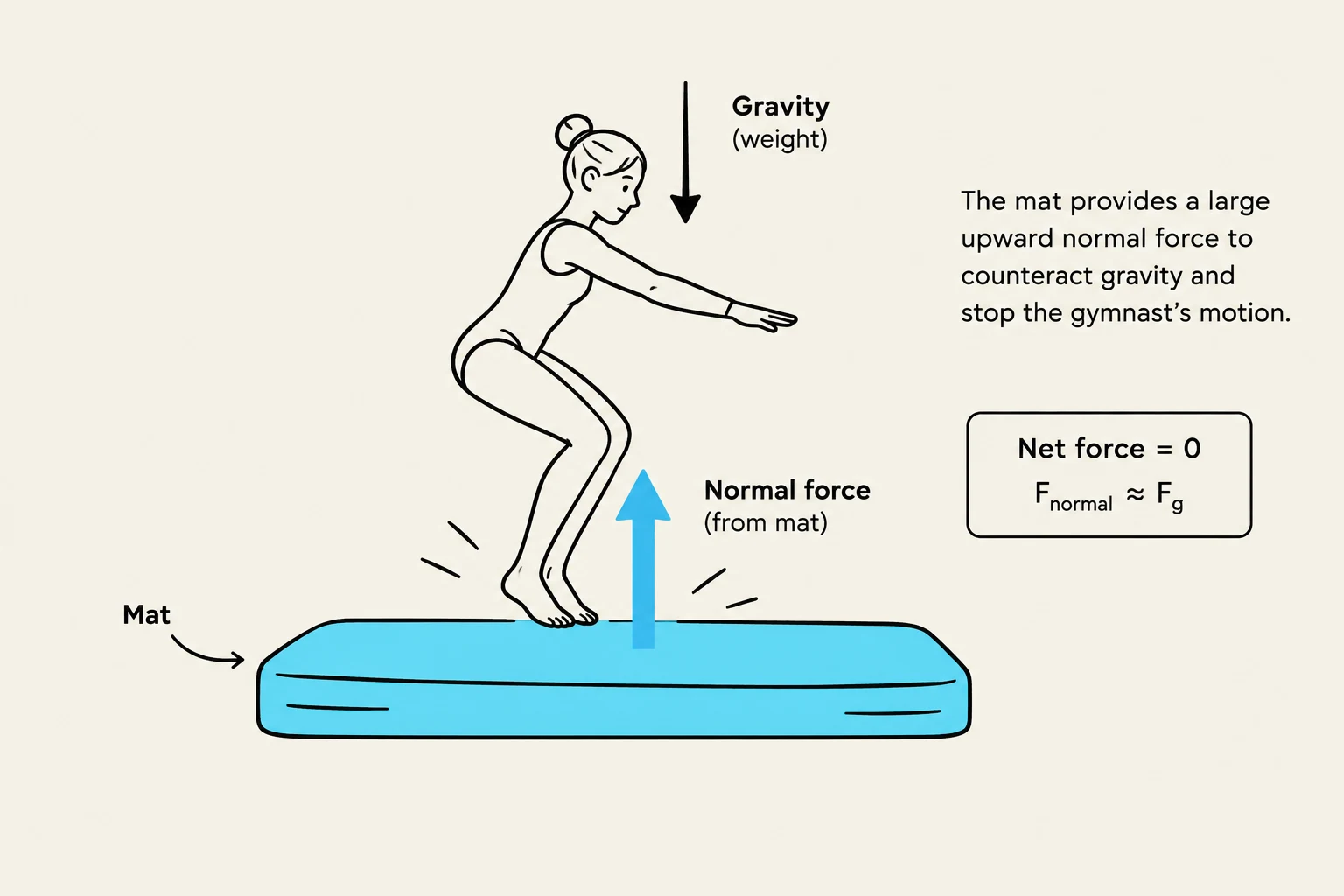
When a gymnast lands a somersault, they undergo rapid deceleration. Deceleration is simply acceleration in the opposite direction of motion.
Consider a 41-kg gymnast who decelerates at 5 times the acceleration due to gravity (a=5g). To find the force the mat must exert, we look at the net force required to stop her:
FnetFmat−FgFmatFmat=m⋅a=m⋅(5g)=m(5g)+mg=m(6g)
Using g=9.8 m/s2:
Fmat=41⋅(6⋅9.8)=2410.8 N
Diagram illustrating the forces acting on a gymnast landing on a mat, showing gravity pulling down and the normal force from the mat pushing up, resulting in a net force of zero.
By mastering the free-body diagram and applying F=ma systematically, you can solve almost any introductory dynamics problem, regardless of whether the object is in a warehouse, a garden, or an elevator.
Keep reading for free.
Create an account to finish this reading and make it part of your study routine.