This article explains Newton's three laws of motion, covering inertia, the relationship between force, mass, and acceleration, and action-reaction pairs. It includes examples of forces like gravity, normal force, and friction, and discusses their application in various scenarios.
Physics is often perceived as a collection of abstract formulas, but at its core, it is the study of how objects interact. By observing simple systems—such as two blocks sliding on a table or two trains on a collision course—we can uncover the fundamental rules that govern all motion in the universe. This article explores Newton's three laws of motion through the lens of practical simulations and real-world scenarios.
The Foundation: Newton's First Law and Equilibrium
Newton's First Law, often called the Law of Inertia, states that an object will maintain its state of motion—whether at rest or moving at a constant velocity—unless acted upon by a non-zero net force.
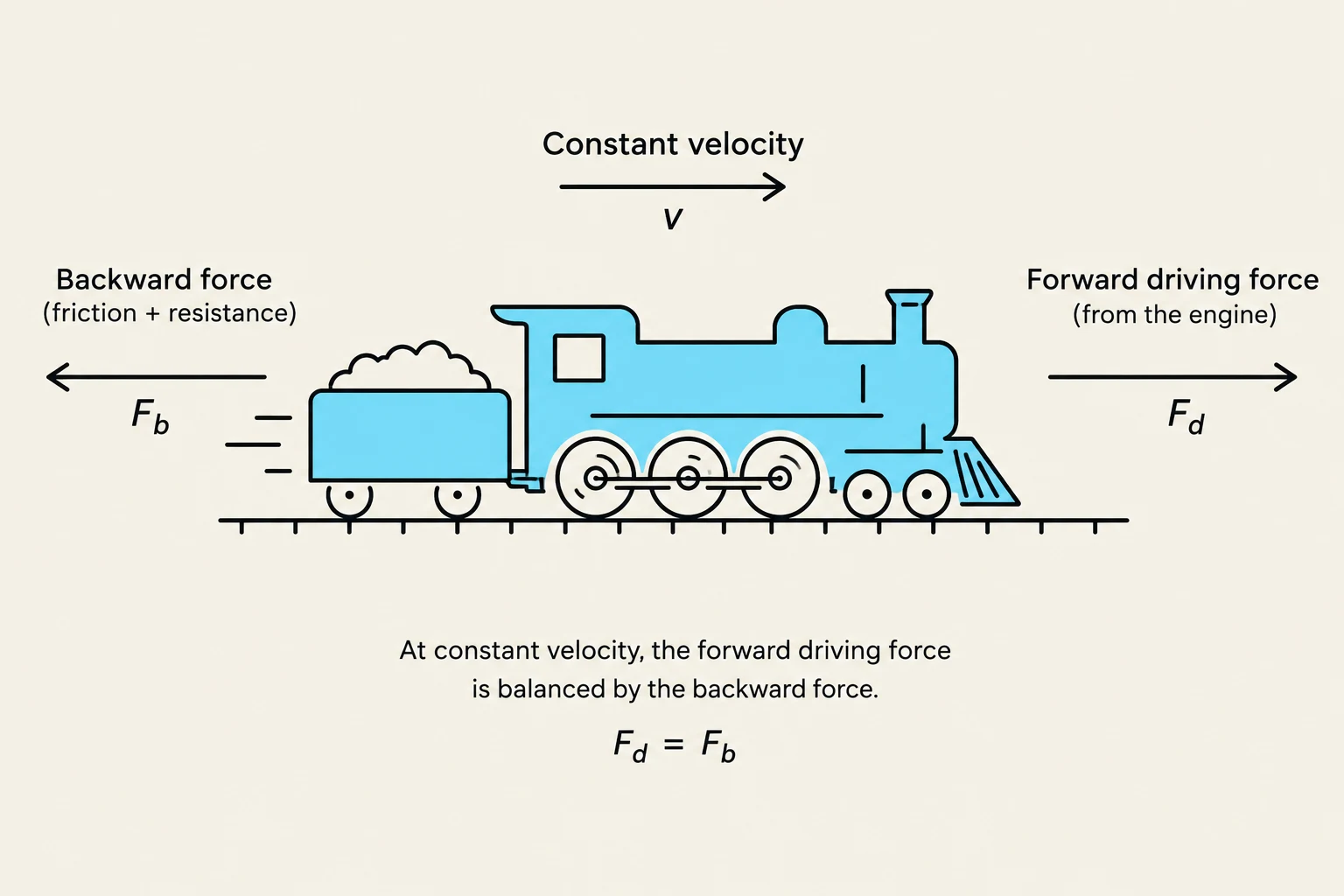
A common misconception is that motion requires a force. However, if a locomotive is moving down a track at a constant speed, the net force acting on it is actually zero. This happens because the various forces acting on the train, such as the engine's push and the opposing frictional force, perfectly balance each other out. When all forces acting on an object sum to zero, the object is in a state of equilibrium.
Diagram illustrating Newton's first law of motion, showing a train moving at constant velocity with balanced forward and backward forces.
Exam Tip: If a problem states that an object is moving at a "constant velocity" or "constant speed in a straight line," immediately recognize that the net force (∑F) is zero. You do not need to search for a "force of motion"; you only need to find the forces that cancel each other out.
Quantifying Motion: Newton's Second Law
While the first law describes what happens when forces are balanced, Newton's Second Law describes what happens when they are not. It provides the mathematical link between force, mass, and acceleration. The law is expressed by the equation:
∑F=m⋅a
In this relationship, acceleration is directly proportional to the net force applied to the object and inversely proportional to the object's mass.
The Role of Mass and Force
Through simulations of colliding or pushed objects, we can observe two critical behaviors:
Increasing Force: If you keep the mass constant and increase the applied force, the acceleration (and subsequently the displacement over time) increases.
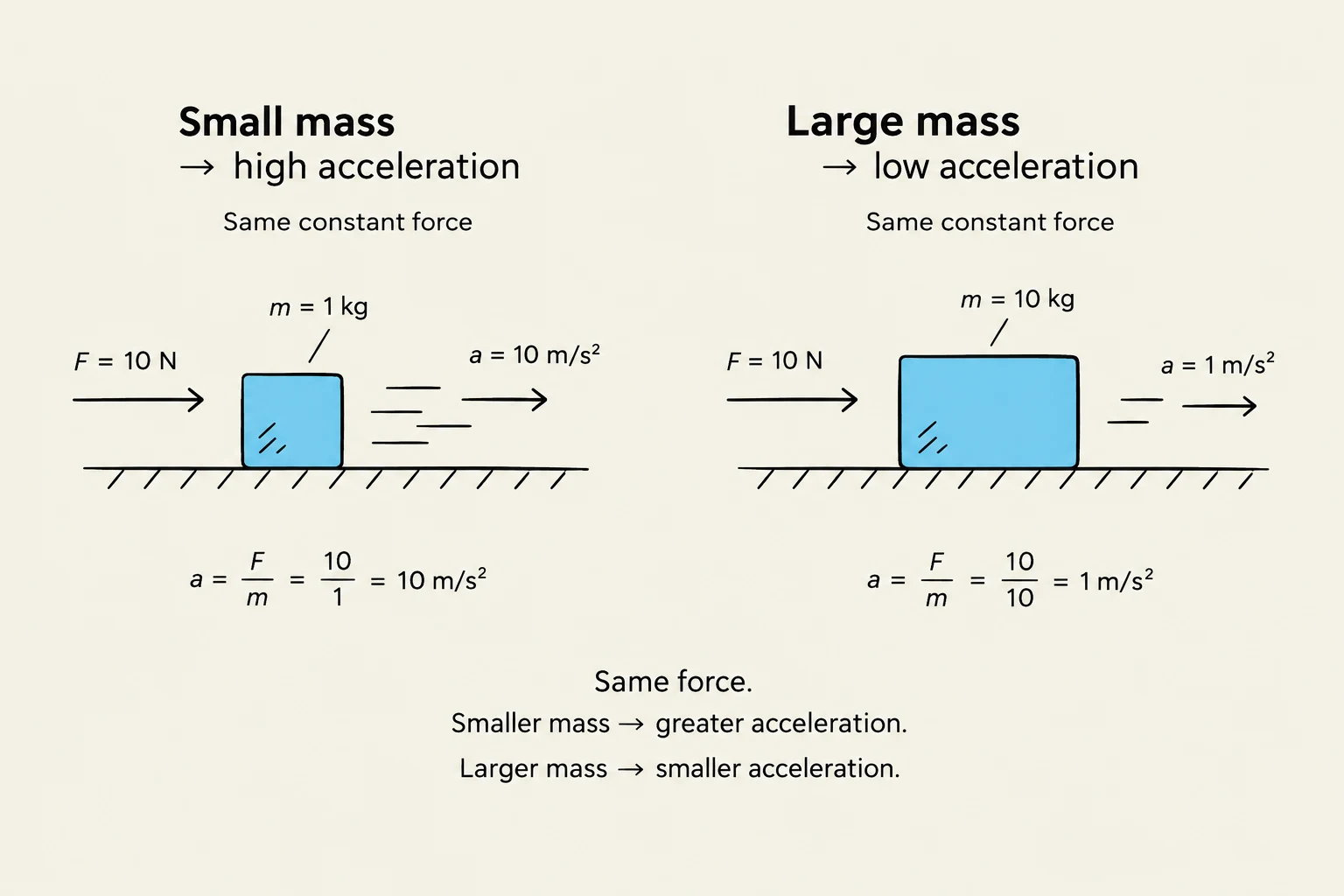
Increasing Mass: If you increase the mass (for example, by adding weight to a box), the acceleration decreases for the same amount of applied force.
This diagram illustrates Newton's second law of motion, showing that for a constant force, acceleration is inversely proportional to mass. A smaller mass experiences greater acceleration than a larger mass when subjected to the same force.
Worked Example: The Two-Block System
Consider two blocks, m1=1.0 kg and m2=0.33 kg, being pushed by a constant horizontal force F=0.2 N. To find the acceleration of the entire system, we treat them as a single unit with a total mass:
m_{\text{total}} &= m_1 + m_2 \\
m_{\text{total}} &= 1.0\text{ kg} + 0.33\text{ kg} = 1.33\text{ kg} \\
a &= \frac{F}{m_{\text{total}}} \\
a &= \frac{0.2\text{ N}}{1.33\text{ kg}} \approx 0.15\text{ m/s}^2
\end{aligned}$$
## Interaction Pairs: Newton's Third Law
Newton's Third Law states that for every action, there is an equal and opposite reaction. This means that forces always exist in pairs.
A common point of confusion occurs during collisions. If a heavy freight train hits a lighter passenger train, many students assume the freight train exerts more force because it causes more damage or moves the other train more significantly. However, Newton's Third Law dictates that the force exerted by the freight train on the passenger train is **exactly equal in magnitude** to the force exerted by the passenger train on the freight train. The difference in the resulting motion (one train slowing down while the other speeds up) is due to their different masses and the resulting accelerations, not a difference in the force of impact.
## Identifying Forces: Gravity, Normal, and Friction
To solve complex physics problems, one must be able to identify all individual forces acting on an object. These are typically categorized into contact forces and non-contact forces.
### Non-Contact Forces
* **Gravitational Force (Weight):** This is the force exerted by gravity on an object's mass. It always acts vertically downward toward the center of the Earth.
### Contact Forces
* **Normal Force ($n$):** This is the support force exerted by a surface on an object. It acts perpendicular to the surface of contact. For an object on a flat surface with no vertical acceleration, the normal force typically balances the weight.
* **Frictional Force ($f$):** This force opposes the relative motion between two surfaces in contact. It is often calculated using the coefficient of friction ($\mu$) and the normal force:
$$f = \mu \cdot n$$
* **Tension ($T$):** A contact force exerted by a string, rope, or cable when it is pulled tight.
> **Note on Normal Force in Accelerating Systems:** When an object is in an elevator that is accelerating upward, the scale (which measures the normal force) will show a reading higher than the object's true weight. This is because the normal force must not only support the weight but also provide the force for upward acceleration:
> $$n = m(g + a)$$
By mastering these laws and the ability to decompose forces into free-body diagrams, you can predict the behavior of any mechanical system, from a simple suitcase being towed at an airport to complex industrial machinery.
$$$
$$$
Keep reading for free.
Create an account to finish this reading and make it part of your study routine.