An explanation of Newton's three laws of motion, covering inertia, mass, weight, force, and acceleration. This article clarifies the relationships between these fundamental concepts in classical mechanics.
Understanding how objects move requires moving beyond simple descriptions of speed and direction. While kinematics allows us to describe how an object moves using velocity and acceleration, dynamics allows us to explain why it moves by examining the forces involved. This article explores the fundamental principles established by Isaac Newton, focusing on the conceptual relationships between mass, force, and motion.
Inertia and the Nature of Mass
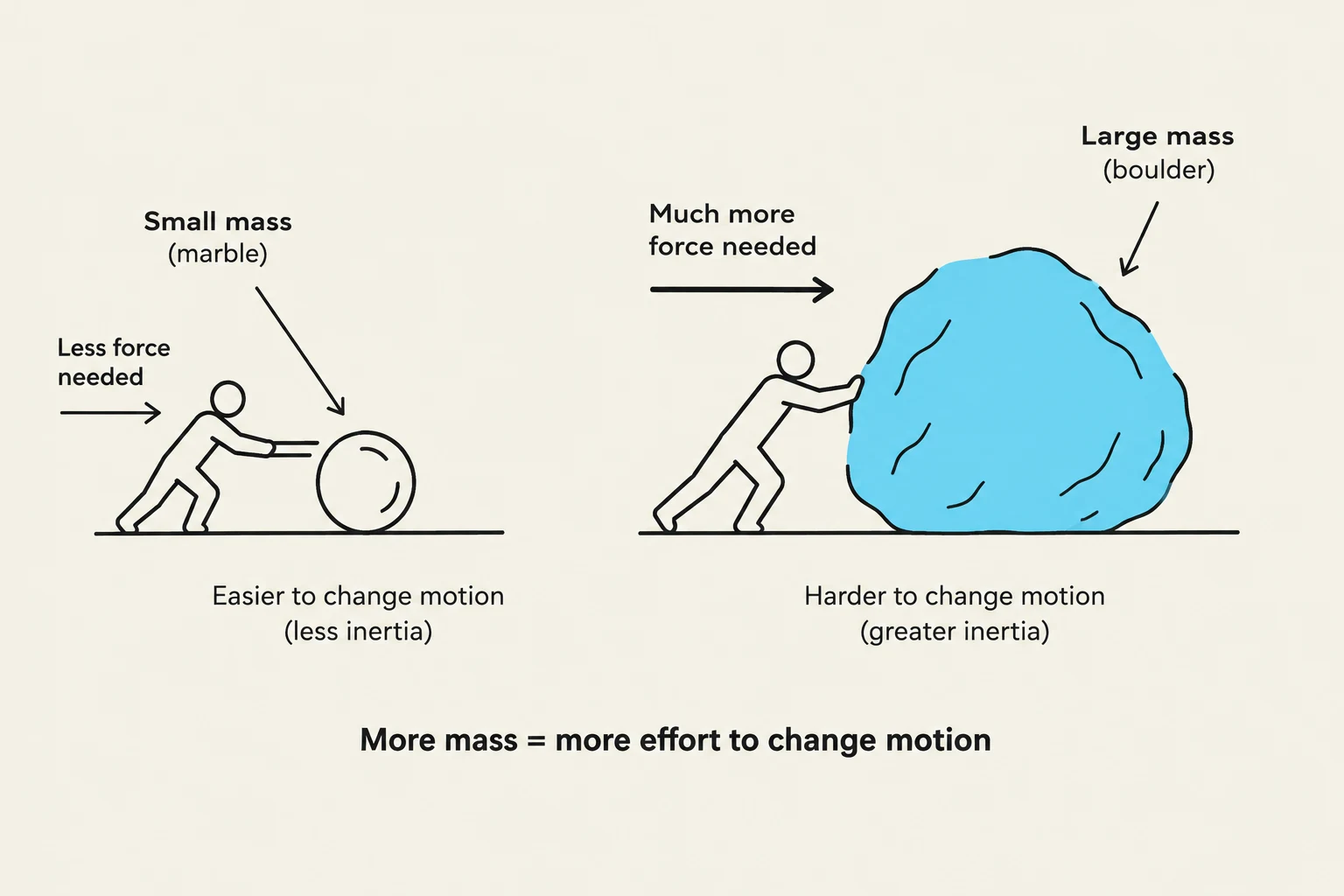
At the heart of classical mechanics is the concept of inertia. Inertia is not a force, but rather a property of matter: it is the inherent tendency of a physical object to resist any change in its state of motion. This means an object at rest will stay at rest, and an object moving at a constant velocity will continue moving at that same velocity and in that same direction unless an external influence intervenes.
The "strength" of this resistance is quantified by an object's mass (m). A larger mass possesses more inertia, meaning it is more difficult to start moving, stop moving, or change its direction.
Exam Tip: If a question asks how inertia and mass are related, remember that mass is the quantitative measure of inertia. More mass equals more resistance to change in motion.
This illustration demonstrates the concept of inertia, showing that a larger mass requires more force to change its motion compared to a smaller mass.
Distinguishing Mass from Weight
A common pitfall in physics is confusing mass with weight. While they are related, they are fundamentally different physical quantities.
Mass (m): This is the amount of "stuff" or matter in an object. It is an intrinsic property, meaning it remains the same whether you are on Earth, the Moon, or floating in deep space. It is measured in kilograms (kg).
Weight (W): This is a force caused by gravity acting on a mass. Unlike mass, weight changes depending on the local gravitational field. It is measured in Newtons (N).
The relationship is expressed as:
W=m⋅g
where g is the acceleration due to gravity.
For example, if you have one kilogram of cotton balls and one kilogram of iron, they have the exact same mass and, assuming they are in the same location, the exact same weight.
Newton's Second Law: The Mathematics of Motion
Newton's Second Law quantifies exactly how a net force affects an object's motion. A net force (Fnet) is the vector sum of all individual forces acting on an object. When the forces acting on an object do not cancel out, the object undergoes acceleration (a).
The fundamental relationship is:
Fnet=ma
By rearranging this formula, we can see that acceleration is directly proportional to the net force and inversely proportional to the mass:
a=mFnet
This relationship leads to several critical conclusions:
Directionality: The acceleration of an object will always occur in the same direction as the applied net force.
Force vs. Acceleration: If mass is held constant, increasing the net force will result in a proportional increase in acceleration.
Mass vs. Acceleration: If the net force is held constant, a larger mass will result in a smaller acceleration.
This graph illustrates Newton's second law of motion, showing that for a constant force, acceleration is inversely proportional to mass. A smaller mass results in greater acceleration.
Worked Example: Deceleration Scenarios
Consider a small car and a large truck both traveling at the same initial velocity. Both drivers slam on the brakes, resulting in the same constant deceleration of −0.5g.
Question: Which vehicle stops in a shorter distance?
Answer: They stop in the same distance. Because the deceleration (acceleration) is identical for both, the kinematic distance required to reach zero velocity is the same.
The Catch: Even though they stop in the same distance, the truck requires a much larger braking force to achieve that deceleration because its massive inertia resists the change in motion more strongly than the car's.
Newton's Third Law: Action and Reaction
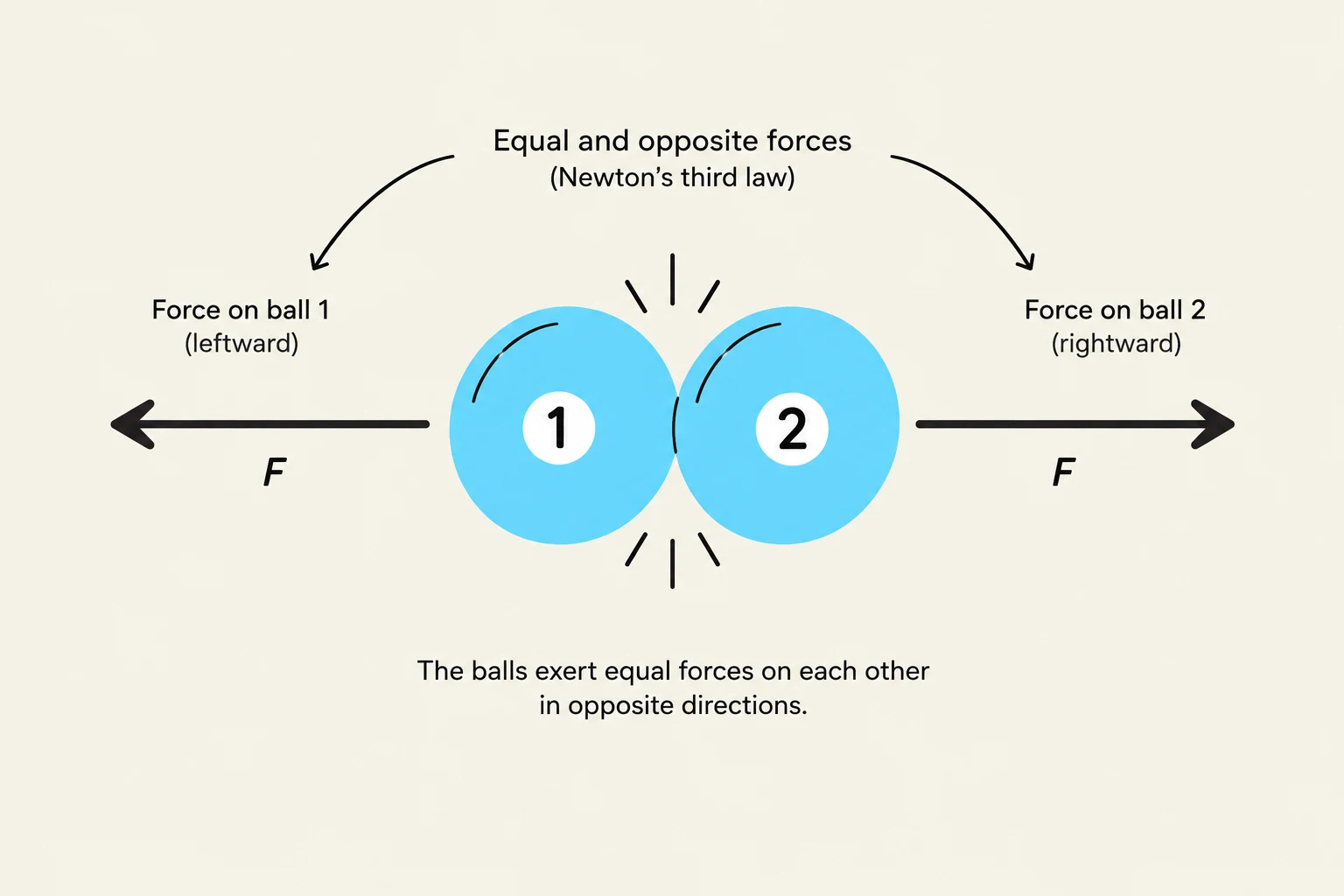
Newton's Third Law states that "for every action, there is an equal and opposite reaction". This means that forces always exist in pairs. If Object A exerts a force on Object B, Object B simultaneously exerts a force of equal magnitude and opposite direction on Object A.
A common misconception is that these equal and opposite forces cancel each other out, preventing motion. This is incorrect. The forces act on different objects.
Conceptual Check: Imagine a football lineman pushing against an opponent. The lineman pushes the opponent (Force 1), and the opponent pushes the lineman (Force 2). While these forces are equal in magnitude, they do not cancel out because Force 1 is acting on the opponent, while Force 2 is acting on the lineman. The motion of either player depends on the net force acting on them specifically.
Illustration of Newton's third law, showing two balls exerting equal and opposite forces on each other.
Summary of Key Concepts
Concept
Definition
Key Relationship
Inertia
Resistance to change in motion
Determined by mass
Mass
Amount of matter in an object
m (kg)
Weight
Force of gravity on a mass
$W = mg$ (N)
Net Force
Vector sum of all forces
Fnet=∑Fi
Acceleration
Rate of change of velocity
a=Fnet/m
Keep reading for free.
Create an account to finish this reading and make it part of your study routine.