


In the study of human anatomy, joints are classified not just by the material that connects them, but by the degrees of freedom they allow. While many joints are limited to moving in a single plane (uniaxial) or two planes (biaxial), a specialized group of joints allows for movement in three distinct dimensions. These are known as multiaxial joints (or triaxial joints). Because they permit movement around three different axes, they are the most mobile joints in the human body, providing the flexibility required for complex tasks like throwing a ball, rotating the torso, or manipulating objects with precision.
Understanding Degrees of Freedom
To understand multiaxial joints, one must first understand the concept of an "axis" of motion. An axis is an imaginary line around which a movement occurs. In a multiaxial joint, the structural arrangement of the articulating bones allows for rotation, flexion/extension, and abduction/adduction simultaneously.
Mathematically, we can think of the range of motion in terms of the planes of the body. If a joint can move in the sagittal, frontal, and transverse planes, it is considered multiaxial.
Exam Tip: When identifying a joint on a practical exam, always ask: "Can this joint move in three different directions?" If the answer is yes, you are looking at a multiaxial joint, likely a ball-and-socket or a saddle joint.
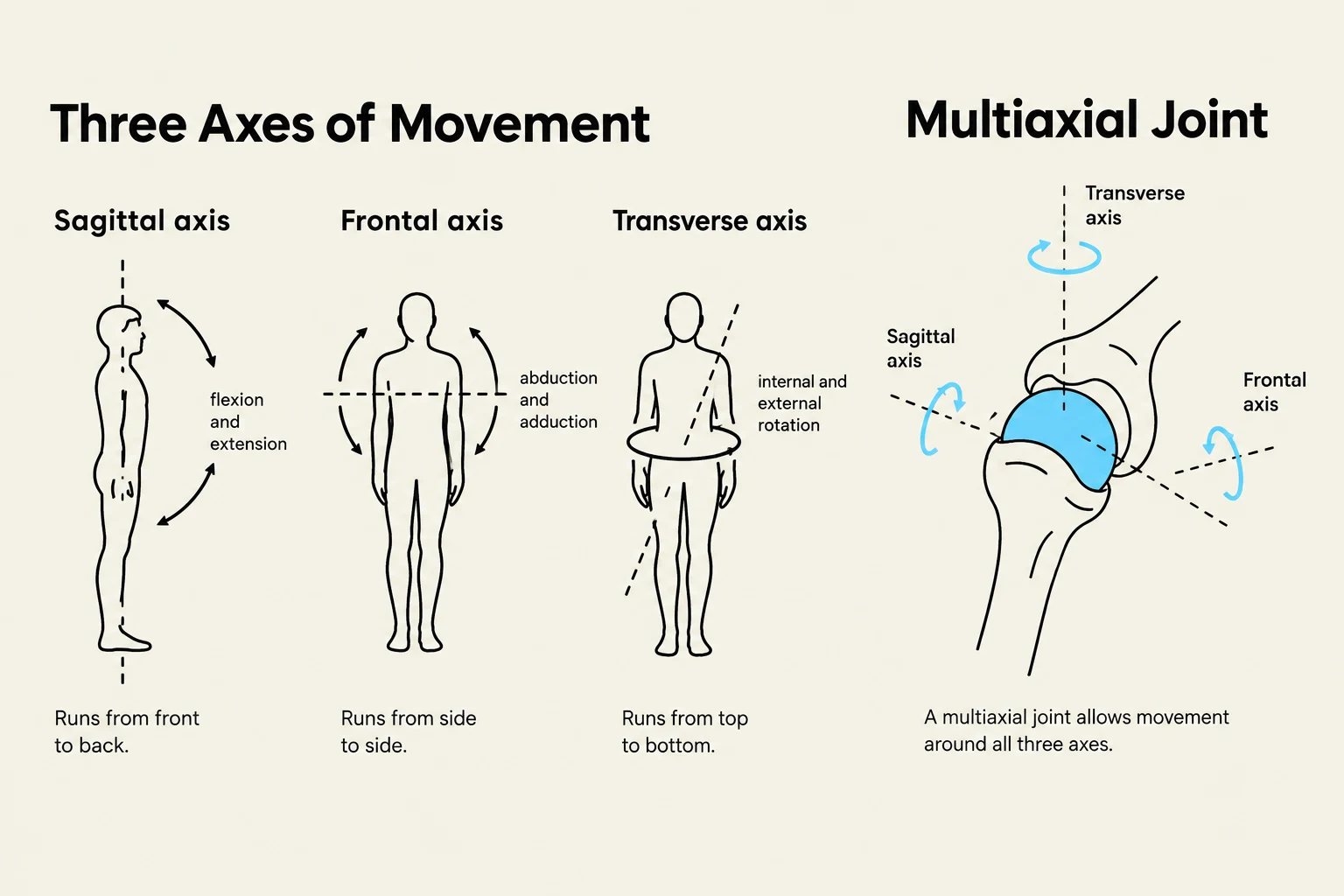
The Ball and Socket Joint: Maximum Mobility
The most iconic example of a multiaxial joint is the ball and socket joint (spheroidal joint). In this configuration, the rounded, ball-like surface of one bone fits into a cup-like depression of another bone.
Keep reading for free.
Create an account to finish this reading and make it part of your study routine.
Continue reading freeAlready have an account? Log in
Updated