Understanding Mental Health Disorders in Children and Adolescents
This content provides a comprehensive overview of mental health disorders in children and adolescents, covering neurodevelopmental disorders, mood disorders, anxiety disorders, trauma-related disorders, and disruptive behavior disorders. It also discusses their etiology, risk factors, manifestations, and pharmacologica
Mental health disorders in children and adolescents are complex and do not always present in the same way as they do in adults. Because children are in constant states of physiological and psychological change, identifying these issues can be challenging. A diagnosis is typically considered when a child's behaviors begin to interfere with their ability to function at home, in school, or within their peer groups.
Etiology and Risk Factors
The development of mental health disorders is rarely the result of a single cause; rather, it is an interplay of biological, social, and environmental factors.
Genetic and Biochemical Factors: Chromosomal abnormalities and alterations in neurotransmitters—specifically norepinephrine, serotonin, and dopamine—are linked to disorders such as ADHD, autism, and bipolar disorder.
Social and Environmental Factors: Risk increases with low socioeconomic status, large family sizes, overcrowding, parental substance use, domestic discord, and witnessing traumatic events like physical or sexual abuse.
Cultural Factors: Difficulties with assimilation or a lack of support from the dominant culture can contribute to psychological distress.
Resiliency: This is a critical protective factor. The ability to adapt to change, use effective problem-solving skills, and form nurturing relationships can help an at-risk child avoid developing a disorder.
Clinical Note: When assessing a child, a nurse should obtain a complete history, including pregnancy/birth history, developmental milestones, attachment behaviors, and any history of abuse.
Neurodevelopmental Disorders
Neurodevelopmental disorders are complex and often result from multiple hereditary and environmental influences. These disorders typically manifest early in development and may persist into adulthood.
Attention Deficit Hyperactivity Disorder (ADHD)
ADHD is characterized by an inability to control behaviors that require sustained attention. It is categorized into three types: predominantly inattentive, predominantly hyperactive-impulsive, and the combined type. Key manifestations include:
Inattention: Difficulty listening, focusing, or paying attention.
Hyperactivity: Fidgeting, inability to sit still, or excessive talking.
Impulsivity: Difficulty waiting for turns or interrupting others.
Symptoms must be present prior to age 12 and occur in more than one setting (e.g., both home and school).
This diagram illustrates the three core components of ADHD: inattention, hyperactivity, and impulsivity, and their potential impact on daily life.
Autism Spectrum Disorder (ASD)
ASD is a complex disorder of genetic origin that affects communication and social interaction. Characteristic behaviors include an inability to maintain eye contact, repetitive actions, and a strict adherence to routines. Physical comorbidities may include sensory integration dysfunction, sleep disorders, and epilepsy.
Other Neurodevelopmental Issues
Intellectual Developmental Disorder: Deficits in mental abilities (reasoning, learning) that impair independence and social responsibility.
Specific Learning Disorder: Persistent difficulty in acquiring academic skills like reading, writing, or mathematics.
Communication Disorders: Persistent problems with language, speech (such as stuttering), or social communication skills.
Tic Disorders: Includes conditions like Tourette’s disorder.
Depressive and Bipolar Disorders
Depressive Disorders
Depression in youth can manifest as sadness, irritability, or even temper tantrums. Expected findings include changes in appetite or sleep, loss of energy, hopelessness, and, most critically, suicidal ideation or attempts. Risk factors include family history, bullying, and chronic illness.
Bipolar and Related Disorders
These involve significant shifts in mood, including periods of mania or hypomania and depression.
Anxiety Disorders
Anxiety is considered problematic when it interferes with normal growth, development, or daily functioning.
Generalized Anxiety Disorder (GAD): Excessive, near-daily worry about various situations like school or relationships.
Panic Disorder: Unexpected periods of extreme physiologic and psychologic hyperarousal (panic attacks).
Separation Anxiety Disorder: Developmentally inappropriate fear regarding separation from attachment figures.
Social Anxiety Disorder: Intense fear of scrutiny or embarrassment in social settings.
Selective Mutism: A consistent failure to speak in specific social situations (like school) despite being able to speak in others.
Phobias: Marked fear of specific objects or situations, such as animals or heights.
This diagram illustrates the progression of anxiety, starting with separation anxiety, leading to increased general anxiety, and potentially developing into school phobia. It also notes that this cycle can reinforce itself, worsening anxiety over time.
Trauma- and Stressor-Related Disorders
These disorders are precipitated by experiencing or witnessing traumatic events.
Acute Stress Disorder (ASD): Severe anxiety and dissociation occurring within one month of the trauma.
Posttraumatic Stress Disorder (PTSD): Symptoms (intrusive thoughts, hyperarousal, avoidance) that persist beyond one month.
Adjustment Disorder (AD): Emotional distress that is disproportionate to a stressor, occurring within three months of the stressor and lasting less than six months.
Reactive Attachment Disorder (RAD): Inhibited, withdrawn behavior toward caregivers, often due to severe neglect.
Disinhibited Social Engagement Disorder (DSED): Overly familiar behavior with strangers and a lack of checking back with caregivers.
Disruptive, Impulse Control, and Conduct Disorders
These disorders involve behaviors that violate social norms or the rights of others.
Oppositional Defiant Disorder (ODD): A pattern of negativity, disobedience, and hostility, particularly toward authority figures.
Disruptive Mood Dysregulation Disorder: Recurrent, severe temper outbursts that are not appropriate for the child's developmental level.
Intermittent Explosive Disorder: Recurrent episodes of violent or aggressive behavior, often followed by feelings of regret.
Conduct Disorder: A persistent pattern of violating the rights of others, including aggression to people/animals, destruction of property, or theft.
Exam Tip: Note the distinction between ODD and Conduct Disorder. ODD is characterized by defiance and argumentativeness, whereas Conduct Disorder involves more serious violations of societal rules and the rights of others, such as theft or physical cruelty.
Other Categories
Feeding and Eating Disorders: Includes anorexia nervosa, bulimia nervosa, and binge eating disorder.
Schizophrenia Spectrum and Psychotic Disorders: Involves delusions or hallucinations.
Substance Use Disorders: Includes alcohol, tobacco, and cannabis use disorders.
Tic Disorders: Such as Tourette’s disorder.
Pharmacological Interventions
Medication is often used as part of a comprehensive treatment plan.
Selective Serotonin Reuptake Inhibitors (SSRIs)
Used for depression, anxiety, OCD, and even some aspects of ASD or intermittent explosive disorder. They work by blocking the reuptake of serotonin.
Nursing Alert: SSRIs may increase suicidal ideation in children and adolescents. Monitor closely.
Atypical Antipsychotics (e.g., Risperidone)
Used for ASD, conduct disorder, and psychotic manifestations.
Complications: Monitor for weight gain, diabetes mellitus, and hypercholesterolemia.
Alpha₂-Adrenergic Agonists (e.g., Guanfacine)
Used for ADHD, tic disorders, and conduct disorders.
Nursing Alert: Monitor for hypotension and bradycardia. Do not discontinue abruptly, as this can cause rebound hypertension.
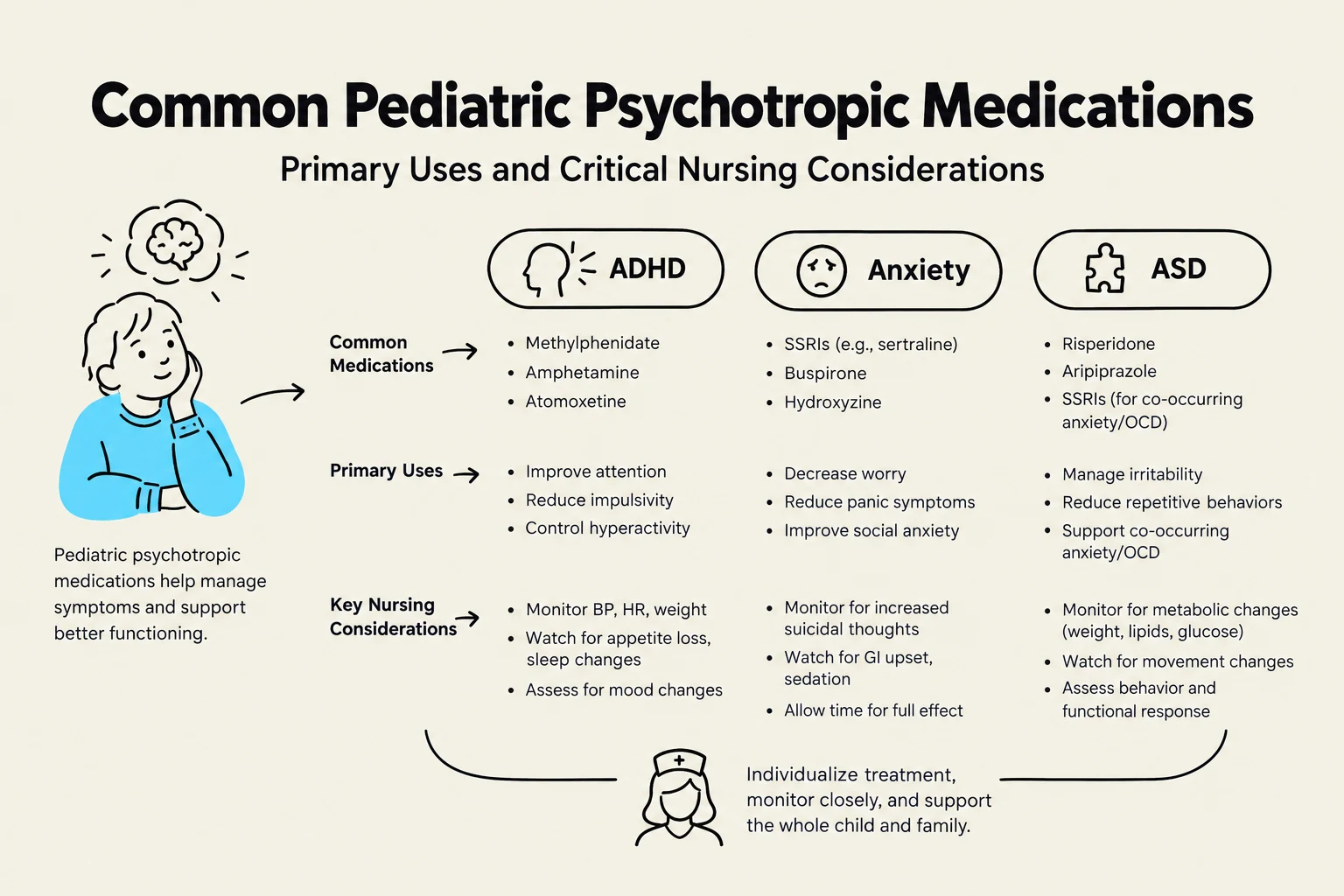
This chart outlines common pediatric psychotropic medications, their primary uses, and critical nursing considerations for ADHD, anxiety, and ASD.
Keep reading for free.
Create an account to finish this reading and make it part of your study routine.