Understanding Respiratory Medications: Congestion, Cough, and Secretion Management
An educational overview of medications used to manage respiratory symptoms such as nasal congestion, cough, and mucus. It details the mechanisms, uses, and nursing considerations for nasal decongestants, antitussives, expectorants, and mucolytics, along with complementary approaches.
When the respiratory system is compromised by the common cold, allergies, or chronic conditions, patients often experience a frustrating cycle of nasal congestion, nonproductive coughing, and thick, obstructive mucus. Pharmacological intervention aims to break this cycle by either suppressing the urge to cough, loosening trapped secretions, or reducing the swelling of nasal passages. Understanding the distinction between medications that suppress a cough and those that help clear it is fundamental to safe and effective nursing care.
Nasal Decongestants
Nasal congestion is a common symptom of the common cold, allergies, and sinus issues. Decongestants work primarily through vasoconstriction—narrowing the blood vessels in the nasal mucosa—to reduce swelling and allow for easier breathing.
Pseudoephedrine (Sudafed)
Pseudoephedrine is a widely used over-the-counter (OTC) agent for the temporary relief of nasal congestion. Because it acts as a cardiac stimulant via vasoconstriction, it carries specific risks for certain populations.
Contraindications: It should be avoided in patients with severe hypertension or coronary artery disease.
Adverse Effects: Patients may experience hypertension, cardiac dysrhythmias, nervousness, and insomnia.
Special Populations: It is generally not recommended for pregnant women, older adults (due to increased risk of adverse effects), or infants and children under the age of 6. Note that for children between 6 and 12, the adult dose should not be used.
Nursing Tip: When administering liquid medications to children, always use precise dosing instruments (such as an oral syringe) rather than household spoons to ensure safety and accuracy.
Diagram illustrating the mechanism of action of pseudoephedrine in reducing nasal congestion by causing vasoconstriction of blood vessels.
Antitussives: Suppressing the Cough
Antitussives are indicated for nonproductive, dry, hacking coughs that interfere with a patient's ability to rest or sleep. It is critical to distinguish these from medications used for productive coughs; the goal of antitussive therapy is to suppress "nonpurposeful" coughing, not to stop the clearance of necessary secretions.
Nonnarcotic Antitussives
Dextromethorphan: Often labeled as "DM" on OTC products, this is a common nonnarcotic agent.
Administration: It should be administered using precise measuring devices. Patients should avoid eating or drinking for 30 minutes after administration.
Monitoring: Nurses must monitor for excessive suppression of the cough reflex (which can lead to an inability to clear secretions) and potential hallucinations if dosages exceed recommendations.
Benzonatate (Tessalon): This is another nonnarcotic option, but it requires specific patient education.
Administration: Patients must swallow the capsules whole. Chewing or sucking on the capsules can cause numbness of the mouth and throat.
Adverse Effects: Serious effects include dizziness, confusion, hallucinations, chest pain, or a choking sensation.
Narcotic Antitussives
Medications containing codeine or hydrocodone are prescription-strength agents.
⚠️ Black Box Warning: Narcotic antitussives carry a Black Box Warning due to the high risks of misuse, addiction, overdose, death, and respiratory depression.
Expectorants and Mucolytics: Managing Secretions
When a cough is "productive" (meaning it produces mucus), the goal shifts from suppression to clearance. This is achieved through expectorants and mucolytics.
Expectorants
Expectorants are used to loosen mucus from the respiratory tract to make it easier to cough up.
Guaifenesin (Mucinex): This is the primary expectorant used for productive coughs.
Enhancing Effectiveness: The effectiveness of guaifenesin is significantly enhanced by increasing fluid intake.
Clinical Note: Mechanical measures—such as deep breathing, ambulation, chest physiotherapy, and forcing fluids—are often more effective than drug therapy alone for managing excessive secretions.
Precautions: Caution is advised in children under 4, and it should be avoided during pregnancy.
Mucolytics
Mucolytics are used as adjunctive agents to directly liquefy viscous (thick) mucous secretions.
Acetylcysteine (Acetadote): This agent is used to thin thick mucus, often via nebulization or orally (in cases of overdose).
Pre-administration Protocol: To prevent bronchospasms, patients should receive an aerosolized bronchodilator 10–15 minutes prior to receiving acetylcysteine.
Monitoring: Nurses should monitor for difficulty breathing, chest tightness, and the patient's ability to effectively expel the liquefied secretions.
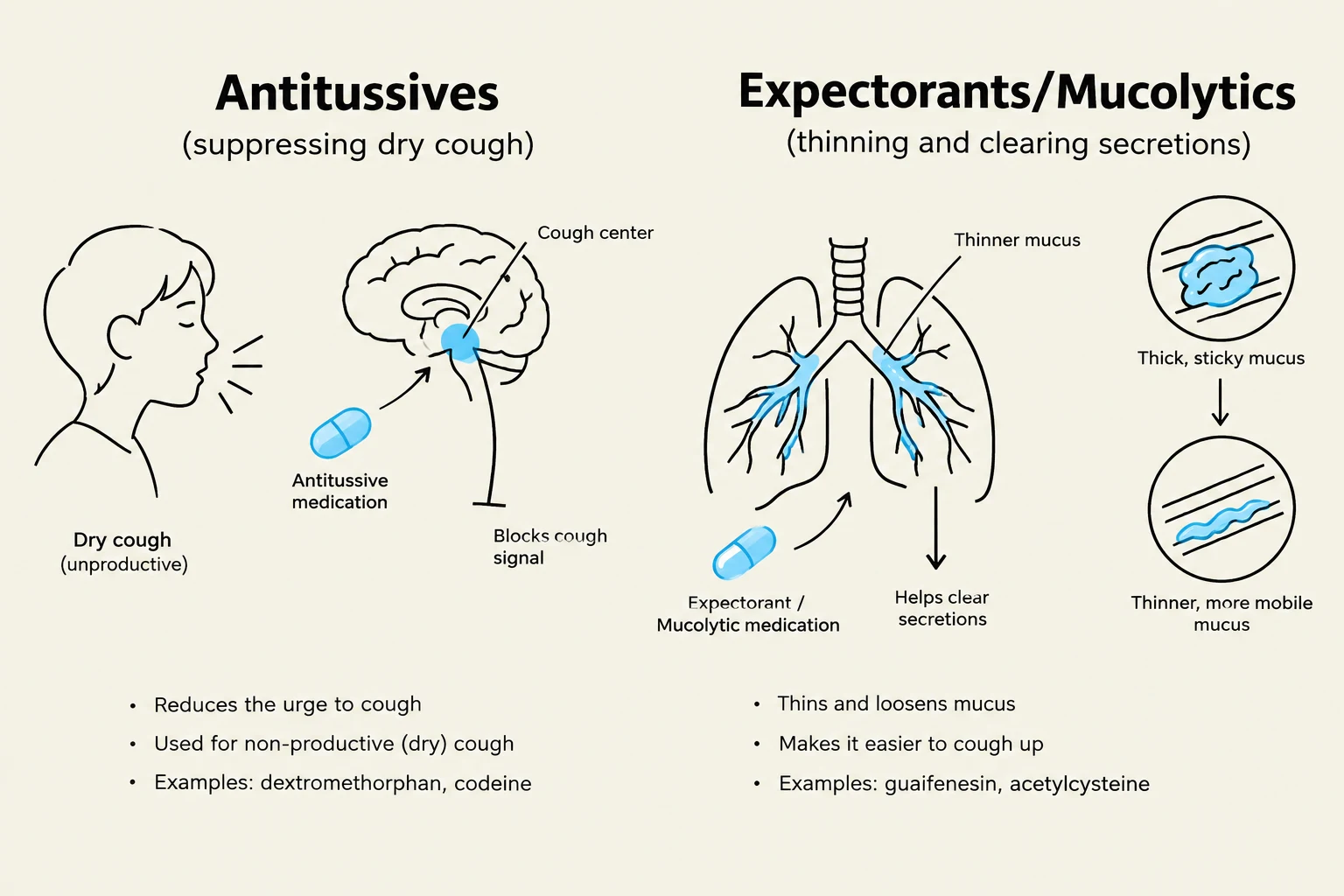
This illustration explains the mechanisms of antitussives, which suppress dry coughs by blocking cough signals in the brain, and expectorants/mucolytics, which thin and clear respiratory secretions to aid in coughing up mucus.
Complementary Approaches
Several non-pharmacological and supplemental approaches are used to manage cold symptoms:
Honey: Shown to be effective in reducing the frequency and severity of coughs in both adults and children with viral upper respiratory infections.
Zinc Sulfate: May reduce the duration and severity of cold symptoms in adults, though this is not well-established in children.
Vitamin C: While it plays a role in the body's respiratory defense mechanisms, there is no clear consensus that it effectively shortens the duration of a cold.
A Note on Zicam: The FDA does not recommend the use of Zicam due to multiple reports of permanent loss of smell.
Summary Table for Quick Review
Drug Class
Primary Goal
Example
Key Nursing Consideration
Nasal Decongestant
Reduce nasal swelling
Pseudoephedrine
Monitor BP; avoid in severe hypertension
Antitussive
Suppress dry cough
Dextromethorphan
Monitor for excessive suppression
Expectorant
Loosen mucus
Guaifenesin
Encourage high fluid intake
Mucolytic
Liquefy thick mucus
Acetylcysteine
Give bronchodilator 10-15 mins prior
Keep reading for free.
Create an account to finish this reading and make it part of your study routine.