Understanding Media Contracts and Professional Liability in Canada
This guide explains the fundamental elements of contract law, including offer, acceptance, and consideration, as they apply to media professionals. It covers jurisdiction, breach of contract, and the complexities of digital platforms and censorship in Canada versus Germany.
For media professionals—whether you are a journalist, a freelance videographer, or a musician—the "fine print" is more than just legal jargon; it is the framework that governs your livelihood. Every time you click "I Agree" on a social media platform or sign a talent release, you are entering into a legally binding agreement. Understanding the foundations of contract law is essential to protecting your intellectual property, your income, and your professional reputation.
The Foundations of a Binding Agreement
Contract law governs how legally binding agreements between two or more parties are created, interpreted, and implemented. While many people assume a contract must be a formal, multi-page document signed in ink, the law recognizes that agreements can be spoken aloud, implied through actions, or written in an email.
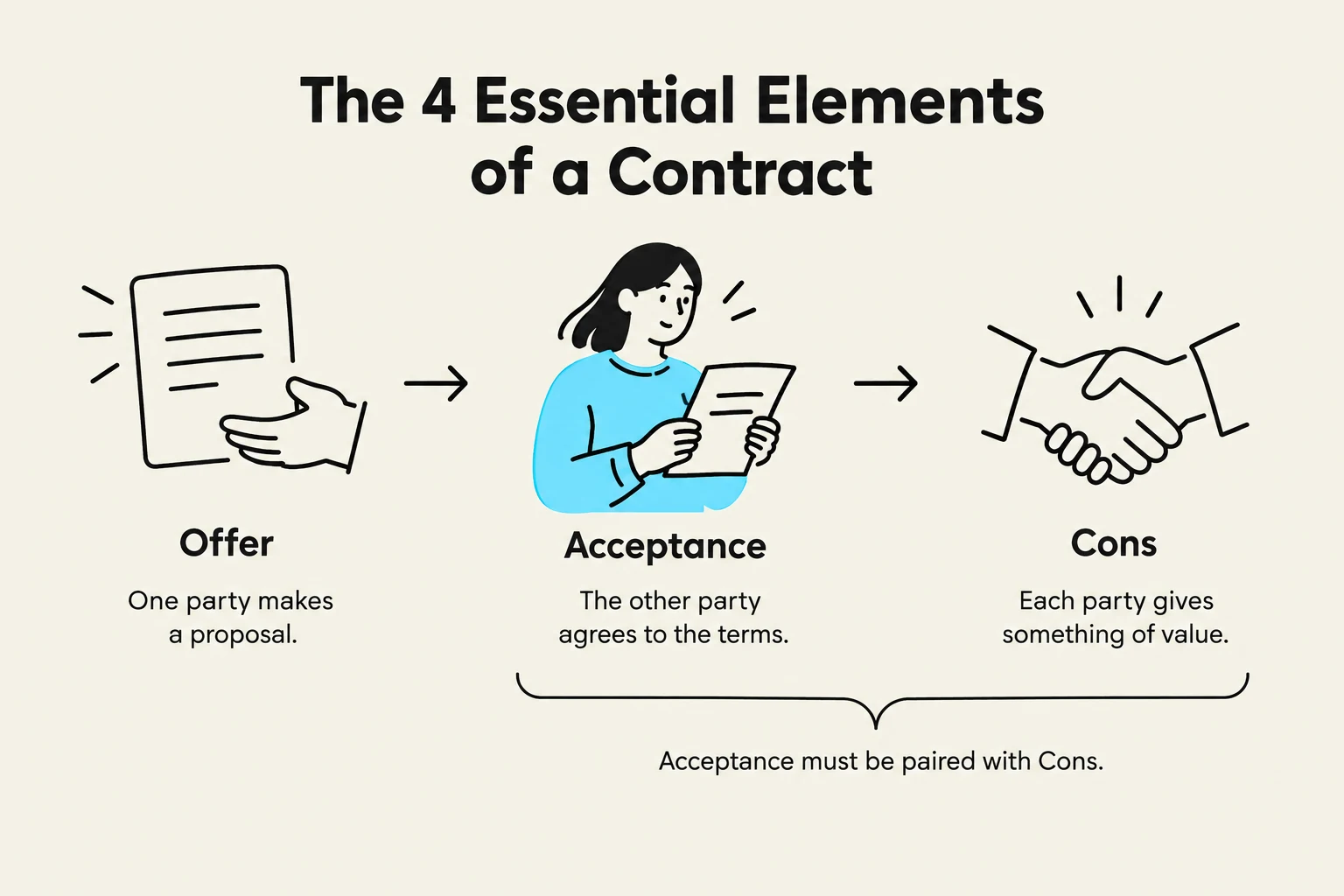
Regardless of the format, a valid contract requires four essential elements to be enforceable:
Offer: A clear proposal of terms by one party to another.
Acceptance: An unconditional agreement to those exact terms.
Consideration: An exchange of value (this can be money, services, or even data).
Capacity and Legality: Both parties must be of legal age, of sound mind, and the purpose of the contract must be legal.
The 4 essential elements of a contract are Offer, Acceptance, and Cons, where acceptance must be paired with Cons.
Offer vs. Invitation to Treat
It is a common mistake to confuse an "offer" with an "invitation to treat". An offer is a communication of an intention to be bound by specific terms. An invitation to treat, however, is merely an expression of willingness to negotiate.
A classic example is a price tag in a retail store. The tag is not an offer to sell you the item; it is an invitation for you to make an offer at the cash register, which the store can then accept or decline.
The Nuances of Acceptance
Acceptance must be explicit and unequivocal. You cannot create a contract through mere inaction or silence. There are several ways the acceptance phase can evolve:
Counteroffer: If you respond to an offer by changing the terms (e.g., "I accept, but only if you pay me $500 more"), you have not accepted the original offer. Instead, you have issued a counteroffer, which effectively terminates the original offer.
Conditional Acceptance: This involves agreeing to the terms only if certain new conditions are met.
Option Agreement: In the media industry, you might pay an "option fee" to ensure an offeror cannot take a contract to someone else for a set period.
Exam Tip: Remember the case of Dickinson v. Dodds (1867). The court ruled that an offeror can withdraw an offer at any point before it is accepted, even if they previously stated the offer would remain open for a certain timeframe, provided there is no consideration (like an option fee) to keep it open.
Jurisdiction and Professional Liability
Where you are located matters immensely. In Canada, contract law is primarily governed by provincial or territorial jurisdiction under "Property and Civil Rights". For example, an employment contract for a journalist in Ontario is governed by provincial common law and specific statutes like the Sale of Goods Act or the Consumer Protection Act.
However, certain aspects of the media industry fall under federal jurisdiction. The CRTC regulates television, radio, and digital media, while the Online Streaming Act imposes federal requirements on streaming platforms.
Breach and Damages
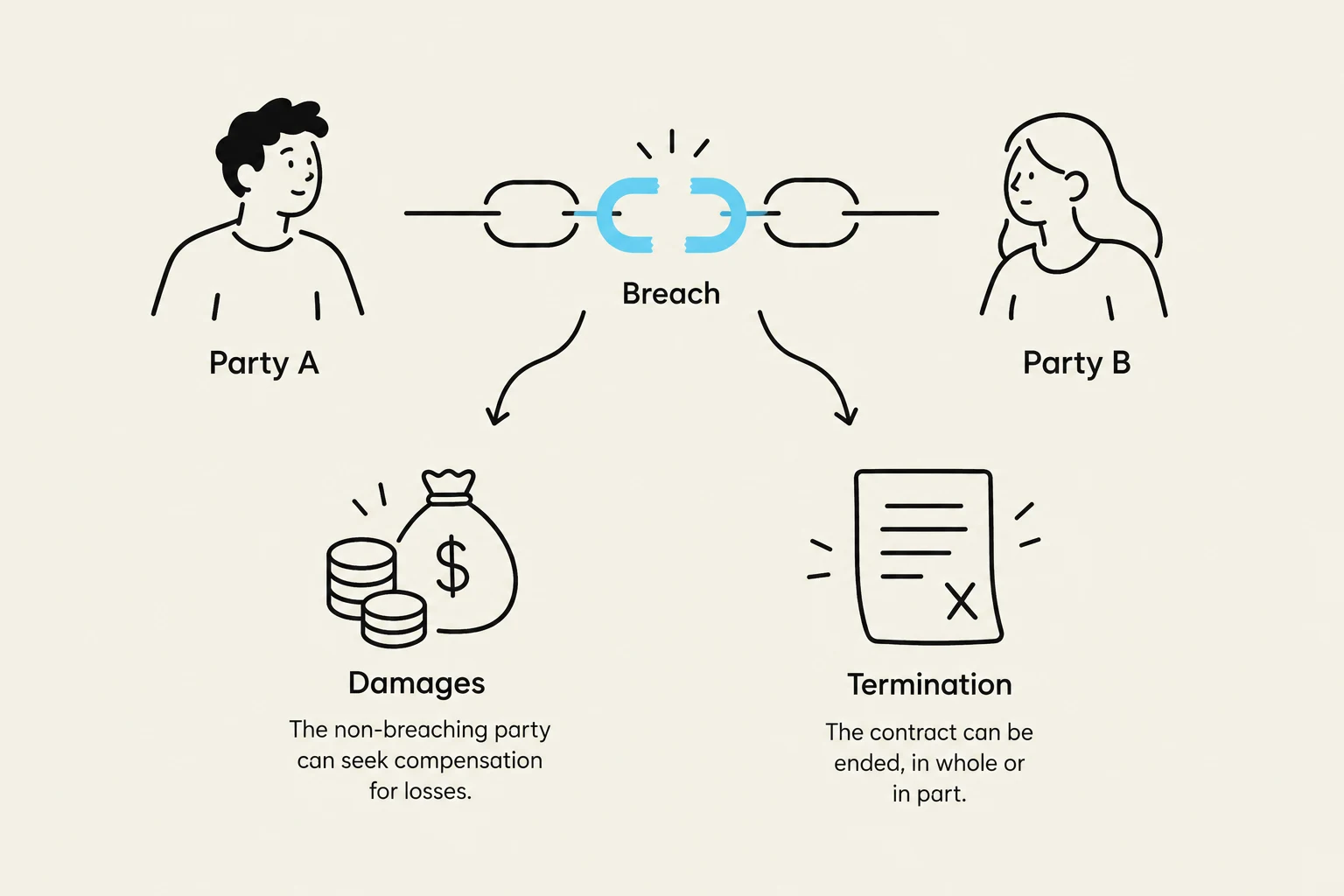
If a party fails to meet the terms of a contract, they have committed a breach of contract. The impacted party has two primary paths for recourse:
Damages: Seeking monetary compensation to cover the losses caused by the breach.
Specific Performance: Requesting a court order to force the other party to fulfill their specific duties as outlined in the contract.
This diagram illustrates the consequences of a contract breach, including damages and termination.
The Modern Dilemma: Digital Platforms and Censorship
One of the most pressing issues for modern creators is the "Contract of Adhesion." Most social media Terms of Service are contracts of adhesion—meaning one party (the platform) dictates all terms, and the user has zero power to negotiate. When you click "Accept," you are often trading your data or rights to your content as "consideration" for using the service.
The Canadian vs. German Approach
This creates a tension regarding digital censorship. If a platform removes your art or content, what are your rights?
In Canada: Social media platforms are private businesses operating on private property. Because the Charter of Rights and Freedoms generally only applies to government action, courts rarely interfere with the private contracts (Terms of Service) of these platforms.
In Germany: The approach is different. German courts perform a "fairness check." They don't treat platform standards as absolute; they balance the platform's right to control its space against the user's constitutional right to freedom of expression. If a platform's rules are found to be abusive or disproportionate, the court can annul them and order the reinstatement of content.
As Canada moves toward more accountability through measures like the Online Harms Act, the debate continues: should we prioritize "freedom of contract" (the right of businesses to set their own rules) or "freedom from exploitation" (the right of users to be protected from unfair terms)?
Critical Thinking for Media Professionals: When navigating your career, always distinguish between your provincial rights (like defamation or employment disputes) and federal regulations (like privacy rights under PIPEDA or broadcasting rules). Understanding which "layer" of law applies will determine how you fight for your rights.
Keep reading for free.
Create an account to finish this reading and make it part of your study routine.