Understanding Market Failures: Public Goods, Common Resources, and Externalities
This content explains market failures, including public goods, common resources, and externalities. It details how excludability and rivalry define goods, leading to issues like the free-rider problem and overuse. It also covers negative and positive externalities and policy solutions like taxes and subsidies.
In a perfect market, competition ensures that goods are produced and consumed at levels that maximize social welfare. However, the real world is often messy. Many goods and services do not fit neatly into the standard model of buying and selling, leading to situations where markets fail to provide the right amount of a good. These failures often stem from the specific characteristics of the goods themselves—specifically whether they are excludable or rival—or from the unintended side effects that transactions have on third parties.
Classifying Goods: Excludability and Rivalry
To understand why markets fail, economists classify goods based on two fundamental attributes: excludability and rivalry.
Excludability: A good is excludable if the supplier can prevent people who do not pay from consuming it (e.g., a pair of jeans). If people cannot be easily prevented from using a good even if they don't pay, the good is nonexcludable (e.g., national defense).
Rivalry: A good is rival in consumption if one person's use of the good diminishes another person's ability to use it (e.g., a cheeseburger). If one person's consumption does not reduce the availability for others, the good is nonrival (e.g., digital music).
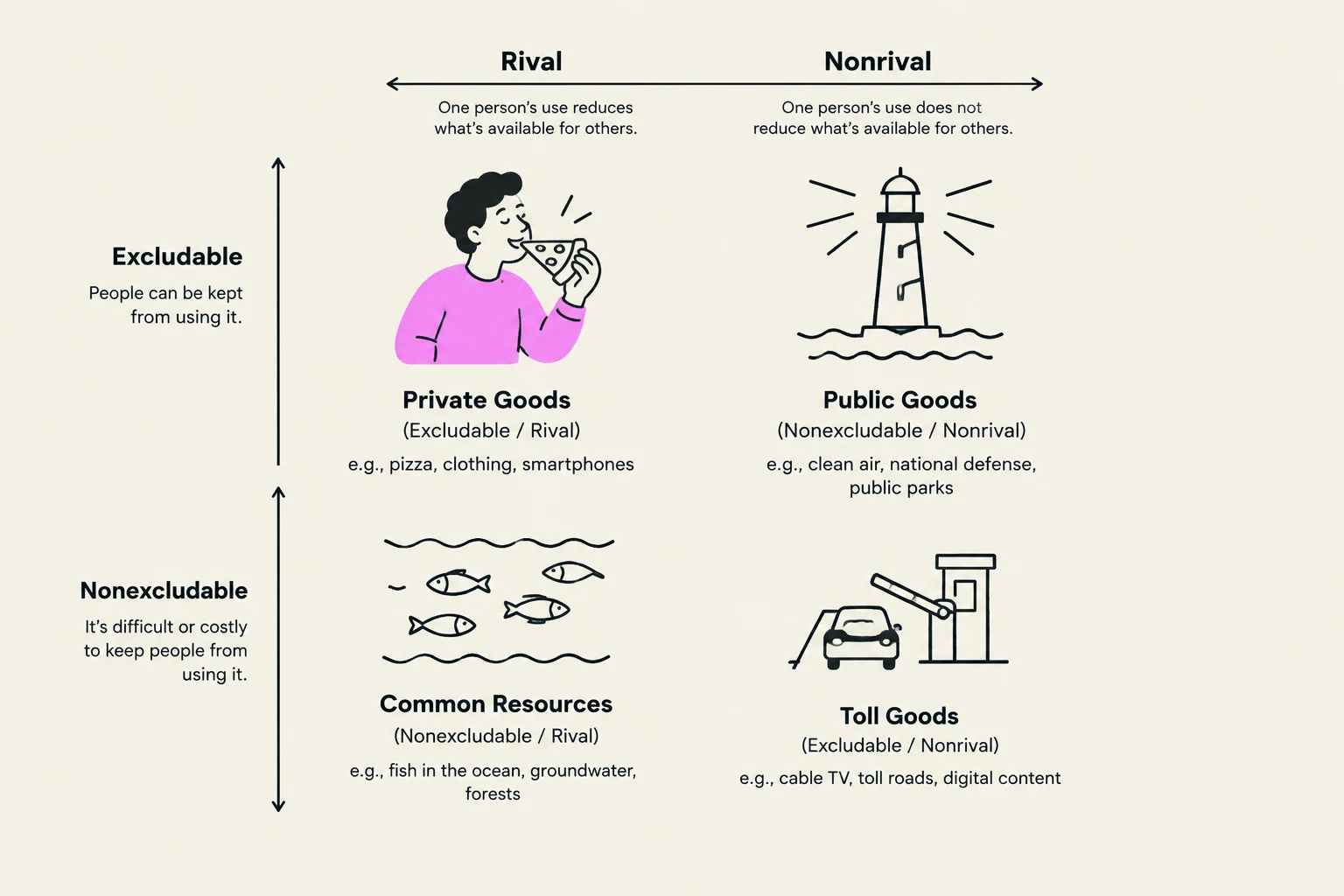
By combining these two attributes, we can categorize all goods into four distinct types:
Private Goods: Both excludable and rival (e.g., wheat, bathroom fixtures). These are efficiently provided by competitive markets.
Public Goods: Both nonexcludable and nonrival (e.g., national defense, public sanitation).
Common Resources: Nonexcludable but rival (e.g., clean water, biodiversity, fish in the ocean).
Artificially Scarce Goods: Excludable but nonrival (e.g., on-demand movies, Wi-Fi).
This diagram illustrates the four types of goods in economics: private goods, public goods, common resources, and toll goods, based on their excludability and rivalrousness.
The Challenge of Public Goods and the Free-Rider Problem
Public goods present a unique challenge for market efficiency. Because they are nonexcludable, they suffer from the free-rider problem: individuals have no incentive to pay for their own consumption and instead attempt to take a "free ride" on those who do pay. Because they are nonrival, the cost of adding one more user is essentially zero, meaning the efficient price for consumption should be zero.
If a private firm tries to charge a positive price to cover production costs, the result is inefficiently low consumption. Consequently, the market will fail to provide the socially optimal amount of a public good, often leading to an underprovision.
Finding the Socially Optimal Amount
To solve this, governments often step in to provide public goods, funded by taxation. But how much should they provide? The goal is to find the quantity where the marginal social benefit (MSB) equals the marginal cost (MC).
Unlike private goods, where the market price reflects individual demand, the MSB of a public good is the vertical sum of all individuals' marginal benefit curves.
Exam Tip: When calculating the MSB for a public good, remember that it is the sum of all individual marginal benefits at each quantity level, not the average.
Common Resources and Overuse
Common resources (nonexcludable but rival) face the opposite problem of public goods. Because people cannot be excluded from using them, but each use depletes the resource, there is a strong incentive to consume the resource as quickly as possible before others do.
This leads to overuse. For example, a fisherman's private marginal cost does not include the "external cost" of depleting the fish stock for everyone else. To manage this, society can use taxes, regulations, property rights, or tradable licenses.
Externalities: Spillovers in the Market
An externality occurs when a transaction between two parties impacts a third party (a "bystander") who was not part of the deal.
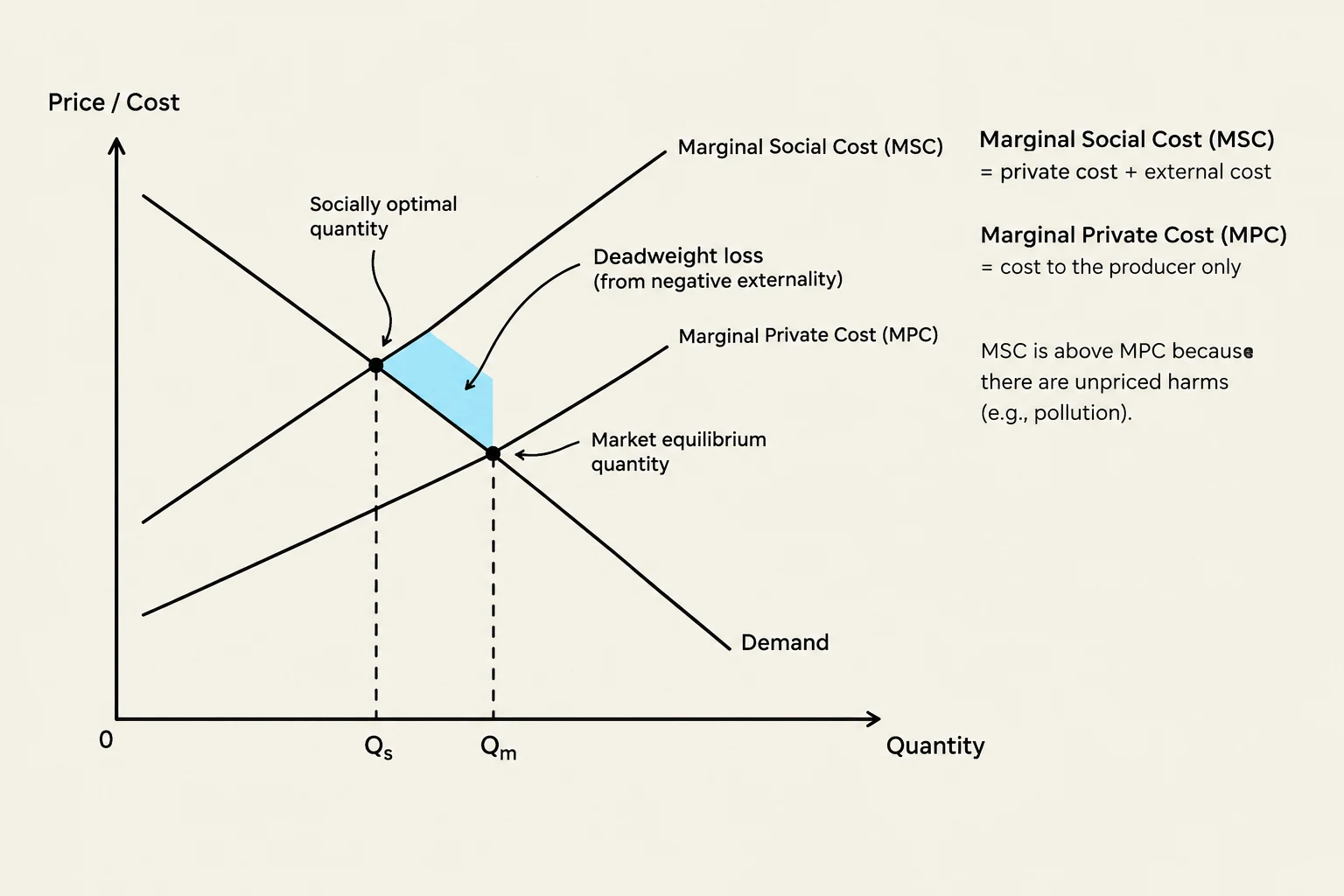
Negative Externalities (External Costs): These occur when a transaction imposes a cost on others, such as pollution from a factory or the risk of fire from a neighbor's bonfire. In these cases, the marginal social cost is greater than the private marginal cost, leading to too much of the activity being performed.
Positive Externalities (External Benefits): These occur when a transaction provides a benefit to others, such as a neighbor's beautiful garden or the benefits of education. Here, the marginal social benefit is greater than the private marginal benefit, leading to too little of the activity being performed.
Policy Solutions
To correct these inefficiencies, governments use several tools:
Pigouvian Subsidies: Payments designed to encourage activities that yield external benefits (e.g., subsidizing education).
Taxes and Regulations: Used to reduce activities that create negative externalities.
Tradable Permits: Creating a market for the right to pollute, which allows firms that can reduce pollution cheaply to sell their permits to those who cannot.
This graph illustrates the economic concept of deadweight loss resulting from a negative externality. It shows the divergence between the socially optimal quantity and the market equilibrium quantity, with the difference attributed to unpriced harms like pollution.
Network Externalities
A special type of externality is the network externality, where the value of a good to an individual increases as more people use it. Examples include telephone systems or standardized electrical plugs; the more people who use the standard, the more useful and available the associated products become.
Summary Table: Market Efficiency and Intervention
Good Type
Characteristic
Market Problem
Typical Solution
Public Good
Nonexcludable & Nonrival
Underprovided (Free-rider)
Government provision via taxes
Common Resource
Nonexcludable & Rival
Overused (Depletion)
Regulation, Taxes, or Property Rights
Negative Externality
External Cost
Overproduced
Taxes or Regulations
Positive Externality
External Benefit
Underproduced
Pigouvian Subsidies
Keep reading for free.
Create an account to finish this reading and make it part of your study routine.