Explores the ecological principles of low biodiversity environments, focusing on limiting factors in polar and desert regions and their impact on species survival and ecosystem stability.
Biodiversity is often visualized as a lush, teeming rainforest, but nature also contains vast stretches of land where life is sparse, specialized, and incredibly resilient. These "low biodiversity environments"—most notably polar regions and deserts—are defined not by a lack of biological potential, but by extreme limiting factors that restrict the number of species capable of surviving there. Understanding these environments requires looking at the intersection of climate, energy availability, and resource scarcity.
The Concept of Limiting Factors
In ecology, a limiting factor is any resource or environmental condition that restricts the growth, abundance, or distribution of a population within an ecosystem. In high-biodiversity areas like tropical rainforests, nutrients, sunlight, and water are often abundant, allowing for complex food webs. However, in extreme environments, one or more of these factors becomes so scarce that it dictates the entire structure of the biological community.
The relationship between an organism's survival and its environment can often be modeled by looking at how temperature or moisture affects metabolic rates. For instance, the metabolic rate of an ectotherm (an organism whose body temperature depends on the environment) is often tied to temperature (T) through the Arrhenius equation, implying that as T drops toward freezing, biological processes slow down significantly.
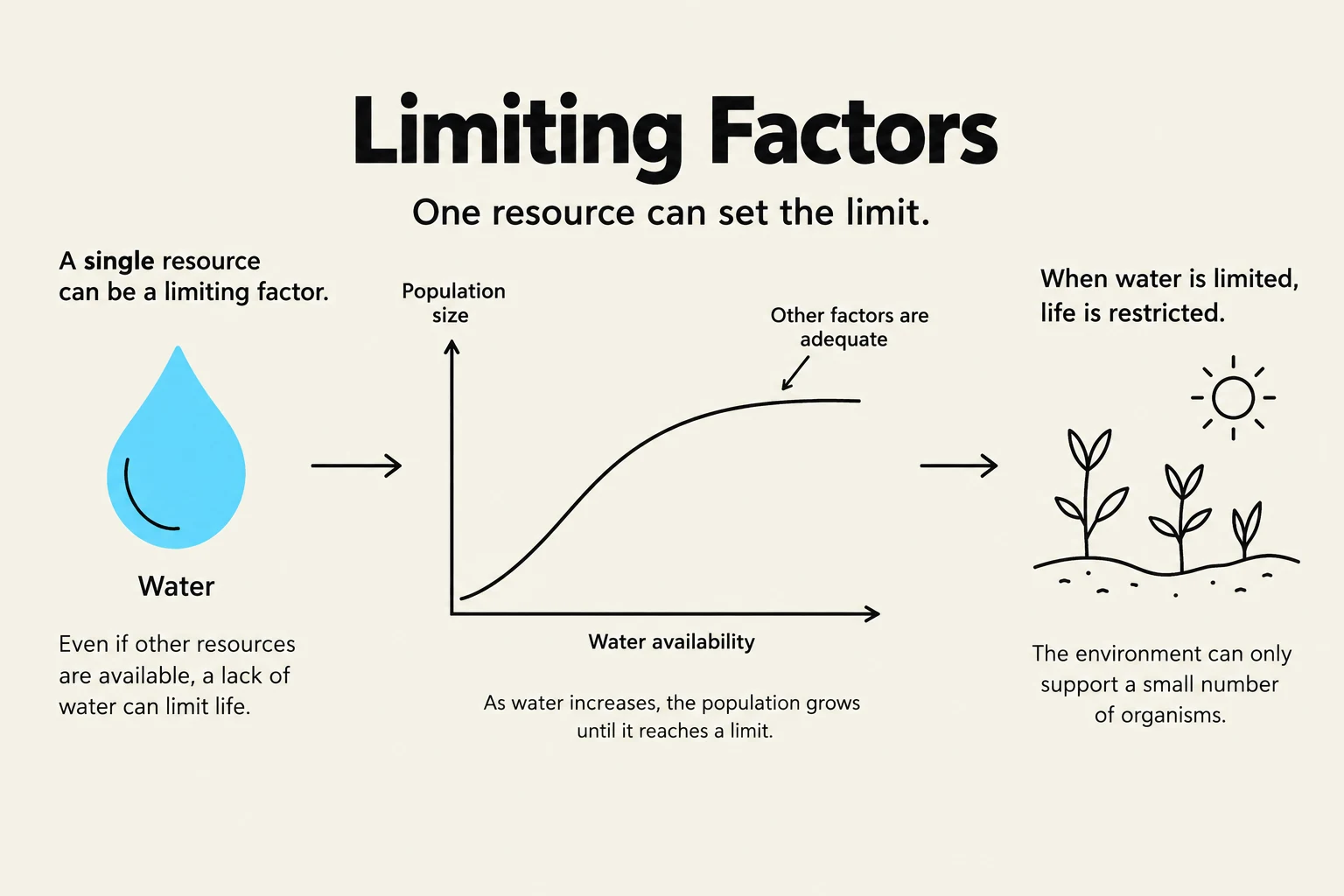
This diagram illustrates the concept of limiting factors in ecology, showing how a single resource like water can restrict population growth even when other factors are adequate. The graph depicts population size increasing with water availability until a limit is reached, after which the environment can only support a small number of organisms.
Exam Tip: When analyzing an ecosystem, always identify the "primary limiting factor." In a desert, it is almost always water (moisture); in the polar regions, it is often temperature or liquid water availability.
Polar Regions: The Challenge of Extreme Cold
Polar regions, such as the Arctic and Antarctic, are characterized by low solar radiation and extremely low temperatures. These conditions create a cascade of challenges for life. The most immediate constraint is the lack of thermal energy.
The primary limiting factors in polar regions include:
Temperature Extremes: Freezing temperatures can cause cellular damage through ice crystal formation.
Liquid Water Scarcity: Even if ice is abundant, it is not "bioavailable" to most plants because it cannot be easily absorbed by roots.
Short Growing Seasons: The window of time where temperatures are above freezing is incredibly narrow, limiting the time available for photosynthesis and reproduction.
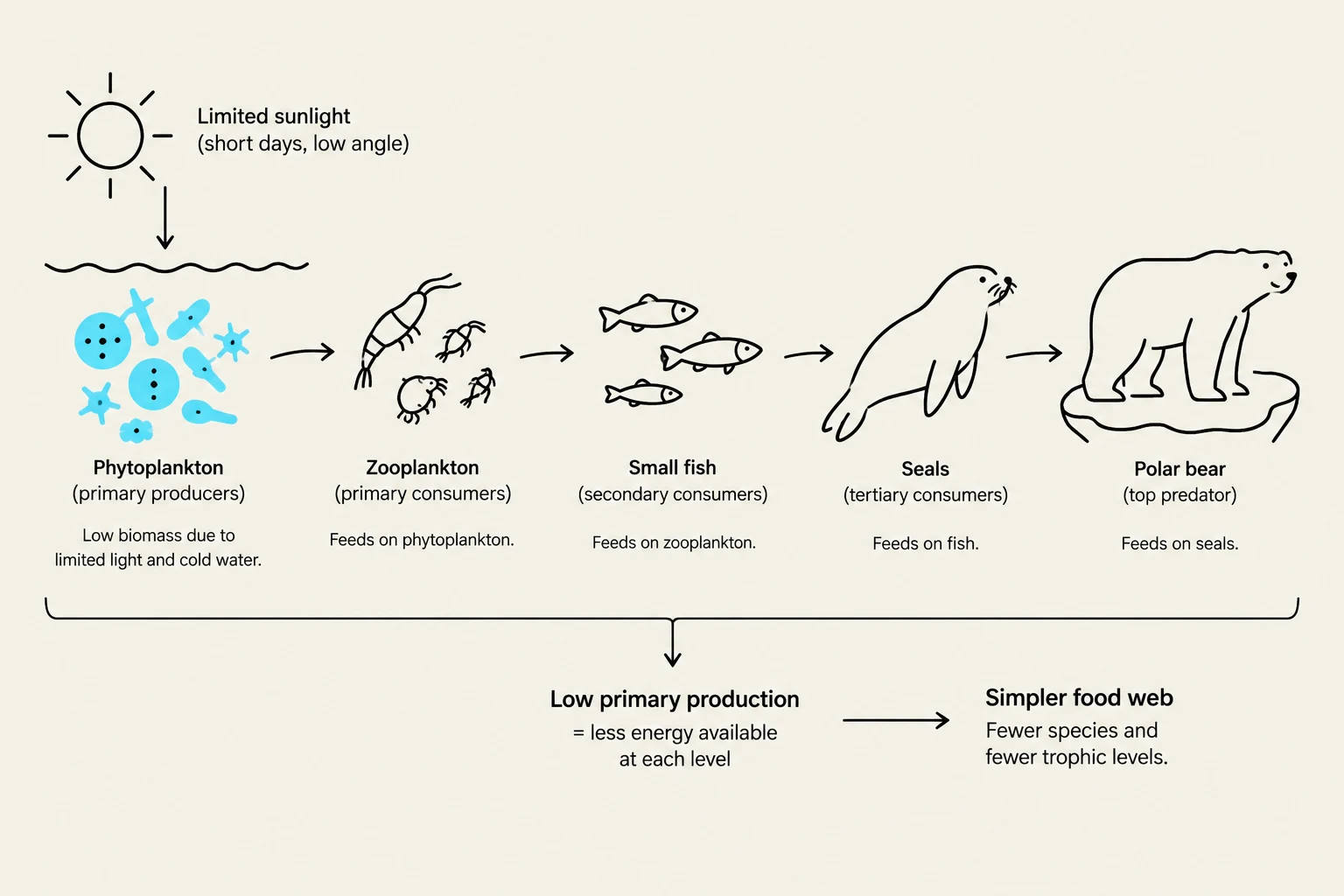
Because of these constraints, the food webs in polar regions are often "short" and highly dependent on a few key species. For example, in the Antarctic, much of the ecosystem relies on krill, which serves as a central link between primary producers (phytoplankton) and apex predators (whales and seals). If the temperature shifts and affects the phytoplankton, the entire system can collapse due to this lack of redundancy.
This diagram illustrates a simplified Arctic food web, showing the flow of energy from phytoplankton to zooplankton, small fish, seals, and finally to the polar bear as the top predator. It also explains how limited sunlight affects primary production and consequently the complexity of the food web.
Deserts: The Scarcity of Moisture
While polar regions are limited by temperature, deserts are primarily limited by precipitation. A desert is defined not by its heat, but by its aridity—specifically, a state where the rate of evapotranspiration exceeds the rate of precipitation.
In these environments, life must solve the problem of desiccation (drying out). The limiting factors include:
Water Availability: The most critical constraint for both plant and animal metabolism.
Nutrient Cycling: Low moisture levels slow down the decomposition of organic matter by bacteria and fungi, meaning nutrients stay locked in dead biomass rather than returning to the soil.
Temperature Fluctuations: Many deserts experience extreme diurnal (day-to-night) temperature swings, requiring organisms to have specialized behavioral or physiological adaptations.
Plants in these regions, such as cacti, have evolved specialized tissues to store water (succulence) and reduced leaf surfaces to minimize water loss. Animals often adopt nocturnal lifestyles to avoid the peak heat of the day, effectively "timing" their life processes to coincide with periods of lower environmental stress.
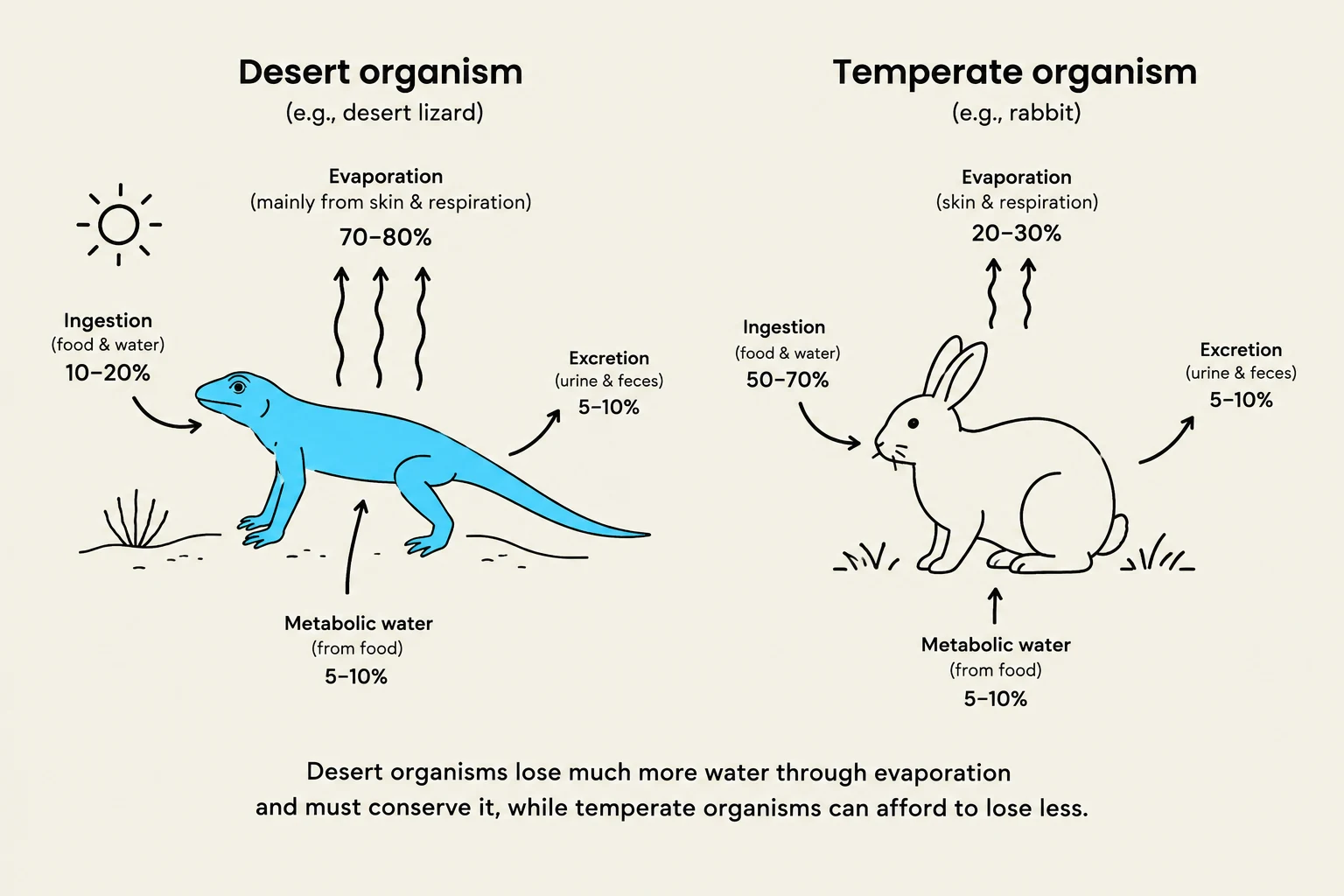
This diagram illustrates the water balance in desert and temperate organisms, comparing evaporation, ingestion, excretion, and metabolic water percentages.
Comparing Extreme Environments
While polar and desert environments seem opposites—one being freezing and the other being scorching—they share fundamental ecological similarities. Both are characterized by low "species richness" (the number of different species present) and high "specialization."
Feature
Polar Regions
Desert Regions
Primary Limiting Factor
Temperature / Liquid Water
Precipitation / Moisture
Energy Availability
Low (due to low solar angle)
High (but limited by water)
Biological Strategy
Heat retention / Dormancy
Water storage / Nocturnality
Food Web Structure
Simple and fragile
Simple and fragmented
In both cases, the lack of biodiversity makes these ecosystems particularly vulnerable to climate change. In a high-biodiversity system, if one species disappears, another might fill its niche. In a low-biodiversity system, the loss of a single key species can trigger a "trophic cascade," leading to the collapse of the entire local environment.
Summary for Students
To master this topic, remember that biodiversity is not just a count of species, but a reflection of how well an environment can support life. Low biodiversity is a direct consequence of extreme limiting factors. Whether it is the lack of heat in the poles or the lack of water in the desert, these constraints force life into highly specialized, often fragile, evolutionary paths.
Study Check: Can you explain why a desert is not necessarily defined by high temperatures? Can you explain why a polar food web is more susceptible to species loss than a tropical one?
Keep reading for free.
Create an account to finish this reading and make it part of your study routine.